Manufacturing Part 4: Analytics & Machine Learning
04.14.2026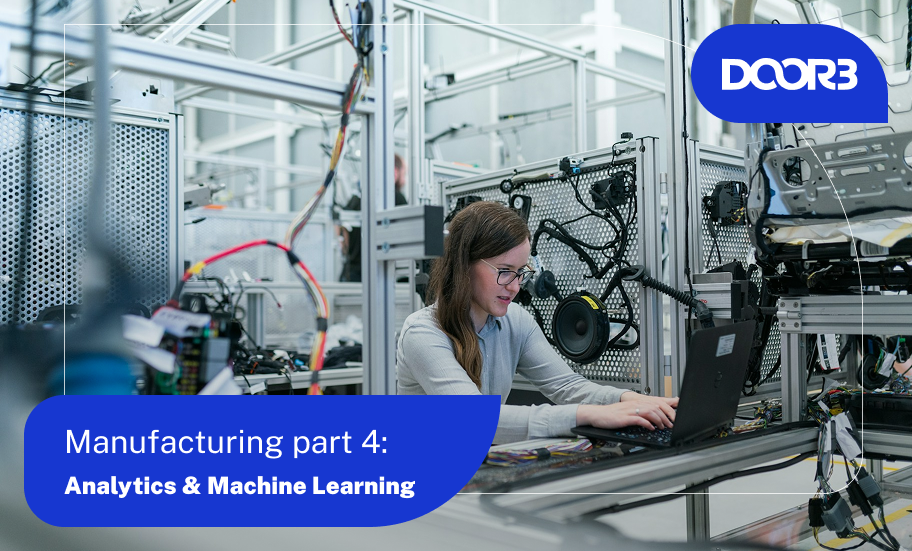 The "AI Adoption" Series: Where We Are
-
Part 1 (Strategy): We defined the outcomes (Asset Max, Labor Augmentation).
-
Part 2 (Team): We aligned IT and OT to bridge the air gap.
-
Part 3 (Data): We built the Unified Namespace (UNS) to structure the data.
Now, we ignite the engine. We are moving from Data (having the numbers) to Insight (knowing what they mean).
For years, manufacturers have looked at "lagging indicators"—yesterday's scrap rate, last week's downtime report. In this article, we focus on Predictive Analytics and Machine Learning: the ability to know a machine will fail before it smokes, and to spot a defect before it leaves the line.
The Industry Opportunity: The "Unplanned" Cost
The difference between a profitable year and a breakeven year often comes down to unplanned downtime and scrap.
-
The Downtime Tax: In 2025, unplanned downtime costs manufacturing companies an estimated $50 billion annually, with Fortune Global 500 companies losing nearly 11% of their yearly turnover to machine failure (Arda Cards).
-
The Predictive Savings: Implementing AI-driven predictive maintenance typically reduces overall maintenance costs by 18-25% and cuts unplanned downtime by 30-50% (ATS).
-
The Quality Jump: AI-powered visual inspection systems can improve defect detection rates by up to 90% compared to manual human inspection, which is prone to fatigue and inconsistency (Jidoka Tech).
The Strategic Imperative:
You must move your plant from "Run to Failure" to "Run to Prediction."
The Strategy Template: Two Engines of Value
To execute this effectively in an SMB environment, you should focus on two specific applications of machine learning.
1. Predictive Maintenance (PdM): The "Health Check"
You do not need a team of data scientists to do this. You need vibration and temperature sensors.
-
The Application: Instead of changing a bearing every 6 months (Preventive) or waiting for it to seize (Reactive), you monitor its vibration signature.
-
The Insight: The ML model notices a "micro-wobble" that humans cannot feel. It predicts: "Bearing 4 on Line 2 will fail in 72 hours."
-
The Action: You schedule the replacement during the Tuesday lunch break.
-
Key Metric: Reduction in Unplanned Downtime Hours.
2. Computer Vision: The "Automated Inspector"
Quality Control (QC) is often the bottleneck of the factory.
-
The Application: Install high-speed cameras at the end of the line, connected to an Edge AI unit.
-
The Shift: The AI compares every single part against a "Golden Master" image. It checks for scratches, misalignments, or missing labels in milliseconds.
-
The Result: You move from sampling (checking 1 in 100 parts) to 100% Inspection. You ship zero defects.
-
Key Metric: Cost of Poor Quality (COPQ) reduction.
3. "Golden Batch" Analysis: Process Optimization
-
The Application: Why does Shift A produce 10% more output than Shift B?
-
The Insight: The AI analyzes thousands of variables (temperature, pressure, operator settings) and finds the correlation. "Shift A runs the extruder 2 degrees cooler, which prevents micro-stoppages."
-
The Action: You update the SOP (Standard Operating Procedure) to lock the temperature at that optimal setting for all shifts.
The Underpinning: Safety Limits (Hard Stops)
This is where Governance is a matter of life and death.
-
The Rule: AI provides advice; it does not override safety.
-
The Governance: You must maintain "Hard Stops" in the PLC code that the AI cannot touch. Even if the AI calculates that running the motor at 110% speed would improve yield, the safety logic must physically prevent it if it risks overheating or injuring a worker.
-
The Strategy: We trust the AI to optimize, but we trust the PLC to protect.
The Direction: From Open Loop to Closed Loop
We are currently in a transition phase.
-
Current State (Open Loop): The AI sends an alert to a human: "Temperature is drifting high. Please adjust." The human walks over and turns a dial.
-
Future State (Closed Loop): The AI talks directly to the machine: "Temperature is drifting high. Adjusting setpoint by -1.5 degrees." The human is notified but does not need to act.
-
The Trend: "Self-Healing" production lines where minor deviations are corrected instantly by the control system.
Next Step: Physical Automation
You now have a smart factory. It predicts failures and spots defects.
But who does the work? Who moves the heavy box? Who loads the CNC?
In Manufacturing Part 5, we will discuss Automation & Efficiency. We will look at how AI drives the physical layer of the factory—Collaborative Robots (Cobots), Autonomous Mobile Robots (AMRs), and automated scheduling.
Salvatore Magnone is a father, veteran, and a co-founder, a repeat offender in the best way in fact, and a long-time collaborator at DOOR3. Sal builds successful, multinational, technology companies and runs obstacle courses. He teaches business and military strategy at the university level and directly to entrepreneurs and military leaders.