Trusted by leading brands












Automation isn't enough anymore
Traditional automation follows fixed rules. Your business doesn't.
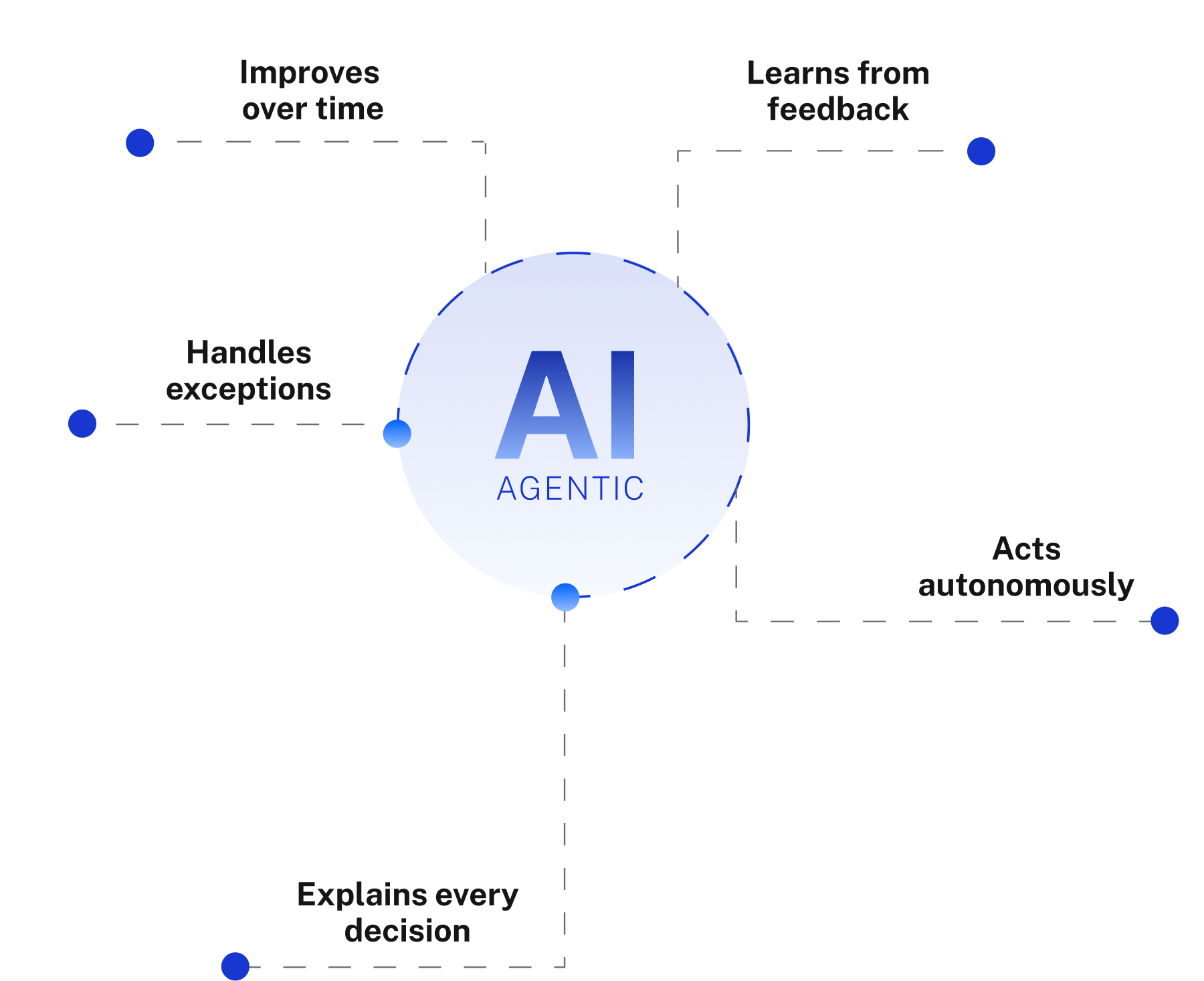
You need AI that handles exceptions, learns from feedback, makes contextual decisions, and acts autonomously, with appropriate guardrails. That's agentic AI.
How it works
Perception
Receives input from multiple sources: claims documents, legal filings, production data, sensor feeds.
Reasoning
Evaluates options and confidence levels: "This claim looks routine, 90% confidence for straight-through processing."
Action
Executes the appropriate decision: routes the claim, flags the contract clause, generates the maintenance order.
Learning
Improves from every outcome: adjuster overrides teach escalation patterns, attorney approvals build confidence, prevented failures refine prediction models.
Applied use cases by industry
Insurance: AI Agents
Claims Triage Agent
Reviews incoming claims, assesses complexity and fraud risk, routes to the right adjuster or straight-through processing, and learns from every override.
Underwriting Support Agent
Pulls data from 7+ systems, pre-populates underwriting worksheets, flags risk factors requiring human judgment, and learns which data points matter most per line of business.
Fraud Detection Agent
Monitors all claims for fraud indicators, learns from historical cases, flags suspicious claims with explanation, and adapts as fraud tactics evolve.
Legal: AI Agents
Contract Review Agent
Reviews contracts page by page, identifies key clauses, flags deviations from firm standards, and learns from attorney edits to improve accuracy.
Document Classification Agent
Processes millions of pages, classifies by type, relevance, and privilege, organizes by matter, and learns firm-specific patterns over time.
Matter Prediction Agent
Analyzes new matter details, predicts costs from 10+ years of historical data, flags matters likely to exceed estimates.
Manufacturing: AI Agents
Production Scheduling Agent
Evaluates 50+ orders, 10 machines, 100+ constraints, optimizes for on-time delivery and utilization, reschedules in real-time when disruptions occur.
Quality Control Agent
Monitors production via cameras, detects defects, stops the line automatically, and learns which defect patterns matter most.
Predictive Maintenance Agent
Monitors equipment sensors, detects failure patterns 2–4 weeks ahead, schedules maintenance before breakdown occurs.
Not sure where to start?
Begin with the AI Pathfinder Assessment.
Identify your highest-ROI agent opportunities, assess data readiness, and build an implementation roadmap.
Timeline: 4–6 weeks

From strategy to production in 3 phases
Phase 1
Agent Design
Map the decision-making process, identify data sources, define success criteria, and design escalation paths.
Deliverables
- Agent architecture
- Data requirements
- Success metrics
- Risk assessment
Phase 2
Development & Training
Train models on historical decisions, build the reasoning engine, develop the action layer, create monitoring dashboards.
Deliverables
- Working agent in staging
- Accuracy benchmarks
- System integrations
- Monitoring and alerting
Phase 3
Deployment & Optimization
Deploy with human oversight, monitor daily, collect feedback, iterate on edge cases, then scale.
Deliverables
- Production deployment
- Monthly retraining
- Expanded capabilities
- Reduced human oversight as confidence grows
"They had a great team, and we have nothing but praise for them."
Debbie Penko, Chief Product Officer, RISA Tech
Agentic AI with appropriate guardrails
Autonomous agents need oversight. We build safety in from day one.
Confidence thresholds
Agent only acts autonomously above a defined confidence level. Below it, escalates to human.
Explainability
Every decision includes a plain-language explanation of what data informed it and why.
Human override
Humans can always override. When they do, the agent learns.
Audit trail
Every action logged — decision, data, confidence level, and whether a human intervened.
Kill switch
Agents can be paused instantly if performance degrades.
Why DOOR3?
Domain expertise
We understand how claims are triaged, how attorneys review contracts, how production is scheduled. Generic AI consultants don't know your domain. We do.
Safety-first approach
We've been building mission-critical systems for 20+ years. Confidence thresholds, human oversight, explainability, and kill switches are built in from day one, not added later.
Integration expertise
Your agent needs to connect to legacy policy admin systems, document management platforms, and production MES systems. We've integrated 1,000+ systems. We know how to make agents work with what you have.

Case study
Regional P&C Carrier
Claims Triage Agent
Challenge
18-day average claims processing. Adjusters spending 60% of time on data entry and routine triage.
DOOR3 Solution
Claims Triage Agent reviewing incoming claims, assessing complexity and fraud risk, routing routine claims to straight-through processing and complex claims to specialists.
Ready to build your first AI agent?
Let's discuss agent design, data requirements, timeline, investment, and success metrics.
