Legacy Modernization for Insurance: Eliminating Technical Debt in Core Systems
06.30.2026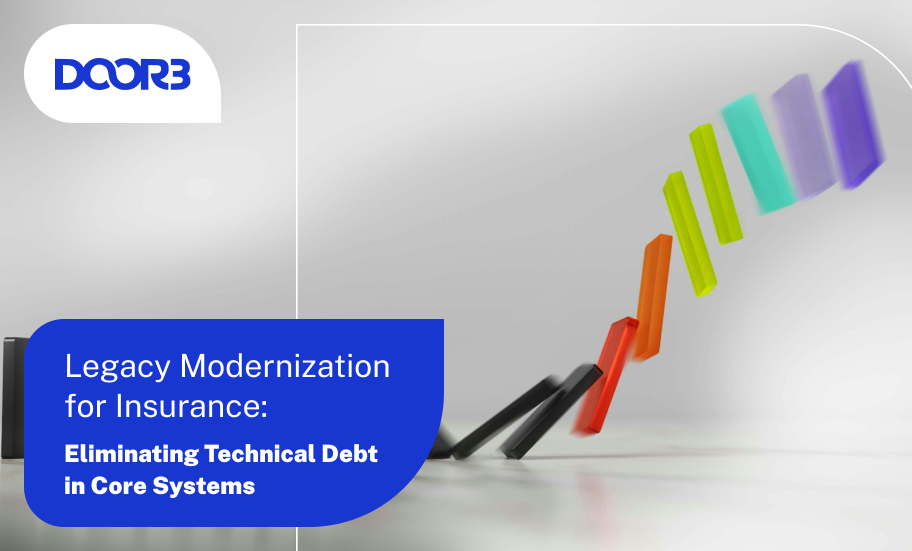
By DOOR3 | Insurance Technology | Legacy Modernization
No industry carries a heavier legacy technology burden than insurance. Property and casualty carriers, life insurers, reinsurers, and managing general agents operate core systems — policy administration, claims management, billing, and reinsurance accounting — that were built decades ago, in many cases on COBOL and mainframe platforms designed in the 1970s and 1980s. These systems process trillions of dollars in premiums and claims annually. They are, in many carriers, the operational heartbeat of the business.
They are also, increasingly, existential constraints on competitiveness.
The insurance technology gap has widened sharply in the last three years. InsurTechs deploying AI-native platforms, real-time underwriting, and digital-first claims experiences are establishing new customer expectations that legacy core systems cannot meet. Carriers that cannot modernize their technology infrastructure face a compounding competitive disadvantage: declining ability to attract engineering talent, increasing cost and risk of compliance failure, and an AI strategy that remains aspirational because the data architecture required to execute it does not exist.
This guide — written from DOOR3's direct experience modernizing technology systems for leading insurance organizations including AIG and Munich Re — provides a practical framework for insurance technology leaders approaching legacy modernization.
The Legacy System Problem in Insurance
Insurance technology is unique in the enterprise software landscape for several reasons that amplify the difficulty and cost of modernization.
Why Insurance Carries the Oldest Technology in Enterprise Software
Insurance contracts are long-lived. A life insurance policy written in 1995 is still active today — and the system that administered it in 1995 has been maintained, patched, and extended to continue administering it for 30 years. Unlike industries where systems can be replaced on a 5–10 year cycle, insurance systems accumulate obligations that make replacement extraordinarily complex.
The business rules encoded in legacy insurance systems represent decades of regulatory interpretation, actuarial methodology, and operational refinement. These rules are not documented anywhere other than in the code itself — and frequently, the engineers who wrote the code are no longer available to explain it. DOOR3's insurance software development practice is built specifically around this challenge: preserving business logic while transforming the technical implementation.
The Core Systems Challenge: Policy, Claims, and Billing
Policy administration systems manage the lifecycle of insurance contracts: quoting, binding, endorsements, renewals, and cancellations. Legacy policy administration systems typically use proprietary data models with no external APIs, process transactions in nightly batch cycles, and contain business rules for hundreds or thousands of product lines accumulated over decades.
Claims management systems process claims from first notice of loss through final settlement and subrogation. They contain claims history, reserve adequacy calculations, fraud detection logic, and regulatory reporting data. The regulatory and legal sensitivity of claims data — including its admissibility in litigation — creates specific continuity and data integrity requirements during modernization.
Billing systems manage premium collection, commission calculation, disbursement, and accounting integration. They are typically the most tightly coupled of the three core domains, with dependencies on policy administration, claims, reinsurance, and general ledger systems that must all be mapped before migration begins.
The Business Impact of Legacy Insurance Systems
New Product Velocity
The time required to launch a new insurance product on a legacy policy administration system is typically 12–24 months. Modern cloud-native policy administration platforms deliver new product launches in 2–6 weeks. This velocity gap is a revenue problem — every market opportunity that requires a new product or a material modification to an existing product is constrained by the legacy system's development and testing cycle.
InsurTech Integration Failures
The InsurTech ecosystem — digital distribution platforms, third-party data providers, embedded insurance platforms, digital claims vendors — universally expects API-based real-time connectivity. Legacy insurance core systems cannot provide this without expensive custom middleware. For a detailed view of how carriers are navigating the build-vs-buy-vs-partner decision in this context, DOOR3's analysis of InsurTech partnership strategy covers the strategic trade-offs in depth.
AI Adoption Blockers
Every insurance AI use case — AI-assisted underwriting, predictive claims management, real-time fraud detection, automated policy issuance — requires three things that legacy core systems typically cannot provide: real-time data access, clean structured data in a modern format, and API connectivity to the AI platform. DOOR3's AI Insurance platform is purpose-built to layer onto modernized insurance core systems, providing a pre-built architecture reference that dramatically reduces the time from modernization completion to AI capability activation. For a view of specific AI use cases delivering ROI in 2026, see DOOR3's analysis of generative AI in insurance.
Compliance and Regulatory Risk
Insurance regulatory requirements are becoming increasingly technology-specific. State insurance regulators are expanding their technology examination scope to include data governance, cybersecurity controls, and technology risk management. Legacy systems that cannot be adequately patched or documented present growing regulatory examination risk. DOOR3's experience with organizations like AIG and Munich Re, documented in our financial software development practice, has validated our regulatory compliance architecture approach across multiple jurisdictions.
Legacy Modernization Approaches for Insurance Core Systems
Incremental Modernization vs. Full System Replacement
The instinct to solve the legacy core system problem through full replacement — typically by purchasing a modern policy administration platform — is understandable but frequently counterproductive for large carriers.
Commercial policy administration platforms are built around standard product architectures. Large, complex carriers with proprietary product lines, unique business rules, and extensive customization requirements often find that commercial platforms require more customization than the legacy system they are replacing. For a structured framework on how to evaluate this decision, see DOOR3's guide on custom insurance software vs. off-the-shelf platforms.
Incremental modernization — progressively transforming the legacy system's technical implementation while preserving its business logic — is the lower-risk path for most large carriers. When previous modernization attempts have stalled, DOOR3's project rescue service provides a structured recovery path before the full incremental program resumes.
API-First Architecture for Insurance Integration
The most immediate and impactful modernization intervention for most insurance core systems is the construction of a modern API layer that provides external systems with structured, real-time access to core system data and functions — without requiring changes to the legacy core itself.
This API-first approach allows the InsurTech ecosystem, AI platforms, and digital channels to connect to core system data through modern interfaces, dramatically reducing the integration tax while the deeper core system modernization proceeds in phases.
Strangler Fig Pattern for Core System Migration
The strangler fig pattern — named for a vine that gradually replaces a host tree while it is still alive — is the most effective approach for phased insurance core system modernization:
- Build a modern routing layer in front of the legacy system that intercepts all incoming requests
- Implement specific functions in the modern architecture, routing those requests to the new implementation
- Redirect data writes to both legacy and modern systems, maintaining synchronization
- Progressively expand the scope of the modern implementation until it handles all functions
- Decommission legacy components as they are replaced
This pattern maintains full operational continuity throughout migration and prevents the big-bang failure risk of full replacement approaches. DOOR3's step-by-step migration guide for insurers covers the implementation of this pattern in insurance-specific detail.
Building an Insurance Legacy Modernization Roadmap
Priority 1 — Policy Management System Modernization
Policy management modernization typically begins with the API layer construction, enabling ecosystem connectivity, followed by incremental product line migration beginning with the newest and simplest product lines and progressively addressing the oldest and most complex.
Priority 2 — Claims Processing Modernization
Claims modernization typically begins after policy API connectivity is established, enabling the modern claims system to query policy data through APIs rather than requiring direct database access to the legacy system. The claims modernization sequence follows litigation exposure — lower-severity, higher-volume claims lines modernize first, with casualty and complex commercial lines following.
Priority 3 — Billing and Payment System Modernization
Billing modernization is sequenced last because it has the broadest integration dependencies across policy administration, claims, reinsurance, and general ledger. Attempting to modernize billing without first establishing API connectivity in the other core domains creates integration complexity that makes the migration significantly more difficult.
AI-Ready Insurance Architecture: What It Looks Like
The target architecture for an AI-ready insurance technology stack shares common characteristics:
- Real-time event streaming that makes every core system transaction visible to AI platforms in real time
- Unified data platform that provides AI models with clean, consistent access to policy, claims, and billing history
- API management platform that provides governed, secure access to core system functions for AI applications, digital channels, and ecosystem partners
- Modern identity and access management that supports fine-grained authorization for AI applications accessing sensitive insurance data
DOOR3's AI Insurance platform provides a pre-built architecture reference and accelerated implementation path for insurance AI capabilities, designed specifically to activate on top of modernized insurance core systems.
Frequently Asked Questions
How long does insurance core system modernization take? A single-domain modernization at a mid-sized carrier typically takes 18–30 months using incremental approaches. Full three-domain core system modernization at a large complex carrier typically runs 36–60 months across multiple phased programs.
What is the cost of insurance legacy system modernization? Investment ranges from $2–5 million for a targeted single-domain API modernization at a mid-sized carrier to $20–100 million for a comprehensive multi-year core system transformation at a large complex insurer. The appropriate comparison is the annual cost of legacy maintenance, which typically runs $5–20 million annually for large carriers.
Can we keep writing new business while modernizing core systems? Yes — maintaining full business continuity throughout is the fundamental requirement of any properly structured insurance modernization program. Incremental approaches and parallel running ensure that policy writing, claims processing, and billing continue uninterrupted throughout the transformation.
How do you handle undocumented business rules in legacy systems? Through a combination of structured code analysis, stakeholder interview programs with experienced underwriters and claims examiners, and parallel validation that runs both legacy and new systems against the same inputs and compares outputs to identify undocumented rule variations.
What should we modernize first — policy, claims, or billing? Start with the API layer construction across all three domains, then follow the sequence: policy administration first (highest business value, most InsurTech and AI dependencies), claims second, billing third.
Start Your Insurance Legacy Assessment
DOOR3 has spent over two decades building deep expertise in insurance technology — through direct engagement with some of the world's largest and most complex insurance organizations. We understand policy administration architecture, claims system business logic, actuarial data requirements, and the specific compliance landscape of the insurance sector at depth.
Our insurance legacy assessment program delivers a comprehensive technology inventory, prioritized modernization roadmap, and structured business case in 4–6 weeks.
Book an Insurance Legacy Modernization Consultation with DOOR3's insurance practice, explore the AI Insurance platform to see the AI-ready target architecture, or review DOOR3's insurance software development credentials for more on our regulated-industry capabilities.