Manufacturing Part 5: Automation & Efficiency
04.20.2026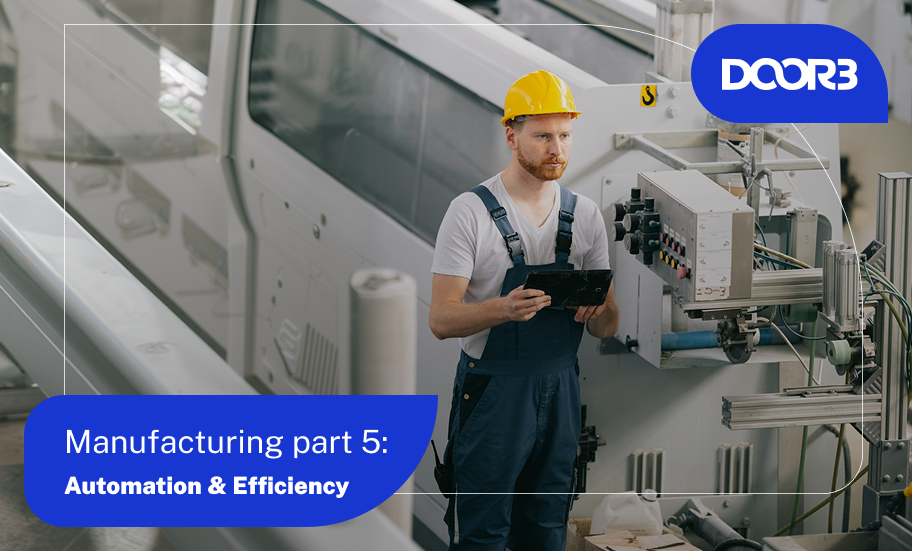 The "AI Adoption" Series: Where We Are
-
Part 1 (Strategy): We defined the outcomes (Asset Max, Labor Augmentation).
-
Part 2 (Team): We aligned IT and OT.
-
Part 3 (Data): We built the Unified Namespace.
-
Part 4 (Insights): We used Machine Learning to predict failures and spot defects.
We now have a factory that is "smart." It knows when a bearing will fail and when a part is scratched. But knowledge is not production. A prediction doesn't box a part, and a dashboard doesn't load a CNC machine.
In this article, we focus on Automation & Efficiency—the physical application of AI to move, make, and manage materials on the shop floor. For the SMB manufacturer, this is not about building a "lights out" factory; it is about building a "force-multiplied" workforce.
The Industry Reality: The High Cost of "Walking and Waiting"
In the average SMB factory, skilled labor is wasted on unskilled tasks. If your best welder spends 20% of their day walking to the warehouse to get parts, you are burning margin.
-
The Cobot Advantage: Collaborative Robots (Cobots), designed to work safely alongside humans, are transforming high-mix, low-volume shops. Unlike traditional caged robots that take years to pay off, cobots typically achieve ROI in just 12 to 18 months, significantly faster than traditional industrial robots (TechAhead).
-
The Material Movement Gap: A massive amount of factory time is spent simply moving things. Autonomous Mobile Robots (AMRs) are solving this, with the market for these devices in manufacturing growing rapidly to address labor shortages (Grand View Research).
-
The Scheduling Nightmare: Most SMBs still schedule production on whiteboards or Excel. This static approach cannot react to machine downtime. AI-driven scheduling allows for dynamic adjustments, reducing overtime costs and improving on-time delivery (MyShyft).
The Strategic Imperative:
You must use physical automation to strip away the "non-value-added" work (moving, loading, scheduling) so your humans can focus on the "value-added" work (crafting, fixing, improving).
The Strategy Template: The Three Layers of Flow
To deploy automation effectively, you must target the physical flow of three things: The Part, The Material, and The Schedule.
1. The Part: Collaborative Robotics (Cobots)
Do not try to replace the worker. Give them a "third hand."
-
The Application: Machine Tending. A human sets up the job on the CNC, but the Cobot handles the boring task of opening the door, taking the part out, putting a new blank in, and hitting "Start."
-
The Value: The operator can now run three machines instead of one.
-
The Flexibility: unlike old robots, cobots are easy to reprogram. If you change parts next week, you simply "teach" the arm the new motion by moving it with your hand.
-
Key Metric: Output per Labor Hour.
2. The Material: Autonomous Mobile Robots (AMRs)
Forklifts are dangerous, expensive, and require a driver.
-
The Application: Instead of a human driving a pallet of raw materials from Receiving to Line 1, an AMR (a flat, self-driving platform) does it.
-
The Shift: The AMR navigates like a self-driving car. If a pallet is in the way, it drives around it. It integrates with the Unified Namespace (Part 3)—when Line 1 runs low on material, it automatically signals the AMR to bring more.
-
The Value: Your material handlers stop driving and start managing inventory accuracy.
-
Key Metric: Reduction in "Travel Time" for skilled workers.
3. The Schedule: AI Dynamic Scheduling
The schedule you print on Monday is wrong by Tuesday morning.
-
The Application: An AI scheduling engine that consumes real-time data from the shop floor.
-
The Scenario: Machine A breaks down (Event). The AI instantly recalculates the entire week's schedule. It moves Machine A's jobs to Machine B (which has compatible tooling), delays a low-priority order, and alerts the Sales team to the change.
-
The Value: You stop fighting fires and start managing flow. The schedule is always "live" and feasible.
-
Key Metric: Schedule Adherence / On-Time Delivery (OTD).
The Underpinning: Safety Standards (ISO)
This brings us to the Execution underpinning. You cannot just buy a robot and turn it on.
-
The Rule: You must adhere to ISO/TS 15066 (Safety of Collaborative Industrial Robots).
-
The Governance: Just because a robot is "collaborative" doesn't mean it is safe with a sharp knife in its hand. You must perform a Risk Assessment for every application.
-
The Strategy: Speed is secondary to Safety. If the robot moves too fast, it triggers a safety stop when a human approaches. Your strategy must accept that cobots are slower than humans but win the race because they never take breaks, sleep, or text.
The Direction: Flexible Automation
We are moving away from "Hard Automation" to "Flexible Automation."
-
Current State (Hard): A machine built to make one part very fast. If the design changes, the machine is scrap.
-
Future State (Flexible): A standard robot arm mounted on a mobile cart. Today it tends a lathe; tomorrow it packs boxes; next week it sands a surface.
-
The Trend: "Robotics-as-a-Service" (RaaS). You don't buy the robot; you lease the capability by the hour, treating labor as a variable cost (OpEx) rather than a capital expense (CapEx).
Next Step: Closing the Loop
You now have a factory that senses, predicts, and automates. It is efficient, safe, and fast.
But is it profitable? And how does it handle a global supply chain disruption?
In the final article, Manufacturing Part 6, we will discuss The Feedback Loop. We will look at how to use AI to connect your factory floor to your top-line business strategy, ensuring that your efficient factory is actually making the right products at the right time.
Salvatore Magnone is a father, veteran, and a co-founder, a repeat offender in the best way in fact, and a long-time collaborator at DOOR3. Sal builds successful, multinational, technology companies and runs obstacle courses. He teaches business and military strategy at the university level and directly to entrepreneurs and military leaders.