Application Modernization Services: The Complete Enterprise Playbook
06.15.2026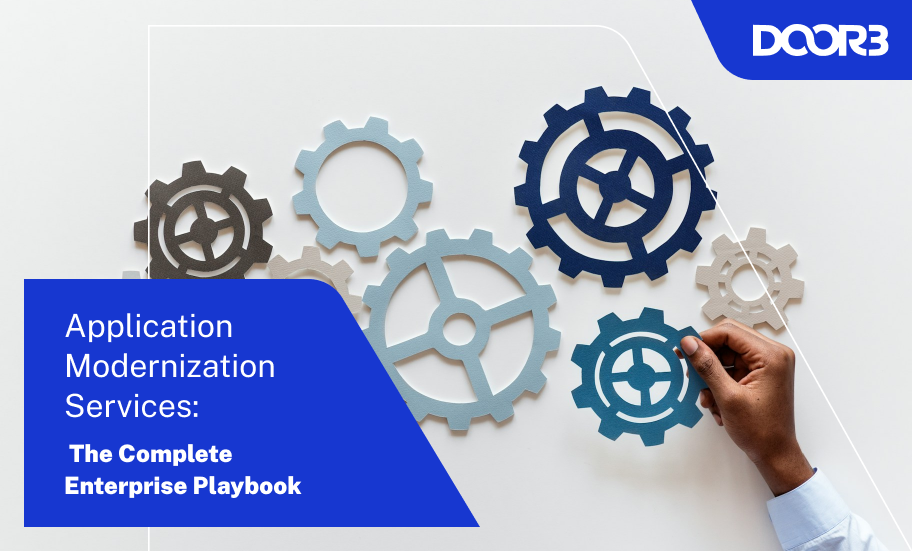
By DOOR3 | Legacy Modernization | Enterprise Technology
Enterprise applications that were built to last are now preventing organizations from moving forward. Whether it is a claims processing system written in COBOL, a financial platform running on a 1990s Oracle stack, or a custom ERP built before cloud architecture existed, legacy applications carry enormous hidden costs — in maintenance, velocity, talent, and competitive positioning.
Application modernization services exist to solve this problem without gambling on a high-risk, big-bang replacement project. This guide explains what application modernization is, how enterprise programs are structured, and what separates a partner with genuine regulated-industry experience from one that only knows cloud platforms.
What Is Application Modernization?
Application modernization is the process of updating or transforming existing software systems to meet current and future business requirements — without losing the business logic, data, and institutional knowledge embedded in those systems.
Unlike application migration, which primarily involves moving an application from one environment to another, application modernization addresses the underlying architecture, codebase, technology stack, and integration model. The goal is a system that is maintainable, scalable, and ready for modern capabilities like AI integration, API connectivity, and cloud deployment.
Application Modernization vs. Application Migration
Migration moves an application to a new environment, typically cloud. Modernization changes what the application is and how it works. In practice, most enterprise programs involve both: you modernize the architecture while migrating to a target infrastructure. DOOR3's AI Pathfinder assessment program evaluates both dimensions together in a structured 4–6 week engagement before any production work begins.
The 6 Rs of Application Modernization
Enterprise modernization frameworks organize transformation options around six strategies, each appropriate for different combinations of business value and technical complexity:
-
Rehost (Lift and Shift): Move the application to a new environment with minimal code changes. Fast and low-risk, but preserves technical debt.
-
Replatform: Migrate to a new platform with targeted optimizations. Balances speed and improvement.
-
Refactor / Re-Architect: Restructure internal application code without changing external behavior. High effort, high long-term value.
-
Rebuild: Rewrite the application from scratch using modern architecture. Highest risk and cost, appropriate only when the legacy codebase is irredeemably unmaintainable.
-
Replace: Retire the legacy application and adopt a commercial or SaaS solution.
-
Retire: Decommission the application entirely when business value no longer justifies maintenance cost.
Selecting the right strategy requires a structured technical debt and business value assessment. DOOR3's custom software development practice applies all six strategies across client portfolios, selecting and sequencing them based on the structured assessment that precedes every engagement.
Why Enterprises Are Modernizing Legacy Applications Now
Three converging pressures have made the current window the defining moment for enterprise application modernization.
The AI Readiness Imperative
Every major enterprise AI initiative — predictive analytics, intelligent automation, generative AI copilots, real-time decisioning — requires clean, accessible, well-structured data and modern API connectivity. Legacy applications were built before these requirements existed. They store data in proprietary formats, communicate via batch file transfers, and expose no APIs. Organizations that have not modernized their core applications cannot adopt AI at scale regardless of their investment in AI platforms.
For insurance carriers and financial institutions, legacy application modernization has become a board-level priority. DOOR3's AI services practice and AI Insurance platform are built around this premise: modern architecture is the prerequisite for AI capability, not an optional upgrade.
The True Cost of Doing Nothing
The annual cost of maintaining a large legacy application ecosystem is rarely accurately calculated. Beyond direct maintenance spending, organizations pay engineering velocity penalties (development teams spending 60–80% of their time managing legacy code), talent acquisition premiums for engineers who know COBOL, Delphi, or FoxPro — a challenge DOOR3's FoxPro migration practice directly addresses — and integration failure costs when modernized partner systems cannot connect to legacy applications.
A McKinsey analysis estimated that technical debt costs the global economy over $1.52 trillion annually. For a mid-sized insurance carrier, annual legacy maintenance typically consumes 70–80% of the IT budget, leaving almost nothing for innovation.
Regulatory Pressure in Insurance and Financial Services
Regulators in the US and EU have sharpened their focus on technology risk. The SEC's updated cybersecurity rules, DORA in European financial services, and state-level insurance technology requirements all create direct liability for organizations running unpatched, undocumented legacy systems. Application modernization is increasingly a compliance imperative alongside a competitive one — a dimension that DOOR3's financial software development practice and insurance software development team treat as a default design constraint in every engagement.
The Application Modernization Services Framework
Effective application modernization is a structured program, not a project. Organizations that approach it as a single initiative typically fail. Those that follow a phased, risk-managed framework succeed.
Phase 1 — Discovery and Technical Debt Assessment
The starting point is always an honest inventory of what exists. This phase maps every application in the portfolio, documents dependencies, quantifies technical debt, and assigns business value scores. The output is a prioritized modernization roadmap that sequences work based on risk, value, and complexity.
Key activities:
-
Application portfolio mapping
-
Dependency and integration analysis
-
Technical debt quantification
-
Business criticality assessment
-
Target architecture definition
Phase 2 — Modernization Architecture Design
With a prioritized roadmap in place, the next phase defines the target architecture for each application. For most enterprise programs, this involves defining an API-first integration architecture, selecting cloud infrastructure and managed services, designing the strangler fig migration pattern for critical systems, establishing automated testing requirements, and defining data migration and governance protocols.
Phase 3 — Incremental Transformation
Effective application modernization programs execute in small, validated increments rather than large releases. Each increment is deployed, tested in production, and validated before the next begins.
For systems that cannot tolerate downtime — insurance policy processing, financial transaction systems, healthcare records — parallel running, where the legacy and modernized systems operate simultaneously, is standard practice. DOOR3 has maintained zero operational disruption across all major modernization programs for regulated-industry clients including AIG and Munich Re.
Phase 4 — Validation and Optimization
The final phase validates that modernized applications meet functional, performance, and compliance requirements, decommissions legacy components, and optimizes cost and performance in the target environment. This is also when AI integration capabilities are enabled — the direct business value that justified the modernization investment. See DOOR3's AI Pathfinder program for how the assessment and activation phases connect.
Key Considerations When Choosing an Application Modernization Partner
Application modernization is a high-stakes engagement. Evaluating partners rigorously before committing is essential.
Regulated Industry Experience
Application modernization in insurance, financial services, or healthcare is categorically different from modernization in unregulated industries. Your partner must understand policy administration systems, claims processing architecture, core banking systems, or EHR data governance — not just cloud platforms and refactoring methodologies.
Ask for named client references in your specific industry and validated case studies that describe challenges, approach, and measured outcomes. DOOR3's project portfolio includes named work with AIG, Munich Re, PepsiCo, and Johnson & Johnson.
Proven Methodology
Tool selection — AWS, Azure, Kubernetes, microservices — is secondary to methodology. A modernization partner with a structured assessment process, a defined phased execution model, and a risk management framework will consistently outperform one that leads with a technology stack.
Ask to see their discovery-to-roadmap process, their dependency mapping methodology, and how they handle parallel running for zero-downtime migration.
Risk Mitigation Track Record
The most common modernization failure mode is scope expansion — a phased project that grows into a multi-year, multi-million-dollar program with no clear end state. If your organization has already experienced a stalled program, DOOR3's project rescue service is specifically designed for programs that need structured recovery before modernization resumes.
How DOOR3 Approaches Application Modernization
DOOR3 has delivered application modernization programs for some of the most demanding organizations in financial services and insurance. Our methodology is built on three principles that distinguish us from technology-only modernization firms.
Business continuity above all. Every modernization program we run maintains full operational continuity throughout. We design parallel running, strangler fig migration patterns, and incremental release strategies into every program from day one.
Assessment-first, execution-second. Our AI Pathfinder assessment program provides a structured technical debt inventory, dependency map, and prioritized modernization roadmap before a single line of production code changes. This eliminates the scope expansion risk that kills most modernization programs.
AI-ready architecture as the end state. We do not modernize to maintain the status quo. Every target architecture we design supports AI integration, real-time API connectivity, and cloud-native scalability. See how this connects to DOOR3's broader AI services practice for organizations ready to activate those capabilities post-modernization.
For context on specific challenges that arise during these programs, DOOR3's analysis of legacy modernization challenges covers the most common obstacles and how enterprise organizations navigate them.
Frequently Asked Questions
What is the difference between application modernization and digital transformation? Application modernization is a specific technical program that updates legacy software systems. Digital transformation is a broader business change initiative that may include modernization as one component alongside process redesign, organizational change, and new business model development. Modernization is what enables digital transformation to succeed at the technology layer.
How long does an enterprise application modernization program take? Duration depends on portfolio size, complexity, and chosen strategy. A single legacy application can be modernized in 3–6 months using refactoring and replatforming. A full enterprise portfolio modernization program for a large insurer or financial institution typically runs 18–36 months in phased increments.
How much does application modernization cost? The critical comparison is not the cost of modernization but the cost of continued legacy maintenance — which typically exceeds modernization investment within 3–5 years.
Can modernization happen without downtime? Yes. Using parallel running, strangler fig migration patterns, and incremental release strategies, DOOR3 delivers modernization programs with zero operational downtime for business-critical systems in regulated industries.
What is the first step in starting an application modernization program? A structured technical assessment that inventories your application portfolio, maps dependencies, quantifies technical debt, and defines a target architecture. DOOR3's AI Pathfinder assessment program delivers this in 4–6 weeks.
Ready to Begin Your Modernization Journey?
DOOR3 has spent over two decades helping regulated-industry organizations modernize complex legacy applications without disruption, without budget overruns, and without losing the institutional knowledge embedded in existing systems.
Book a free Legacy Modernization Assessment with DOOR3's application modernization architects, or explore the AI Pathfinder program to understand what the assessment process delivers before you commit to a full engagement.