How to Modernize Legacy Systems Without Disrupting Operations: A Proven Framework
07.02.2026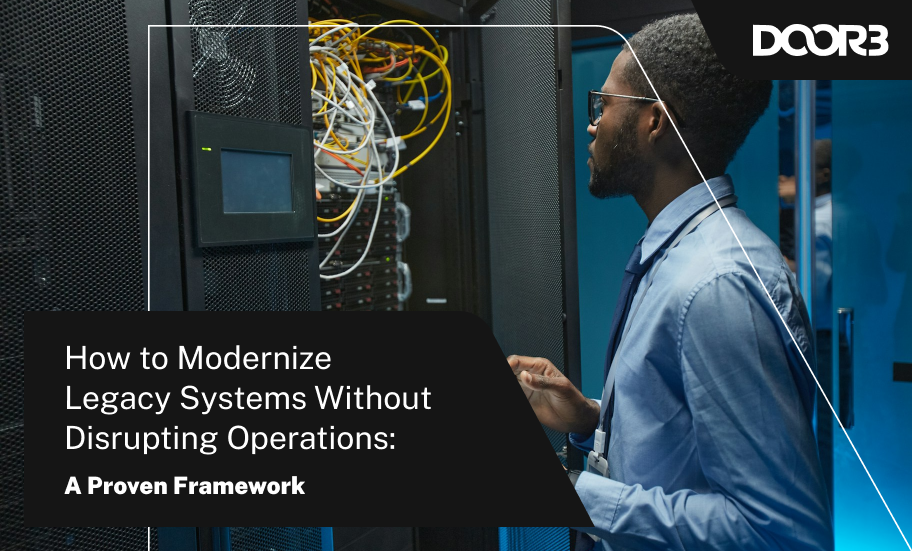
By DOOR3 | Legacy Modernization | Enterprise Technology
The fear that stops most legacy modernization programs before they start is not budget. It is operational risk. The systems in question are not peripheral utilities — they are business-critical. They process insurance claims. They execute financial transactions. They manage patient records. Any disruption to these systems is not an inconvenience; it is a business emergency with regulatory, financial, and reputational consequences.
This fear is rational. Legacy modernization programs have a documented failure rate. Many large-scale transformation projects have stalled, overrun, or failed to deliver promised outcomes. The cautionary tales are real.
But the conclusion most organizations draw from this history — that legacy modernization is inherently risky and therefore best delayed — is incorrect. The programs that fail do so for identifiable, preventable reasons. The programs that succeed share specific architectural and organizational practices that make zero-disruption modernization achievable, not aspirational.
This guide documents those practices in detail.
Why Most Legacy Modernization Projects Fail (And How to Avoid It)
Understanding failure modes is the starting point for preventing them. The most common causes of legacy modernization failure fall into five categories:
Starting without a complete dependency map. Legacy systems are deeply connected to other systems through integration points that are often undocumented. Organizations that begin modernization without fully mapping these dependencies encounter integration failures mid-execution. DOOR3's project rescue service exists specifically for organizations whose modernization programs have stalled at exactly this point.
Big-bang execution. The temptation to complete the modernization in a single large release — driven by pressure to "get it done" — is the most reliable predictor of failure. Large, infrequent releases accumulate change risk. When they fail, the rollback scope is enormous.
Insufficient test coverage before touching production code. Legacy systems with no automated test coverage make every modification dangerous — there is no safety net. Organizations that begin refactoring or re-architecting before establishing test coverage create more problems than they solve.
Neglecting organizational change management. The people who operate legacy systems have built their workflows, their expertise, and their professional identity around those systems. Modernization programs that treat this as purely a technical problem and underinvest in stakeholder engagement consistently fail when operations teams resist adoption of the modernized system.
Scope expansion. Modernization programs that add scope during execution — because new technical debt is discovered, or because stakeholders add requirements — consistently overrun timelines and budgets. The technical debt audit that precedes modernization execution is specifically designed to surface the discoveries that would otherwise become mid-execution scope additions.
The Principles of Zero-Disruption Modernization
Zero-disruption modernization is not a technique or a tool. It is an organizational philosophy built on four operating principles that must be applied consistently throughout the program.
Principle 1 — Modernize in Phases, Not Big Bangs
Every increment of a modernization program should be small enough to be fully validated before the next increment begins — and small enough to roll back without catastrophic impact if validation fails.
Phased execution is slower than big-bang execution in the short term. Over the full program lifecycle, it is consistently faster, because it eliminates the time lost to failed large releases, emergency rollbacks, and extended incident recovery.
Principle 2 — Decouple Before You Migrate
The primary cause of migration-induced disruption is undiscovered dependencies. Before any migration execution begins, every integration dependency of the target system must be documented, tested, and — to the extent possible — decoupled through API abstraction.
Decoupling does not require that all integrations be rewritten before migration begins. It requires that they be mapped, understood, and covered by automated tests that will detect breakage during migration execution. DOOR3's AI Pathfinder assessment delivers this dependency map as its primary output, before a single line of production code is changed.
Principle 3 — Maintain Business Continuity Throughout
This is the design goal, not a constraint to work around. Every architectural decision in a zero-disruption modernization program should be evaluated first against the question: does this choice allow the business to continue operating normally throughout?
Parallel running (operating legacy and modern systems simultaneously against the same inputs), feature flagging (controlling which users or transactions are routed to the modernized system), and canary deployments (progressively shifting traffic from legacy to modern) are the primary architectural tools for maintaining business continuity during modernization. These tools are standard practice in DOOR3's insurance software modernization engagements and financial software transformation programs.
Principle 4 — Automate Test Coverage Before Touching Core Code
This principle often requires investment before visible modernization progress can occur — which creates organizational pressure to skip it. That pressure must be resisted. Automated test coverage is the safety net that makes all subsequent modernization work safe.
The priority is behavioral coverage: tests that verify that the system produces the same outputs from the same inputs, not tests that verify internal implementation details. This behavioral coverage captures undocumented business rules in executable form, making them visible and verifiable throughout the transformation. For a detailed analysis of how legacy systems accumulate undocumented complexity over time, DOOR3's guide to legacy modernization challenges covers the most common patterns.
Step-by-Step: How to Modernize Legacy Systems Without Disruption
Step 1 — Comprehensive Legacy System Audit
Begin with a structured audit that produces: a complete inventory of the application's components, technology stack, and language versions; an assessment of code quality, documentation completeness, and test coverage; a quantified technical debt inventory; an initial dependency list that will be refined in Step 2; and performance and reliability baselines against which modernized components will be validated.
This audit typically takes 3–6 weeks for a single large application. Do not abbreviate it. DOOR3's AI Pathfinder program is structured to deliver this audit at enterprise scale.
Step 2 — Dependency Mapping
The dependency mapping exercise documents every integration the system has with the outside world: APIs it calls and APIs that call it; databases it reads and writes; file-based data exchanges, incoming and outgoing; batch jobs and scheduled processes; shared libraries and services it depends on; and other applications that depend on it.
For each dependency, document the integration protocol, the data exchanged, the calling frequency, and the business criticality of the dependency. For legacy systems with FoxPro or Delphi-based integrations, DOOR3's FoxPro migration practice provides specialist dependency analysis that general modernization firms cannot reliably deliver.
Step 3 — Strangler Fig Implementation
The strangler fig pattern is the primary architectural technique for zero-disruption modernization. The implementation sequence is:
-
Build a routing layer in front of the legacy system that intercepts all requests and can route them to either the legacy implementation or the modernized implementation.
-
Implement the first modernization increment in the new architecture — a well-defined, testable slice of functionality.
-
Route a controlled subset of traffic — ideally non-production or low-criticality production traffic — to the modern implementation while the legacy implementation continues to handle the remainder.
-
Validate completeness and correctness by comparing outputs between legacy and modern for the same inputs. This comparison testing is the most powerful tool available for detecting undocumented business rules that have not been replicated in the modern implementation.
-
Expand routing progressively as each increment is validated, until all traffic flows to the modern implementation.
-
Retire the legacy implementation once modern routing handles 100% of traffic and has been validated through a sufficient parallel running period.
Step 4 — Incremental API Layer Development
For systems that need to expose their functionality to external consumers — as part of an API-first modernization or to enable AI integration as described in DOOR3's AI services practice — build the API layer incrementally alongside the strangler fig migration. Each modernized component should expose its functionality through the API layer as it is completed, enabling downstream consumers to connect progressively rather than waiting for full migration completion.
Step 5 — Parallel Running and Cutover Planning
Define parallel running criteria for each migration wave before execution begins: how long will legacy and modern systems run in parallel; what comparison testing will confirm correctness of the modern implementation; what business events must be covered by the parallel running period; and what are the rollback triggers.
For business-critical systems in regulated industries — the environment in which DOOR3 operates most frequently, with clients including AIG, Munich Re, and Johnson & Johnson — parallel running should cover at least one full business cycle. Attempting to shorten this period to save cost is the most common source of post-migration incidents.
Step 6 — Decommissioning Legacy Components
Legacy decommission should follow a staged process that mirrors the migration sequence in reverse. Decommission each legacy component only after: its modern equivalent has been in production for the defined parallel running period; all comparison testing has confirmed output equivalence; all dependent systems have been updated to use modern interfaces; and a defined hypercare monitoring period has elapsed without incidents.
Technologies That Enable Zero-Disruption Modernization
API gateways such as AWS API Gateway, Azure API Management, and Kong provide the routing and traffic management capability needed for strangler fig implementation.
Feature flag platforms such as LaunchDarkly and Unleash enable controlled rollout of modernized components to subsets of users or transactions.
Event streaming platforms such as Apache Kafka, Azure Event Hubs, and AWS Kinesis enable real-time data synchronization between legacy and modern components during parallel running. These platforms also serve as the foundation for the AI-ready data architecture described in DOOR3's AI Insurance platform and AI Pathfinder program.
Automated testing frameworks — Selenium and Playwright for UI, REST Assured and Postman for APIs, custom behavioral test suites for business logic — provide the test coverage foundation for safe incremental changes.
Infrastructure as code tools such as Terraform and Pulumi enable consistent, repeatable environment provisioning that supports reliable deployment across modernization waves.
Measuring Success During Legacy Modernization
Zero-disruption modernization success is measured across four dimensions:
-
Business continuity: Zero unplanned downtime attributable to modernization activities.
-
Output equivalence: Behavioral comparison between legacy and modern components during parallel running should show zero functional divergence.
-
Velocity improvement: As technical debt is retired, feature delivery velocity should measurably improve. Track feature lead time and deployment frequency across the modernization program.
-
Maintenance cost reduction: Track the proportion of engineering time allocated to maintenance vs. new development. This ratio should improve as legacy components are decommissioned — visible in the software development productivity metrics that the modernization program tracks from day one.
When to Bring in External Expertise
External modernization expertise is most valuable in three situations:
When the legacy system requires knowledge the current team does not have. Legacy systems written in COBOL, Delphi, FoxPro, or other non-mainstream languages require specialist knowledge for assessment and migration planning. DOOR3's FoxPro migration practice and custom legacy language expertise address this directly.
When the program scope requires capacity that cannot be sourced internally without disrupting delivery. A zero-disruption modernization program running in parallel with normal operations requires engineering capacity that most organizations cannot sustainably provide from their existing teams.
When previous internal modernization attempts have failed. External expertise brings both technical skill and organizational independence. DOOR3's project rescue service is the structured entry point for organizations in this situation.
Frequently Asked Questions
Is zero-disruption modernization actually achievable for business-critical systems? Yes, consistently, with the right methodology. The key requirements are: complete dependency mapping before execution, strangler fig or parallel running architecture throughout, behavioral test coverage before code modification, and disciplined phase-gate management. DOOR3 has maintained zero operational disruption across all major modernization programs for regulated-industry clients.
How do you handle legacy business rules that are undocumented? Through behavioral testing: run the legacy system against a comprehensive set of inputs and capture its outputs. These captured behaviors become the specification for the modernized implementation. Comparison testing during parallel running then validates that the modernized implementation replicates every captured behavior.
What is the strangler fig pattern and why is it the preferred modernization approach? The strangler fig pattern involves building a modern routing layer in front of the legacy system, incrementally implementing modern components, and progressively routing traffic to them while the legacy system continues to operate. It is preferred because it maintains continuous operational capacity, allows each increment to be validated in production conditions, and eliminates the big-bang failure risk of full replacement approaches.
How long should legacy and modern systems run in parallel? At minimum, through a complete business cycle for the functions being modernized. For insurance policy administration, this typically means a full annual renewal cycle. For financial transaction systems, it means covering peak processing periods and at least one full quarter-end cycle.
What is the most common cause of legacy modernization project failure? Insufficient dependency mapping before execution begins is the single most common cause of mid-execution failure. Big-bang execution is the second most common. Both are preventable with a disciplined assessment-first approach — the foundation of every engagement delivered through DOOR3's AI Pathfinder program.
Get a Free Legacy System Assessment
DOOR3's legacy modernization practice has delivered zero-disruption transformations for regulated-industry organizations across insurance, financial services, and healthcare. Our methodology is built on the principles documented in this guide, refined through direct execution experience with some of the world's most demanding enterprise environments.
The first step is a structured legacy system assessment that maps your environment, quantifies your technical debt, and defines a phased modernization roadmap with business continuity guaranteed throughout.
Book a Free Legacy Assessment with DOOR3's modernization architects, or explore the AI Pathfinder program for a full view of the assessment methodology.