Enterprise AI Solutions: Bridging the Gap Between Ambition and Execution
07.08.2026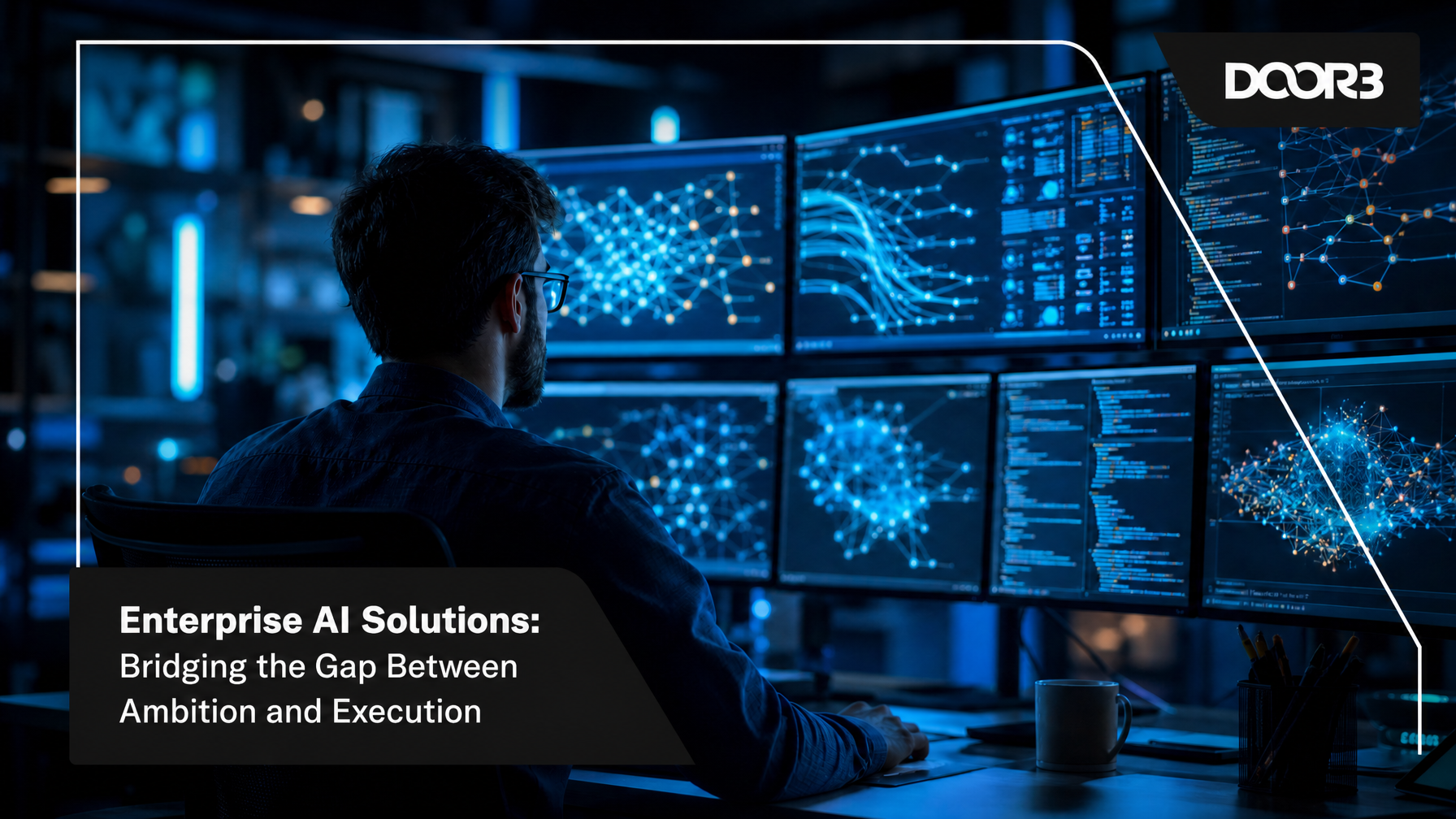
There is no shortage of enterprise AI ambition in 2026. According to Kyndryl's People Readiness Report 2026, AI adoption across large organizations has increased dramatically over the past year — yet the gap between adoption and meaningful execution remains stubbornly wide. A recent Meta report found that while 75% of enterprises have adopted agentic AI, only 15% are seeing measurable ROI.
The diagnosis is consistent across research: most organizations are investing in AI tools before addressing the foundational conditions those tools require to succeed. The result is a proliferation of pilots that never scale, AI initiatives that stall at the proof-of-concept stage, and leadership frustration when transformation promises go unmet.
This post outlines the practical conditions enterprises need to close that gap — and the decisions that separate organizations generating real value from those still searching for it.
Why Enterprise AI Ambition Outpaces Execution
The challenge is rarely the AI itself. Modern large language models, automation platforms, and machine learning tools are more capable and accessible than ever. The gap lives in the enterprise — in its data infrastructure, governance structures, operating models, and workforce readiness.
CGI's June 2026 Voice of Our Clients research identified four core barriers to enterprise AI readiness:
-
Weak data foundations — AI models are only as reliable as the data they consume. Fragmented, siloed, or low-quality data produces unreliable outputs regardless of model quality.
-
Absence of governance — Without clear ownership, risk frameworks, and accountability structures, AI deployments become compliance liabilities rather than competitive advantages.
-
Misaligned operating models — Teams built for pre-AI workflows struggle to absorb AI outputs effectively, creating friction that erodes adoption.
-
Workforce unreadiness — The technical capability to deploy AI frequently outpaces organizational readiness to use, interpret, and act on AI-generated insights.
Each of these is a solvable problem. None of them is solved by purchasing more AI tooling.
The Five Conditions for Enterprise AI That Delivers ROI
1. Start with Use Cases, Not Technologies
The enterprises generating the highest ROI from AI share a common discipline: they begin with a clearly bounded business problem, not a technology preference. Software development currently leads enterprise AI spend, capturing 55% of GenAI budget according to recent industry analysis — largely because software workflows offer well-defined inputs, outputs, and success criteria.
The practical implication: Before selecting any AI solution, define the specific workflow you intend to improve, the metric that will confirm improvement, and the data required to measure it. Ambiguous mandates to "adopt AI" produce ambiguous results.
2. Audit Your Data Infrastructure First
AI solutions do not create data quality — they expose it. An enterprise with fragmented CRM records, inconsistent data definitions across business units, or critical information locked in unstructured formats will find that AI amplifies those weaknesses rather than compensating for them.
A meaningful data audit before deployment answers three questions:
-
What data exists, where does it live, and who owns it?
-
What is the quality, completeness, and recency of that data?
-
What integration work is required before an AI solution can consume it reliably?
This step is unsexy and frequently skipped. It is also the most reliable predictor of whether a deployment succeeds.
3. Build Governance Before You Scale
AI governance is not a compliance exercise — it is the operational infrastructure that allows AI to be trusted by the people using it and the stakeholders accountable for its outputs. Enterprises that skip governance in the name of moving fast consistently find themselves rebuilding it later at higher cost, often after a visible failure.
Effective AI governance at the enterprise level establishes:
-
Clear ownership of AI outputs and decisions at the team level
-
Defined escalation paths when AI recommendations are incorrect or ambiguous
-
Regular model performance reviews tied to the business metrics the AI is supposed to move
-
Documented risk thresholds for high-stakes use cases
Key takeaway: Governance is what transforms AI from a tool into a reliable business system. It is also what makes AI auditable, which matters more each year as regulatory expectations increase.
4. Align Your Operating Model to AI Outputs
Most enterprise workflows were designed for human-to-human information transfer. AI-generated outputs — recommendations, summaries, predictions, classifications — often require different handoff structures, different review cadences, and different decision rights.
Organizations that treat AI as a drop-in replacement for existing human processes see limited gains. Organizations that redesign the workflow around what AI does well see compounding efficiency over time.
This is not a technology decision. It is an organizational design decision, and it requires the involvement of the people doing the work — not just the technology leadership commissioning it.
5. Invest in Workforce Readiness in Parallel
The Kyndryl 2026 research is direct on this point: workforce readiness is a prerequisite for AI value, not an afterthought. Employees who do not understand how to evaluate AI outputs, when to override them, and how to provide effective feedback to improve them will underuse or misuse the tools available to them.
Workforce readiness programs that work are specific to the use case, hands-on rather than theoretical, and tied to the actual workflows employees use daily. Generic AI literacy training delivers awareness; use-case-specific enablement delivers adoption.
What DOOR3 Brings to Enterprise AI Engagements
DOOR3 has spent more than two decades helping enterprises navigate complex technology transformations — from legacy system modernization to AI strategy and implementation. Our approach to enterprise AI solutions is grounded in the same discipline that has made our custom software development work effective for clients including AIG, Munich Re, PepsiCo, and J&J.
We do not begin with a technology recommendation. We begin with a structured assessment of where an organization stands across the five conditions above — data infrastructure, use case definition, governance, operating model alignment, and workforce readiness — and build a prioritized roadmap from that baseline.
Our services span the full transformation lifecycle: discovery and strategy, custom AI development, system integration, and ongoing support. For organizations that have invested in AI tools without seeing proportional returns, we frequently find that targeted work on one or two of the five foundations above produces meaningful improvement within a single quarter.
The Strategic Question for 2026
The enterprises that will build durable competitive advantage from AI are not the ones with the largest AI budgets or the most ambitious roadmaps. They are the ones that close the gap between ambition and execution systematically — use case by use case, data foundation by data foundation, workflow by workflow.
The gap is real. It is also closeable. The organizations that treat it as an operational challenge rather than a technology procurement problem are the ones consistently reaching the 15% generating real ROI.
If your organization has been investing in AI without seeing the returns you expected, the issue is almost certainly not the AI. Talk to our team about where the gap is and how to close it.