AI Consulting Services: What Enterprise Leaders Need to Know Before Hiring a Partner
07.13.2026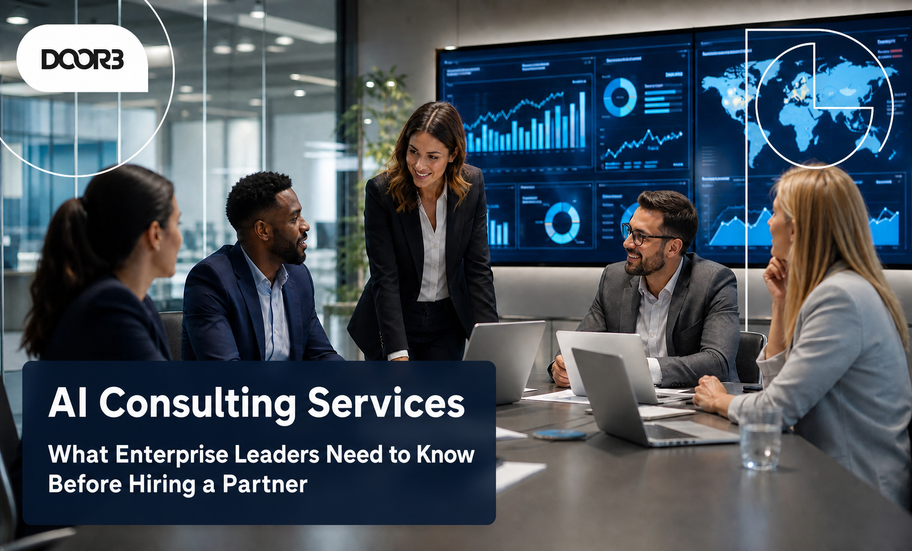
The demand for AI consulting services has outpaced the market's ability to deliver them credibly. Every major systems integrator now leads with AI. Boutique firms that specialized in data engineering six months ago have rebranded as AI transformation consultancies. The signal-to-noise ratio for enterprise leaders trying to find a partner with genuine implementation depth is as low as it has ever been.
That creates a real problem. A poorly matched AI consulting engagement does not just fail to generate value. It often sets organizations back. It consumes internal resources, produces architecture decisions that have to be unwound, and generates enough organizational skepticism about AI investment that the next serious initiative faces resistance before it begins.
This guide is a practical framework for evaluating AI consulting services before you sign. It covers what distinguishes serious implementation partners from firms that are better at selling AI than building it, what questions surface that distinction in a typical engagement conversation, and what governance and delivery structures indicate a partner can take a project from proof-of-concept to production.
Why AI Consulting Is Different from Traditional IT Consulting
The skills required to advise on and build AI systems are different in kind, not just degree, from traditional IT consulting. A firm that excels at ERP implementation or infrastructure modernization has a useful foundation, but that foundation does not automatically translate to AI delivery capability.
The specific differences matter for how you evaluate a partner:
AI requires probabilistic thinking, not deterministic thinking. Traditional software systems have explicit logic: if condition A is true, execute action B. AI systems produce probabilistic outputs: they are right most of the time, not all of the time. A consulting partner who has not internalized this distinction will design governance, monitoring, and exception handling poorly, because the failure modes are different.
Data readiness is a prerequisite, not a parallel workstream. One of the most common reasons AI pilots fail to reach production is that the organization's data layer was not ready for the system being built. A capable AI consulting partner diagnoses data readiness before scoping the engagement, not as a discovery finding halfway through.
Production AI requires ongoing management. Unlike a traditional software deployment that is largely stable after go-live, AI systems drift over time. The underlying data distributions change, user behavior changes, and model performance degrades. A serious AI consulting partner builds monitoring and retraining infrastructure into the delivery scope, not as an afterthought.
What to Look for in an AI Consulting Partner
Production Experience, Not Pilot Experience
Ask directly: how many AI systems has this firm deployed into production? Pilot experience and production experience are not the same thing, and the distinction matters enormously. Building a proof-of-concept in a controlled environment with clean data and flexible timelines is a different activity from deploying a system that runs at operational scale, integrates with live data pipelines, handles edge cases, and gets monitored and maintained.
Firms with genuine production experience will talk fluently about the operational requirements: data pipeline reliability, model versioning, monitoring infrastructure, rollback procedures. Firms without it will talk primarily about the pilot phase and describe production readiness in vague terms.
Domain Depth in Your Industry
AI systems are not industry-agnostic. A model built for claims triage in insurance requires specific understanding of claims workflows, regulatory constraints, and the downstream consequences of errors. A system built for contract review in legal services requires understanding of how attorneys actually use documents, what exceptions matter, and what the liability implications of AI-assisted decisions are.
Generic AI capability without domain depth produces systems that are technically functional and operationally problematic. The firm's portfolio of completed projects (not announced projects, completed ones) is the best signal of whether their domain depth matches your industry.
Technical Breadth Across the Full Stack
Many firms specialize narrowly, focusing on model development, data engineering, or a specific platform. A capable AI consulting partner for enterprise deployments needs technical breadth across the full stack: from data infrastructure and integration through model development, deployment, monitoring, and the application layer that surfaces AI outputs to end users.
The organizations that get the most durable value from AI consulting engagements are the ones whose partner built the whole system, not the ones who stitched together multiple specialized vendors and managed the integration themselves.
Governance and Explainability Literacy
Regulated industries (financial services, insurance, legal, healthcare) have compliance requirements that constrain how AI systems can operate. In any industry, automated decisions require accountability structures: who reviews exceptions, who approves changes to system behavior, how decisions get audited.
An AI consulting partner who cannot discuss governance architecture fluently (not as a compliance checkbox, but as a design discipline) is not ready for enterprise deployment work. Ask how they have handled explainability requirements in previous engagements, and ask what their standard exception handling architecture looks like. The specificity of the answer tells you what you need to know.
Questions to Ask Before You Hire
These questions are not designed to catch a partner out. They are designed to surface the operational depth behind the sales presentation:
"Walk me through a recent AI deployment from pilot to production. What broke between those two phases, and how did you fix it?" Every serious implementation has failure points between pilot and production. A partner with genuine experience will answer this specifically. A partner who has not made this journey will give a generic answer about challenges.
"What does your data readiness assessment look like, and at what point in the engagement do you conduct it?" The answer should describe a structured diagnostic process conducted before scoping begins. If data readiness comes up only as a discovery finding after engagement kickoff, the partner is not managing a common source of project failure proactively.
"How do you design exception handling for AI systems?" The answer should cover: how the system identifies cases it handles poorly, where those cases go, who reviews them, how resolutions feed back into system improvement. If the answer is vague, the partner has not built production systems.
"What monitoring infrastructure do you build into every deployment?" The answer should describe specific tools and processes for tracking model performance over time, alerting on drift, and managing model updates. If monitoring is described as a post-engagement consideration, it will not get built.
"Who from your firm will actually build this, and how much of their time is on our engagement?" The team doing the work matters more than the team doing the selling. Ask to meet the technical leads before you sign. Ask about their current project load.
Common Pitfalls in AI Consulting Engagements
Scope defined by technology, not by business problem. Engagements scoped around implementing a specific technology (a particular platform, a particular model type) frequently produce systems that are technically sound but operationally misaligned. Scope should be defined by the business problem being solved and the outcomes being measured.
Governance treated as a post-deployment activity. The governance architecture (who owns decisions, how exceptions are handled, how the system gets audited) needs to be designed as part of the system, not bolted on after it is live. Partners who defer governance to a later phase are deferring the work that is hardest to retrofit.
Change management deprioritized. The operational teams that will use the AI system daily will determine whether it succeeds or gets quietly worked around. Change management, understood not as a communications exercise but as a structured process of stakeholder engagement, training, and feedback integration, is a core delivery requirement. If it is not in the SOW, it will not happen.
Success defined by pilot metrics. Pilots succeed. Production deployments succeed or fail on different terms. Define production success metrics (business outcomes, not model performance statistics) before the engagement begins, and make them part of how the engagement is evaluated.
Starting the Engagement Right
The best AI consulting engagements start with a structured diagnostic phase: an honest assessment of the organization's AI readiness, data infrastructure, and the operational context of the problem being solved. This phase surfaces the information that determines whether a deployment will succeed and what it will require, before any commitments are made.
DOOR3's Technology Consulting and Software Development teams work with enterprise organizations across financial services, insurance, and legal to design, deploy, and scale AI systems that hold up in production. If you are evaluating AI consulting services and want a clear-eyed assessment of what your organization is ready to deploy and what it will take to get there, we can help.