
Trusted by leading brands












Generic AI doesn't work for your business
Off-the-shelf AI is trained on the internet. Your business isn't generic.
Your insurance portfolio
has unique fraud patterns.
Your law firm
has specific contract language and precedents.
Your manufacturing equipment
has particular failure signatures.
That 10% accuracy gap isn't abstract. In insurance it's $5M in false fraud alerts. In legal it's missed clauses that cause lawsuits. In manufacturing it's a $10M recall.
Generic AI
Custom ML
Accuracy
85%
95%
Trained on
Internet data
Your historical data
Business context
None
Deep understanding
Edge cases
Learns your patterns
Custom machine learning for your business context

Predictive Models
Forecast future outcomes based on historical patterns.
Use cases:
- Insurance: claims costs, fraud likelihood, cancellation risk
- Legal: litigation outcomes, matter costs
- Manufacturing: equipment failures, quality defects, demand

Classification Models
Categorize data into meaningful groups.
Use cases:
- Insurance: claims complexity, triage urgency
- Legal: document type, privilege status
- Manufacturing: defect type, root cause, severity

Recommendation Engines
Suggest next-best actions based on context.
Use cases:
- Insurance: coverage options, cross-sell
- Legal: relevant precedents, case law
- Manufacturing: process improvements, supplier alternatives

Anomaly Detection
Identify outliers that don't fit normal patterns.
Use cases:
- Insurance: fraud, unusual claims patterns
- Legal: non-standard clauses, billing anomalies
- Manufacturing: equipment anomalies, quality drift

Optimization Models
Find the best solution among millions of possibilities.
Use cases:
- Insurance: underwriting decisions, resource allocation
- Legal: case staffing, matter budgets
- Manufacturing: production schedules, inventory, maintenance timing
Every organization is different. We tailor these solutions to your systems, data, and goals, starting with a conversation to understand what will deliver the most impact.
Book time with an expert
Applied use cases by industry
Insurance ML Use Cases
Claims Cost Prediction
Problem:Reserves consistently off by ±50%.
Solution:Train on 10 years of historical claims, predict final cost within ±20%.
±20%
final cost prediction
±50%
current reserve error → fixed
Fraud Detection Problem
Problem:Fraudulent claims cost 5–10% of total claim
Solution:Train on historical fraud cases, flag suspicious claims at 95% accuracy, 20% false positive rate.
95%
detection accuracy
$10M+
annual savings
Policy Cancellation Prediction
Problem:High churn with no early warning system.
Solution:Predict cancellations 90 days ahead, enable proactive retention.
90 days
advance prediction
30%
reduction in churn
Legal ML Use Cases
Document Classification
Problem:Millions of pages, no structure.
Solution:Auto-classify by type, relevance, and privilege at 95% accuracy.
95%
classification accuracy
70%
cost reduction on eDiscovery
Contract Clause Extraction
Problem:200+ hours per M&A deal reviewing contracts.
Solution:Extract key clauses, liability, indemnification, IP, non-competes, at 95% accuracy.
95%
clause extraction accuracy
60%
reduction in review time
Matter Cost Prediction
Problem:Partner estimates off by ±50%.
Solution:Predict matter costs within ±15% based on historical data.
±15%
cost prediction accuracy
±50%
current partner estimate error
Manufacturing ML Use Cases
Predictive Maintenance
Problem:$8M annual unplanned downtime.
Solution:Predict equipment failures 2–4 weeks ahead using sensor data.
±20%
final cost prediction
±50%
current reserve error → fixed
Quality Defect Prediction
Problem:3–5% defect rate with manual inspection.
Solution:Computer vision detects defects in real-time.
95%
detection accuracy
$10M+
annual savings
Demand Forecasting
Problem:30–40% forecast error, too much or too little inventory.
Solution:Forecast demand within 10–15% error using historical and external data.
90 days
advance prediction
30%
reduction in churn
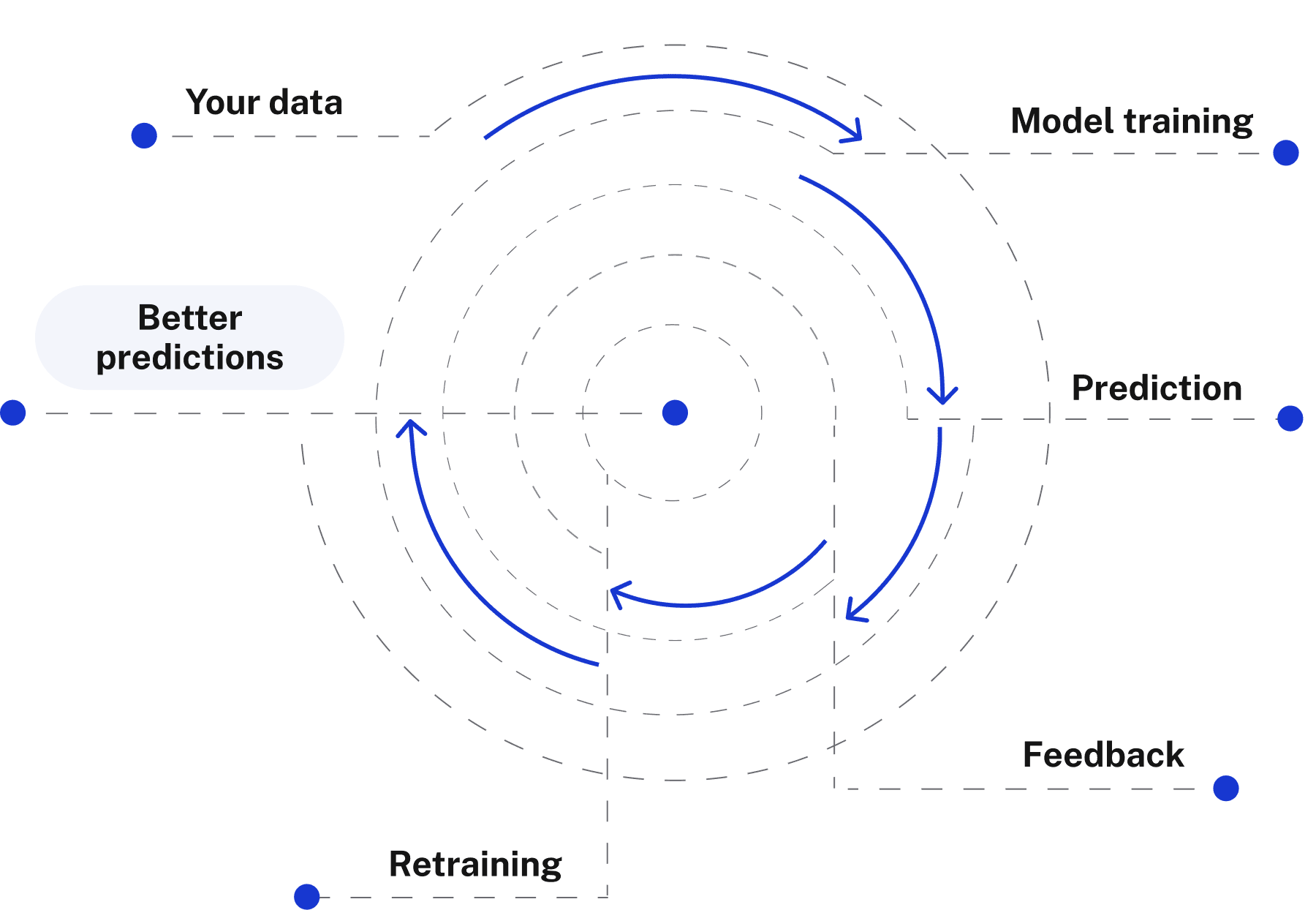
From data to production ML in 4 phases
Phase 1
Problem Definition & Data Assessment
Define the business problem, success crDefine the business problem, success criteria, and data requirements. Assess what you have and identify gaps.iteria, and data requirements. Assess what you have and identify gaps.
Deliverables
- Problem statement
- Success metrics
- Data requirements
- Feasibility assessment
Phase 2
Data Preparation & Feature Engineering
Clean and structure your data, engineer predictive variables, establish a baseline model accuracy.
Deliverables
- Cleaned dataset
- Feature engineering pipeline
- Baseline model accuracy
Phase 3
Model Development & Training
Train multiple architectures, tune performance, validate on unseen data, select the best model balancing accuracy and explainability.
Deliverables
- Trained ML models
- Performance benchmarks
- Model documentation
Phase 4
Deployment & Monitoring
Deploy to production, integrate with your systems, build monitoring dashboards, set retraining schedules.
Deliverables
- Production ML model
- API or batch integration
- Monitoring dashboard
- Retraining plan
"Cadwalader Connect allows us to leverage powerful tools to efficiently manage our business, strengthen internal and external relationships, provide efficient access to data, and deliver exceptional legal services to our clients."
Patrick Quinn, Managing Partner, Cadwalader
The difference between generic and custom
Generic fraud model:
trained on millions of claims from all carriers. 85% accuracy. Doesn't know your portfolio's unique patterns.
Custom fraud model:
trained on your 5 years of claims. 95% accuracy. Learns patterns specific to your geography, policy types, and customer base.
That 10% difference = $5M in reduced false positives.
Aspect
Off-the-Shelf AI
Custom ML
Training data
Internet (generic)
Your historical data
Accuracy
85%
95%+
Business context
None
Deep understanding
Edge cases
Explainability
Black box
Transparent
Adapts to your changes
Limited
Governance & Technology
Production ML with proper oversight
We don't just build models. We build models you can trust, explain, and audit.
Model documentation
Architecture, features, training data, accuracy benchmarks, and known limitations — fully documented.
Performance monitoring
Accuracy tracking, data drift detection, concept drift detection, and automated alerts if performance degrades.
Retraining schedule
Monthly, quarterly, or trigger-based — with rollback plans if a new model underperforms.
Explainability
Feature importance, individual prediction explanations, and bias testing across groups.
Audit trail
Model version history, training data lineage, prediction logs, and human override records.
Best-in-class ML stack. Technology-agnostic.
We choose what's right for your use case, not what we have a partnership to sell.
ML Frameworks
- TensorFlow
- PyTorch
- XGBoost
- LightGBM
- Scikit-learn
Cloud Platforms
- WS SageMaker
- Azure ML
- Google Vertex AI
- Self-hosted / on-prem
Data Platforms
- Snowflake
- Databricks
- Spark
- PostgreSQL
- MongoDB
Deployment
- REST APIs
- Batch processing
- Edge deployment
Why DOOR3?
Domain expertise
We understand your data in context — how insurance claims are structured, how legal documents are organized, how manufacturing sensor data behaves. Generic ML teams don't. We do.
End-to-end ownership
We handle problem definition, data preparation, model development, deployment, and ongoing monitoring. One team, start to finish.
Governance built in
Explainability, audit trails, retraining schedules, and compliance documentation are part of every engagement — not optional add-ons.

Ready to build custom ML for your business?
Let's discuss problem definition, data requirements, timeline, investment, and success metrics.
