Enterprise AI Solutions: A Practical Guide for Technology Leaders
07.15.2026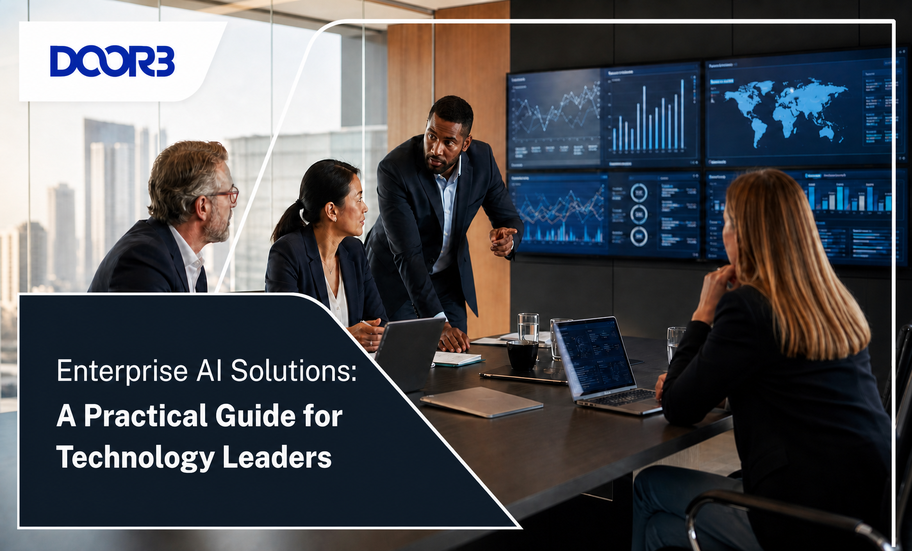
Key Takeaways
- Enterprise AI solutions require a defined business problem first — organizations that begin with a use case rather than a technology achieve measurably faster time-to-value and stronger stakeholder buy-in.
- The build vs. buy decision is rarely binary — most successful enterprise AI deployments combine a vendor foundation layer with custom integration and workflow logic tailored to the organization's data and processes.
- Data readiness is the most common hidden blocker — companies that invest in data governance and pipeline integrity before deployment reduce post-launch remediation costs significantly.
- Phased rollout is not optional for enterprises — piloting with a single business unit, measuring outcomes against defined KPIs, and then scaling is the approach that separates successful deployments from costly failures.
- Governance and change management determine adoption — the technology rarely fails; the organizational structures around accountability, retraining, and human oversight are where most enterprise AI initiatives stall.
The shift from AI experimentation to enterprise deployment is the defining technology challenge of 2026. The organizations pulling ahead are not necessarily those with the largest AI budgets — they are the ones with the clearest frameworks for selection, integration, and governance.
What Are Enterprise AI Solutions?
Enterprise AI solutions are purpose-built artificial intelligence systems designed to operate at the scale, security, and integration requirements of large organizations. Unlike consumer AI tools or point-solution SaaS products, enterprise AI is defined by its need to interact with existing data infrastructure, comply with regulatory requirements, support role-based access controls, and deliver measurable business outcomes across complex workflows.
The category spans a wide range of capabilities: predictive analytics, natural language processing, intelligent process automation, computer vision, and increasingly, multi-agent systems that coordinate several AI models to complete compound business tasks. What distinguishes enterprise-grade from general-purpose AI is not capability alone — it is the architecture, governance, and integration layer that surrounds it.
The market has matured significantly. Organizations are no longer evaluating whether to adopt AI. The conversation among technology leaders has moved to which solutions are production-ready, how to structure vendor relationships, and what internal capabilities need to exist before deployment makes sense.
The Business Case for Enterprise AI in 2026
The business case for enterprise AI solutions has become more concrete and more nuanced simultaneously. Early adoption cycles were driven largely by competitive pressure and board-level mandates. The current cycle is driven by documented outcomes from organizations that have moved past pilot stage.
The clearest ROI cases emerge in three categories:
Operational efficiency at scale. AI systems that handle high-volume, rules-adjacent decisions — claims triage, invoice processing, contract review — free experienced professionals to focus on judgment-intensive work. The efficiency gain is real, but the more durable value is often the reduction in error rates and cycle time variability.
Decision augmentation in complex domains. In industries like financial services, insurance, and legal services, AI solutions are augmenting — not replacing — expert judgment. The value is in surfacing relevant signals faster and reducing the cognitive load on high-cost professionals.
Organizations that treat AI as a decision-support layer rather than a decision-replacement layer consistently report stronger adoption rates and better outcome quality.
Customer experience differentiation. Personalization at enterprise scale, intelligent routing, and proactive service models have become expectations rather than differentiators in many sectors. The competitive pressure here is increasing quarter by quarter.
Choosing the Right Enterprise AI Solution
Defining Your Use Case With Precision
The single most important factor in enterprise AI solution selection is the specificity of the use case definition. Broad mandates — "improve operational efficiency" or "enhance the customer experience" — produce procurement decisions that satisfy no one. Successful technology leaders define the problem at the level of a specific workflow, a measurable outcome metric, and a named user group before engaging any vendor.
A structured use case definition should answer four questions: What decision or action is currently being made manually? What data exists to inform that decision today? What does a good outcome look like, and how will it be measured? Who owns the outcome if the AI recommendation is wrong?
That last question is not rhetorical. Accountability structure is a prerequisite for governance, and governance is a prerequisite for production deployment.
Evaluating Build vs. Buy
The build vs. buy calculus for enterprise AI has shifted. Three years ago, the default for any organization without a large ML engineering team was to buy. Today, the availability of foundation model APIs, pre-built integration frameworks, and AI development platforms means that custom-built solutions are accessible to a much wider range of organizations — provided they have the right consulting and engineering partner.
The correct framing is not build vs. buy but rather: what layer of the stack should be customized, and at what level of abstraction?
For most enterprises, the answer involves buying or licensing a foundation model or AI platform, then building the integration layer, the data pipeline, the business logic, and the human-in-the-loop review workflows on top. This hybrid approach captures the speed and reliability of established platforms while retaining the flexibility to address specific operational requirements.
Integration With Existing Systems
Integration complexity is consistently underestimated in enterprise AI projects. A solution that performs well in isolation frequently struggles to deliver value when it must read from legacy data systems, write results back to operational platforms, and surface outputs to users within existing tools and workflows.
Before finalizing any enterprise AI solution selection, technology leaders should conduct a detailed integration audit covering: the data sources the AI system will consume, the latency and reliability requirements of those sources, the downstream systems that will act on AI outputs, and the identity and access management architecture that will govern which users interact with the system and in what capacity.
Organizations that complete this audit before vendor selection avoid the most common and costly mid-project scope expansions.
How to Deploy Enterprise AI Successfully
Phase 1: Assessment and Strategy
The assessment phase establishes the foundation for everything that follows. It encompasses use case prioritization, data readiness evaluation, organizational capability assessment, and vendor landscape mapping. Done well, this phase takes four to six weeks and produces a deployment roadmap with clear go/no-go criteria for each initiative.
A rigorous assessment surfaces the data quality issues, integration constraints, and organizational readiness gaps that, if left unaddressed, will cause deployment delays. It is also the right moment to establish the governance model: who approves AI outputs before they affect customers or business decisions, how errors are escalated and reviewed, and what the retraining cadence will be.
Phase 2: Pilot and Validation
The pilot phase deploys the solution within a bounded scope — typically a single business unit, geography, or workflow — with explicit success criteria defined before launch. The purpose is not to prove the technology works in general. It is to prove that this implementation, with this data, in this organizational context, produces the target outcomes.
Pilots that are designed to succeed rather than to learn are a waste of resources. The most valuable pilots are structured to surface failure modes, integration gaps, and adoption barriers before they affect the broader organization.
Validation metrics should be agreed upon in advance and include both technical performance metrics (accuracy, latency, uptime) and business outcome metrics (cycle time reduction, error rate, user adoption rate).
Phase 3: Scale and Optimize
Scaling a successful pilot into a production enterprise AI solution requires a different set of capabilities than the pilot itself. The infrastructure must handle production data volumes and reliability requirements. The change management program must address training, workflow redesign, and the management of resistance from teams whose work is being changed.
The organizations that scale AI successfully treat the human side of the transition with the same rigor they apply to the technical side.
Ongoing optimization should be built into the operating model from day one. AI models degrade as the real-world data they encounter diverges from their training distribution. Establishing clear monitoring, drift detection, and retraining protocols before go-live is far less expensive than discovering model degradation through declining business outcomes.
Common Pitfalls in Enterprise AI Implementation
Starting with technology rather than problems. The organizations that purchase AI platforms before defining specific, measurable use cases consistently struggle to justify the investment. The technology should follow the business problem, not precede it.
Underestimating data readiness requirements. Most enterprises discover during deployment that their data is less clean, less accessible, and less consistently structured than their internal assessments suggested. Building a realistic data readiness timeline into the project plan is not pessimism — it is accuracy.
Treating AI governance as an afterthought. Governance frameworks — covering accountability, auditability, bias monitoring, and human review protocols — are significantly more expensive and disruptive to implement after deployment than before. Regulators in financial services, insurance, and healthcare are accelerating their expectations in this area.
Neglecting change management. AI adoption fails most often at the human layer. Employees who do not understand the purpose of the AI system, who distrust its outputs, or who have not been trained to work alongside it will route around it. Executive sponsorship, transparent communication, and sustained training programs are not soft factors — they are adoption determinants.
Selecting vendors based on demo performance rather than production evidence. Proof-of-concept environments are optimized for demos. Procurement decisions should be grounded in reference checks with organizations running similar use cases in production, at similar scale, with similar data characteristics.
FAQs on Enterprise AI Solutions
What is the difference between enterprise AI solutions and standard AI software?
Enterprise AI solutions are distinguished from general AI software by their design for organizational scale, security, and integration requirements. They support role-based access controls, connect to existing enterprise data infrastructure, comply with industry-specific regulatory frameworks, and are designed for operational reliability in production environments. Standard AI software typically lacks the governance, integration depth, and customization capabilities required for enterprise deployment.
How long does it take to implement an enterprise AI solution?
Implementation timelines vary significantly by use case complexity, data readiness, and organizational size. A focused, well-scoped deployment targeting a single workflow with clean data can move from assessment to production in three to six months. More complex, cross-functional deployments involving legacy data integration and significant change management typically require twelve to eighteen months for full-scale rollout. Phased approaches that deliver pilot value within the first ninety days are the standard for well-managed enterprise AI projects.
What internal capabilities does an organization need before deploying enterprise AI?
Organizations need three foundational capabilities before enterprise AI deployment delivers sustainable value: data infrastructure that makes relevant data accessible and reliably structured; technical staff who can manage integrations, monitor model performance, and escalate issues; and a governance framework that defines accountability for AI outputs, escalation protocols for errors, and a retraining and review cadence. Organizations lacking these capabilities should build or partner for them before selecting a solution.
How do you measure the ROI of enterprise AI solutions?
ROI measurement should be defined before deployment, not after. The most reliable framework ties AI outcomes to specific operational metrics that were being tracked before implementation: cycle time for a defined workflow, error rate on a specific decision type, cost per transaction, or customer satisfaction scores for AI-assisted interactions. Organizations that attempt to define ROI post-deployment typically find that baseline data is incomplete and attribution is contested.
When should an enterprise build a custom AI solution versus buying an existing platform?
The build vs. buy decision is most productively framed as a question of which layers to customize. Most enterprises benefit from leveraging established foundation models or AI platforms for core capabilities while building custom integration layers, business logic, and governance workflows on top. A fully custom AI build from the model layer up is justified only when the use case involves proprietary data types, highly specialized domain requirements, or competitive differentiation that cannot be achieved through platform customization. A qualified technology consulting partner can help map the right architecture for your specific requirements.