Legacy System Modernization: A Complete Framework for Enterprise Leaders
06.17.2026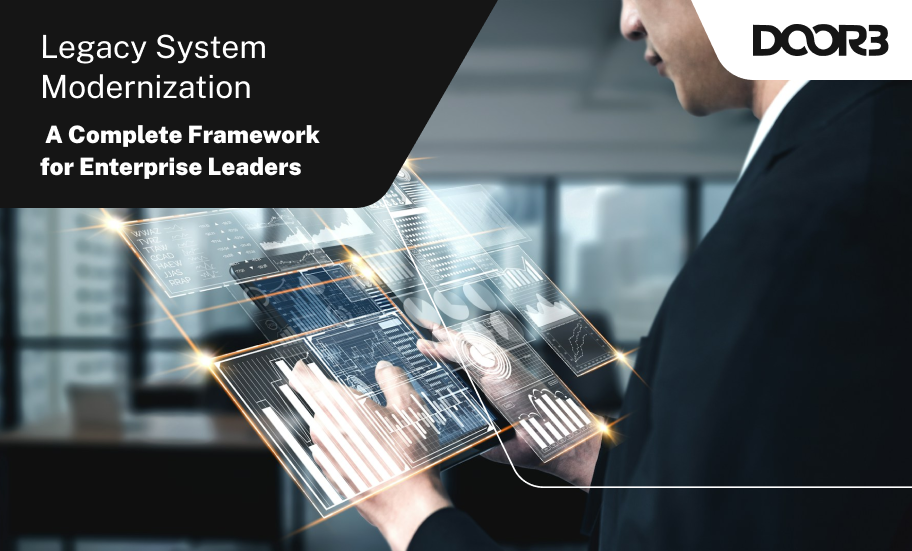
By DOOR3 | Legacy Modernization | Enterprise Technology Strategy
Enterprise applications that were built to last are now preventing organizations from moving forward. Policy management systems running on COBOL, core banking platforms built for mainframe, custom claims processing applications written in languages that most engineers have never encountered — these are the systems that run the world's most regulated and consequential industries, and they are quietly becoming the single largest obstacle to enterprise competitiveness.
This guide provides enterprise technology leaders with a complete framework for understanding, planning, and executing legacy system modernization, drawn from DOOR3's two decades of experience modernizing complex software environments for organizations including AIG, Munich Re, and Johnson & Johnson.
What Is Legacy System Modernization?
Legacy system modernization is the process of transforming outdated software systems — whether in terms of technology, architecture, process integration, or business capability — into systems that meet current and future organizational requirements.
The critical distinction between modernization and replacement is continuity. Modernization preserves the business logic, data, and institutional knowledge encoded in legacy systems while transforming the technology stack, architecture, and integration model. This is why it is almost always preferable to full system replacement, particularly in regulated industries where the business rules embedded in core systems represent decades of regulatory interpretation and operational refinement.
Defining a Legacy System
A system is functionally legacy when one or more of the following conditions apply:
-
It runs on a technology stack or language no longer actively supported or widely understood
-
It cannot integrate with modern systems via standard APIs without expensive custom middleware
-
Its maintenance requires specialist knowledge that is increasingly unavailable in the talent market
-
It cannot be deployed in cloud environments without fundamental architectural changes
-
It blocks adoption of AI, real-time analytics, or modern user experience layers
-
Its total maintenance cost exceeds 60% of the annual IT budget
By these criteria, the majority of core enterprise applications in insurance, banking, and healthcare qualify as legacy — even systems custom-built in the 2000s and early 2010s.
Signs Your System Is Overdue for Modernization
Beyond the definitional criteria, operational signals indicate when modernization has moved from desirable to urgent:
-
Feature requests requiring 6–18 months to implement are being rejected or abandoned
-
Integration projects with vendors, partners, or regulators are failing or requiring costly custom workarounds
-
Security audits are producing escalating lists of unresolvable vulnerabilities
-
Engineering teams spend more time maintaining existing code than building new capabilities
-
AI and automation initiatives are being blocked at the data or integration layer
-
Key engineers with legacy knowledge are retiring with no knowledge transfer path
When these signals cluster together, modernization is no longer a strategic option — it is an operational necessity. Organizations at this point have benefited from DOOR3's project rescue and stabilization service, which provides an immediate triage capability before the full modernization program begins.
The Business Cost of Legacy Systems
Before building a modernization business case, quantify what the current state is actually costing the organization.
Maintenance Costs vs. Innovation Investment
The average enterprise organization with a legacy-heavy portfolio spends 70–80% of its annual IT budget on maintenance and operations rather than innovation. This is not a technology problem — it is a strategic constraint. Every dollar spent maintaining COBOL is a dollar not spent on AI, customer experience, or new product development.
To quantify this for your organization, calculate: annual labor cost for legacy maintenance including specialist contractor rates; infrastructure cost for on-premise legacy environments; integration middleware costs; incident response costs attributable to legacy system failures; and the opportunity cost of delayed feature delivery.
Security and Compliance Risk
Legacy systems are disproportionately vulnerable. They were built before modern security practices, often cannot receive patches without risking system stability, and frequently have undocumented integrations that create attack surface that IT security teams cannot fully map.
In regulated industries, the regulatory exposure is direct. DORA in the EU, SEC cybersecurity rules in the US financial sector, and state insurance technology regulations all create explicit obligations around technology risk management. DOOR3's financial software development practice addresses regulatory compliance architecture as a first-class concern in every engagement.
The AI Readiness Gap
Every AI initiative that is delayed or limited because of legacy architecture represents lost competitive positioning. For a property and casualty insurer, the inability to deploy real-time fraud detection, AI-assisted underwriting, or predictive claims processing is a direct revenue and loss ratio impact.
Legacy system modernization in 2026 is fundamentally an AI readiness investment. DOOR3's AI services practice is built on this premise — modern architecture is the prerequisite for AI capability, not an optional upgrade. For insurance-specific AI use cases, see DOOR3's analysis of generative AI in insurance to understand what becomes possible once the architecture constraint is removed.
Legacy System Modernization Approaches
Selecting the right strategy for each system in your portfolio requires evaluation of business value, technical complexity, risk tolerance, and timelines.
Rehost (Lift and Shift)
Move the legacy system to a new environment — typically cloud — with minimal code changes. Fastest and lowest risk, but does not address underlying technical debt. Appropriate for systems that are functionally adequate but need to exit expensive on-premise data centers.
Replatform
Migrate to a new platform with targeted improvements — for example, replacing a legacy Oracle database with a managed cloud database service while preserving application logic. Balances modernization progress with execution speed.
Refactor / Re-Architect
Restructure internal application code to improve maintainability, performance, and scalability without changing external behavior. The most common approach for high-value business-critical applications where the core logic is sound but the implementation is outdated.
Rebuild
Rewrite the application from scratch using modern architecture. Appropriate only when the legacy codebase is irredeemably unmaintainable, undocumented, or written in a language with no viable path to modern integration. Highest cost and risk of all strategies.
Replace
Retire the legacy application and adopt a commercial or SaaS solution. Appropriate when the business process is standard and competitive differentiation value of a custom system is negligible.
Retire
Decommission the application entirely when business value no longer justifies any investment. This is frequently overlooked but often the right answer for peripheral systems with minimal active use.
Building a Legacy Modernization Roadmap
The modernization roadmap translates the strategic decision to modernize into a sequenced execution plan. A well-constructed roadmap prioritizes by business impact, sequences to minimize risk, and creates measurable milestones.
Step 1 — Inventory and Prioritize
Before any modernization work begins, conduct a comprehensive application portfolio inventory. Document every system, its technology stack, business function, integration dependencies, and current maintenance cost. Score each application on business criticality and technical debt severity.
This inventory is not optional. Organizations that begin modernization without it consistently encounter unexpected dependencies that derail timelines and budgets. DOOR3's AI Pathfinder assessment program delivers this inventory as a structured 4–6 week engagement, including technical debt quantification and a prioritized modernization roadmap.
Step 2 — Define Target Architecture
With the portfolio mapped, define the target state architecture. For most enterprise programs in 2026, this means cloud-native or cloud-compatible deployment, API-first integration architecture, microservices or service-oriented architecture for new development, a modern data platform that supports AI and real-time analytics, and DevOps and CI/CD capability for continuous delivery.
Step 3 — Risk Assessment and Business Continuity Planning
For each system in the roadmap, define the acceptable risk envelope. How much downtime is tolerable? What rollback capability is required? What parallel running duration is necessary? For regulated-industry core systems, the answers drive significant architectural decisions that must be resolved before execution begins.
Step 4 — Phased Execution
Execute modernization in phases, not a single large release. Each phase should deliver measurable business value independently — reduced maintenance cost, new integration capability, improved performance, or AI enablement. DOOR3's step-by-step migration approach for insurers provides a detailed walkthrough of how phased execution works in one of the most demanding regulated contexts.
Common Legacy Modernization Challenges and How to Overcome Them
Undocumented business logic. Legacy systems frequently contain business rules that exist only in code, with no documentation. Overcome this through structured code analysis, stakeholder interviews, and parallel testing against the legacy system during migration.
Unknown dependencies. Large legacy systems typically have integration points that no one fully understands. Overcome this through comprehensive dependency mapping before any migration work begins. For a full treatment of what this involves in practice, DOOR3's analysis of legacy modernization challenges covers the most common obstacles in depth.
Resistance to change. Operations teams familiar with legacy systems often resist modernization. Overcome this by involving operations stakeholders in architecture design and maintaining parallel running during transition.
Scope expansion. Modernization projects frequently grow beyond their original scope as new technical debt is discovered. Overcome this with strict phase gates, clear scope definitions per phase, and a change control process that routes new discoveries to future phases.
Talent gaps. Both legacy-language expertise and modern architecture skills are required simultaneously. Organizations with FoxPro or Delphi environments have found value in DOOR3's FoxPro migration practice, which combines legacy-language expertise with a structured modernization methodology.
Legacy System Modernization in Regulated Industries
Regulated industries face additional constraints that make modernization more complex — and more urgent. Compliance audit trails, data residency requirements, retention policies, and regulatory approval processes must be maintained throughout the transformation.
For insurance carriers, this means policy data continuity, claims history integrity, and regulatory filing continuity throughout migration. For banks, it means transaction record completeness, AML and KYC data integrity, and real-time settlement capability. DOOR3's insurance software development practice and financial software development services both operate with these compliance continuity requirements as default constraints.
See how DOOR3 has applied this approach across regulated-industry clients in our project case studies.
Frequently Asked Questions
What is the difference between legacy system modernization and digital transformation? Legacy system modernization is a technology program that updates specific software systems. Digital transformation is a broader strategic initiative that may include modernization but also encompasses business process redesign, organizational change, and new business model development. Modernization is typically the prerequisite technology foundation that makes genuine digital transformation possible.
Which legacy systems should be modernized first? Prioritize based on two axes: business criticality and technical debt severity. Systems that are both business-critical and technically unsustainable should be addressed first. Secondary priority goes to systems blocking AI or integration initiatives, regardless of their stability.
Can legacy systems and modern systems coexist during a modernization program? Yes — and they must. Successful modernization programs maintain the legacy system in production while the modernized version is being built, tested, and validated. Cutover happens only when the modernized system has been fully validated in production conditions.
How do you prevent scope expansion during a legacy modernization program? Define clear phase boundaries before execution begins. Each phase should have a specific scope, a fixed duration, and measurable outcomes. New discoveries during execution should be documented as future-phase candidates, not added to the current phase scope.
How long does legacy system modernization take? Duration varies significantly based on system complexity, portfolio size, and chosen strategy. A targeted single-system modernization typically takes 3–9 months. A full enterprise portfolio modernization program runs 18–48 months in phased increments.
Start Your Modernization Assessment
The most common mistake in legacy system modernization is delaying the start. Every year of continued legacy maintenance adds to the technical debt backlog, narrows the talent pool available to help, and widens the competitive gap with organizations that have already modernized.
DOOR3's structured legacy assessment process — delivered through our AI Pathfinder program — provides a complete application portfolio inventory, technical debt quantification, dependency map, and prioritized modernization roadmap in 4–6 weeks.
Book a Legacy System Assessment and speak directly with DOOR3's modernization architects about your specific environment.