
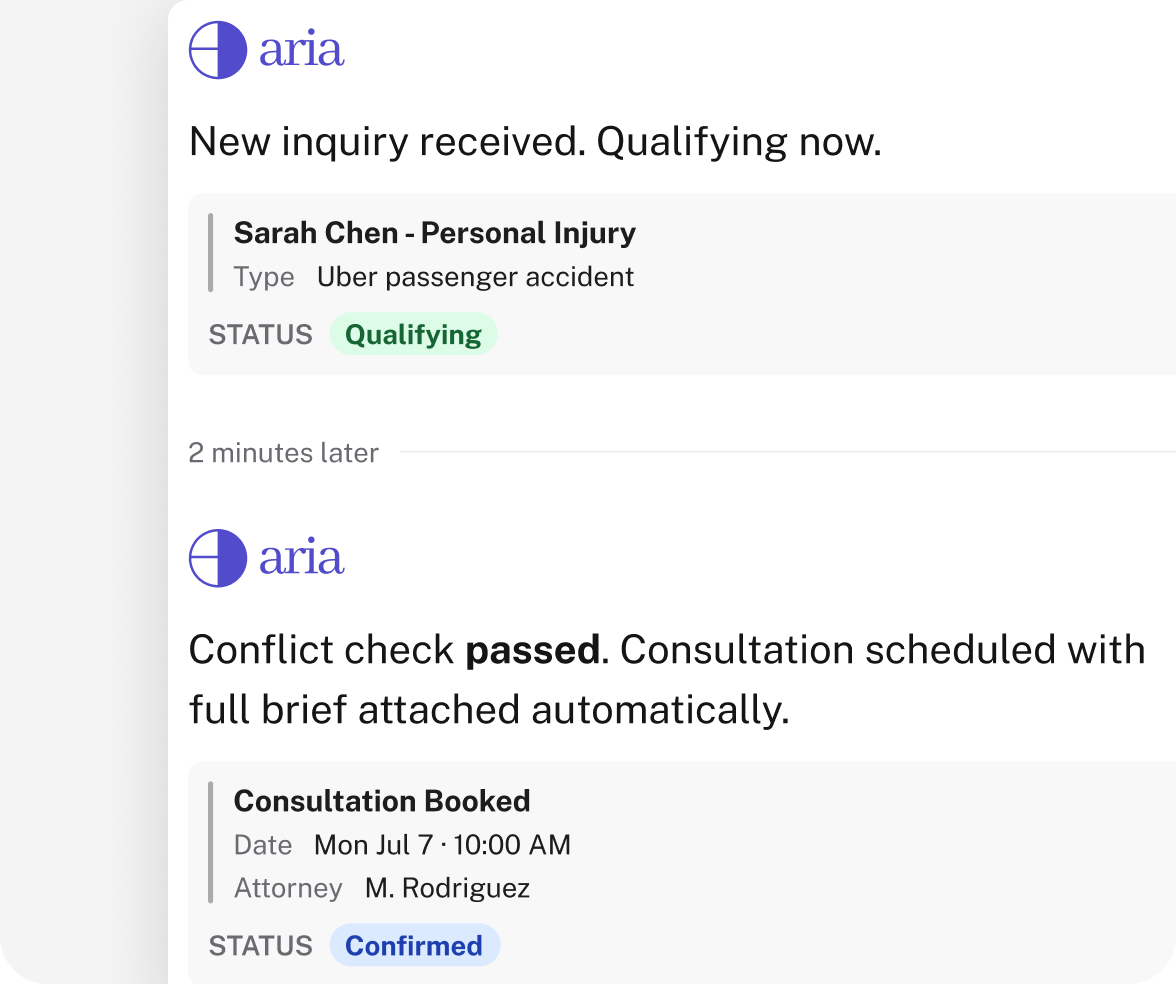
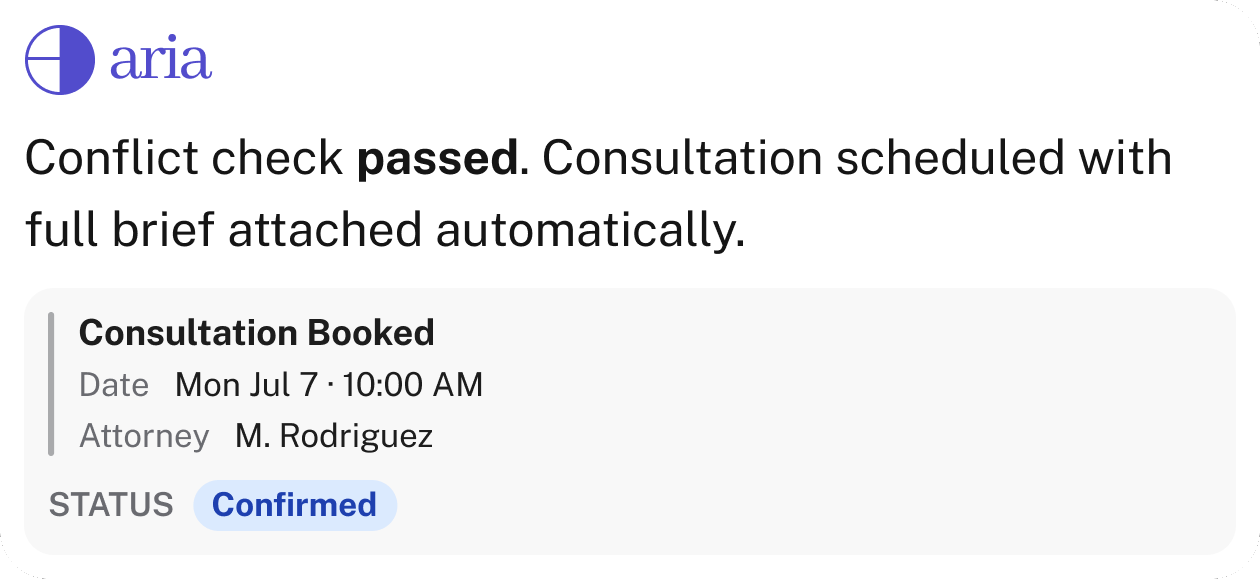
Intake intelligence. ARIA qualifies leads, runs conflict checks, and schedules consultations automatically with full brief, purpose-built for legal teams from the first inquiry.



Trusted by leading law firms and legal teams across the Am Law 200












Three systems. One seamless intake.
Intake intelligence. ARIA qualifies leads, runs conflict checks, and schedules consultations automatically with full brief, purpose-built for legal teams from the first inquiry.
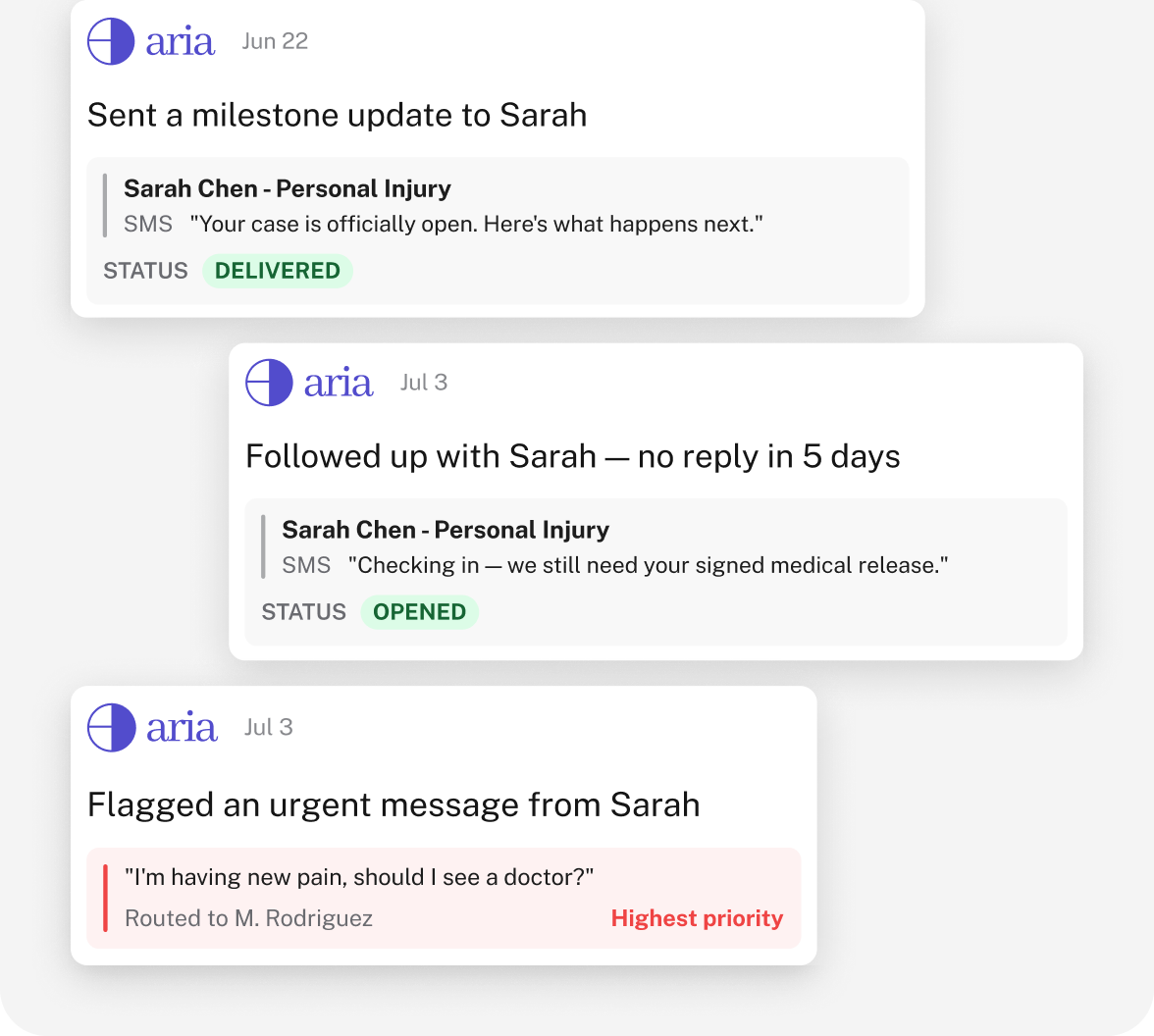
Client communication. ARIA AI agent keep every client informed on a defined cadence. No follow-up falls through the cracks.
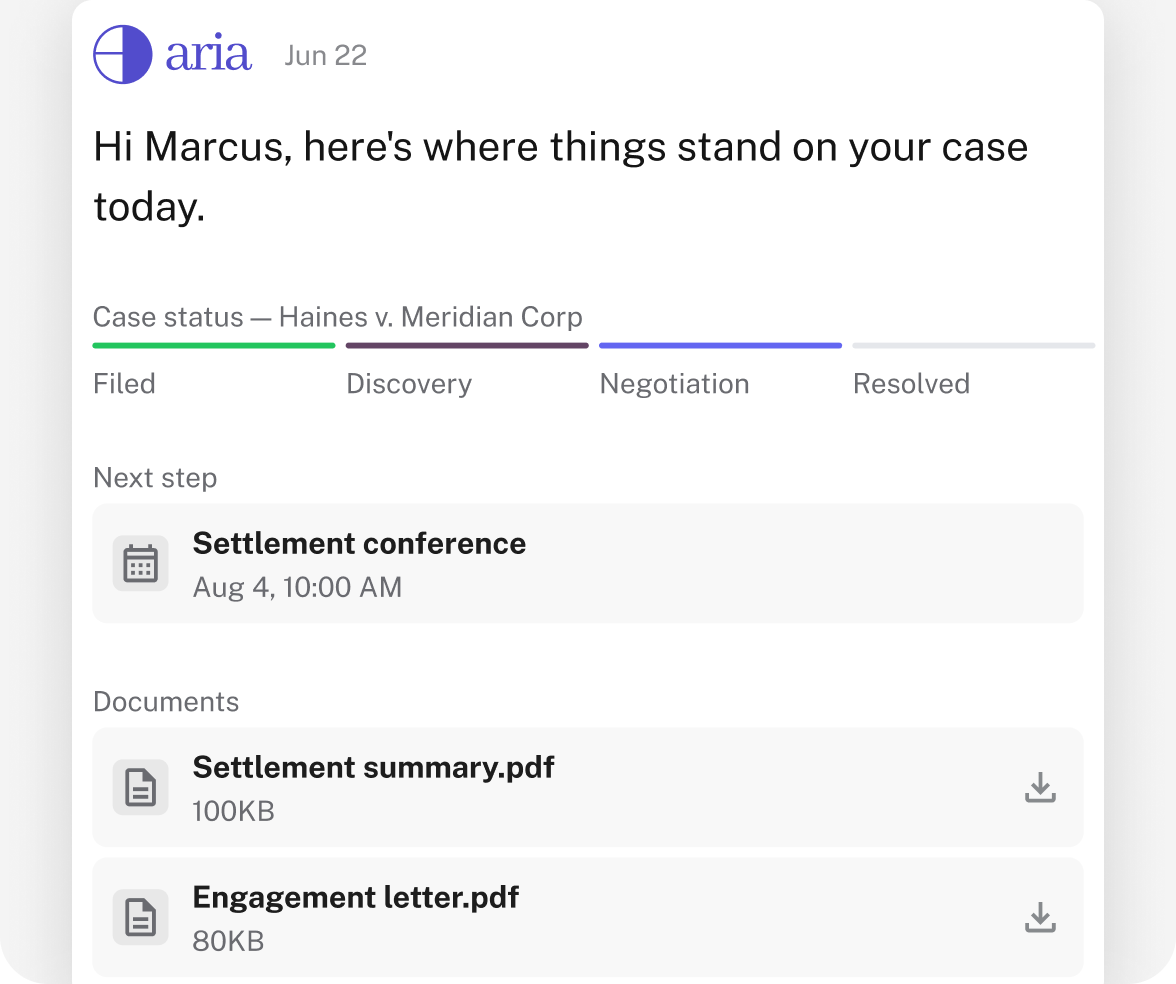
24/7 Client portal. Clients access case status, legal documents, and next steps anytime. Your legal practice stays responsive without adding headcount.
What “secure” actually means here.
“Secure” gets used loosely in AI. Here’s what it actually covers for ARIA.
Security, by design. Attorney-client privilege respected at every layer. Bar ethics rules on AI addressed by design, not bolted on after. Every safeguard below is something we can stand behind today, not a promise for later.
Your firm's biggest cost is not associates. It’s the clients you lost last Friday.
33%[1]
of firms respond to a prospective client's inquiry at all. They don’t go to a better firm, they go to a faster one.
A prospective client submits an intake form. Your office is closed. They need legal help urgently, so they contact two other law firms at the same time. Monday morning your team calls back. The client has already retained someone else.
Retyping
what the intake form already answered, every single consultation. Attorneys spend billable time on repeats.
The attorney opens the meeting with: “Let’s start from the beginning.” Twenty minutes in, they’re collecting the same information the intake form was supposed to capture. Workflows stall before billable work even begins.
35%[2]
of client recommendation rate industry-wide, down from 69% four years ago. Referrals used to be automatic, for most firms, they aren't anymore.
A client whose case is pending hasn’t heard from the firm in three weeks. They assume they’ve been forgotten and call a competitor. By the time your legal team follows up, the relationship is damaged. Or gone.
Unbilled
time that disappears into admin before the real work even starts, every lawyer, every day. That's payroll spent on nothing billable.
The firm wants to grow 30% next year. More clients means more staff. More intake calls, more scheduling, more follow-up. Streamlining your work isn’t optional anymore. It’s survival.
[1] Clio's secret-shopper study of 500 law firms found only 33% responded to email inquiries.
[2] BTI Consulting: client recommendation rates fell from 69.1% (2020) to 35% (2024).
ARIA does not replace your team. It eliminates the part of their work that was never meant to be their job.
In about 10 minutes, score your firm across four readiness dimensions and leave with a recommended starting stage (Foundation, Prepare, Pilot, or Scale) plus a 30-day action plan.
One AI. Six practices.
Litigators
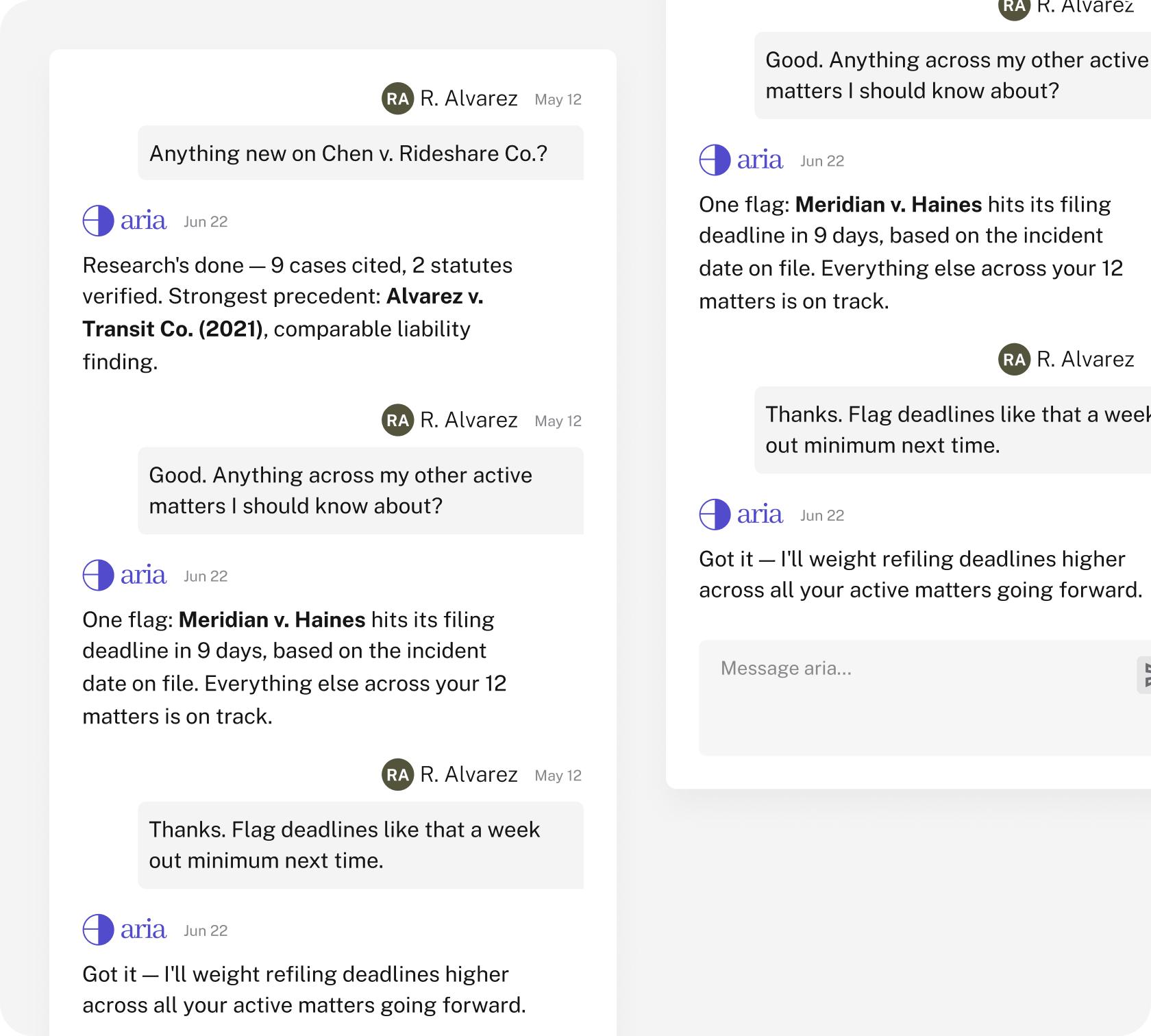
Every case file analyzed. Every citation verified. Before opposing counsel finishes reading the complaint.
ARIA processes research, flags risk, and routes work, learning from every attorney decision until the first draft is already the right draft.
Deal Lawyers
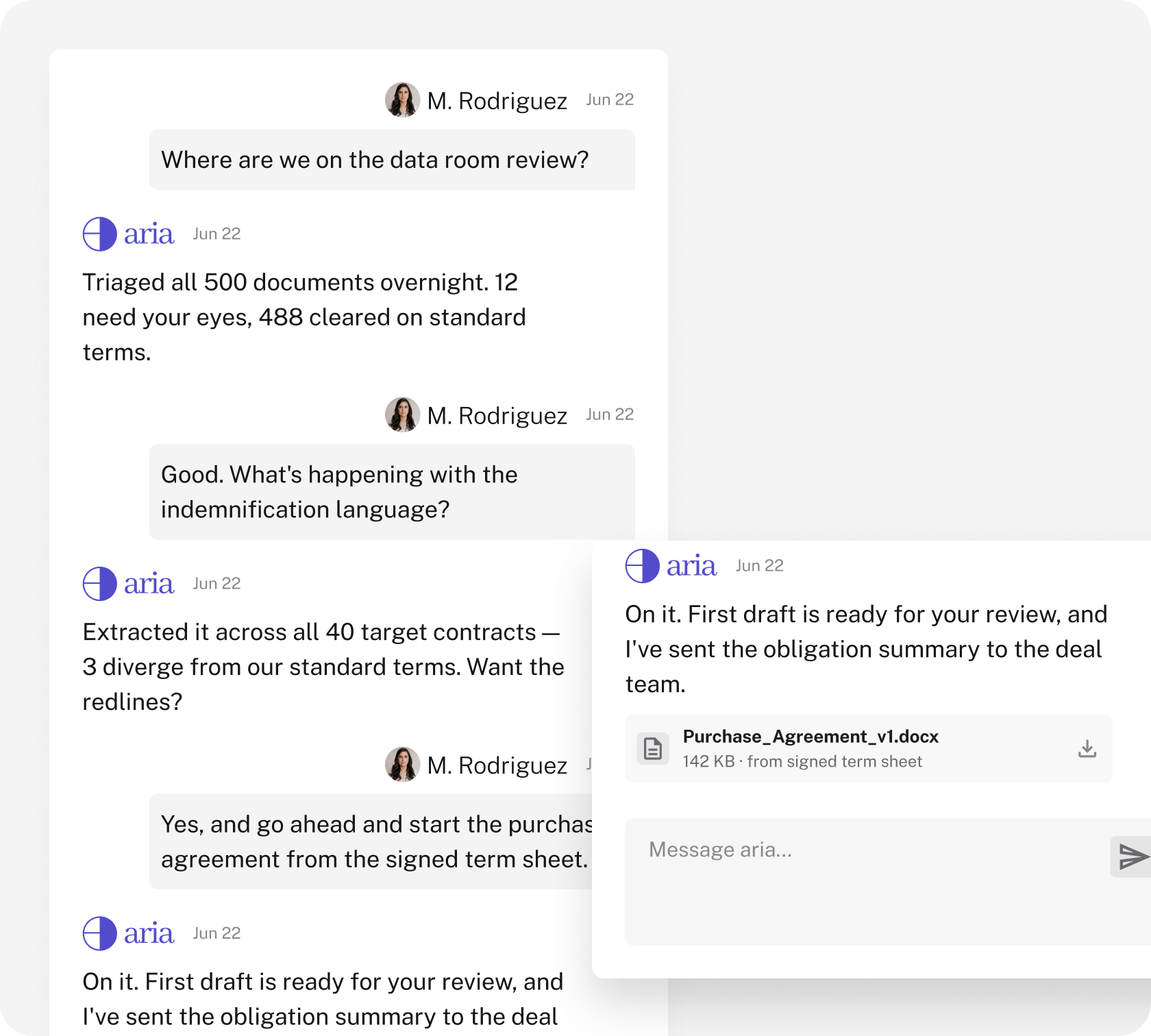
Five hundred legal documents, analyzed before the other side blinks.
AI-powered document review at due diligence speed, clause-level precision, no detail lost.
In-house Counsel
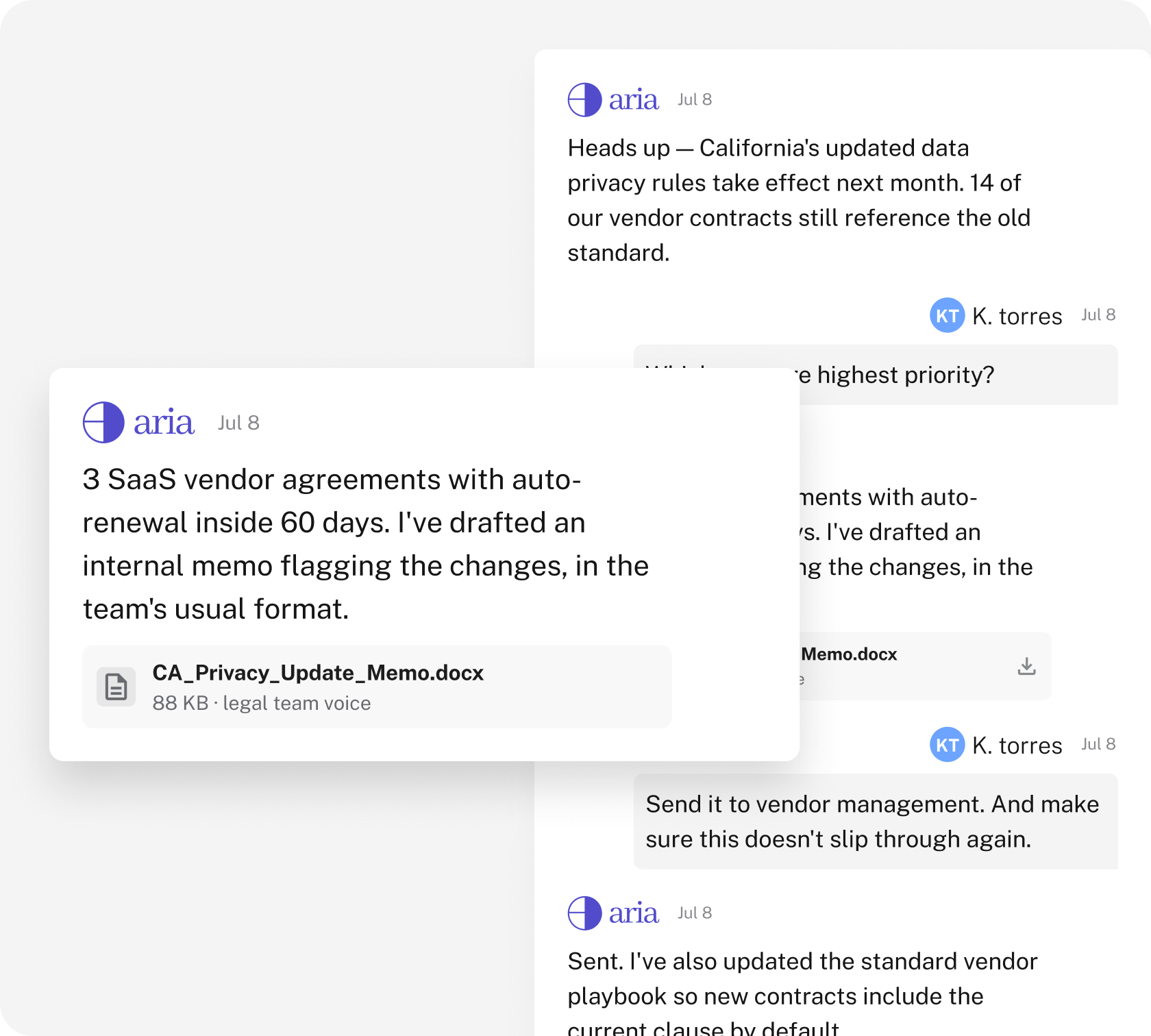
Legal AI built for volume. Compliance that keeps pace. High-frequency contract review, jurisdiction-aware workflows, and internal memos that sound like your legal team wrote them, because the AI learned from them.
Partners
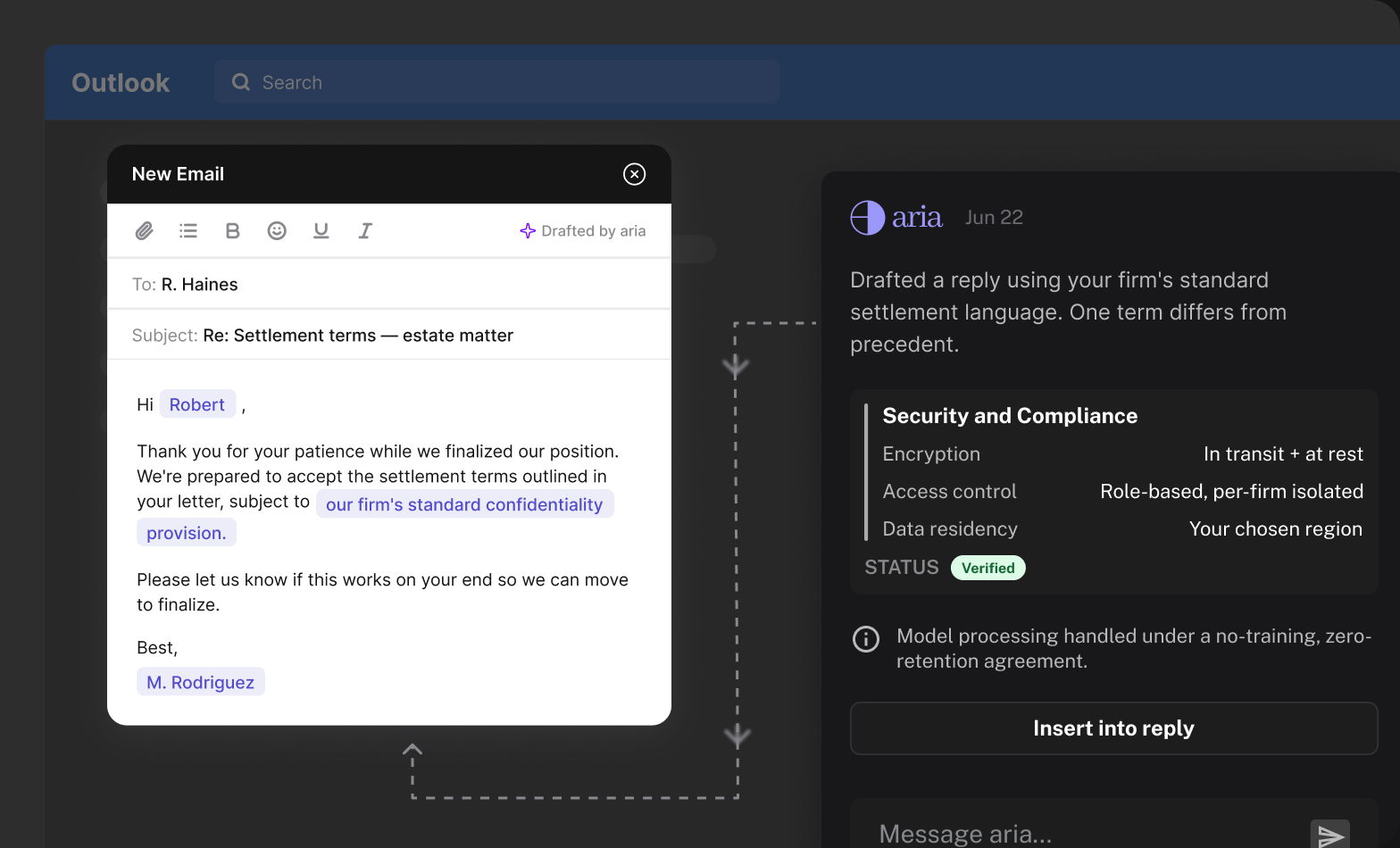
Your standards, enforced before the work reaches your desk.
ARIA's legal AI learns how your practice thinks, so first drafts arrive ready to sign off, not ready to rebuild.
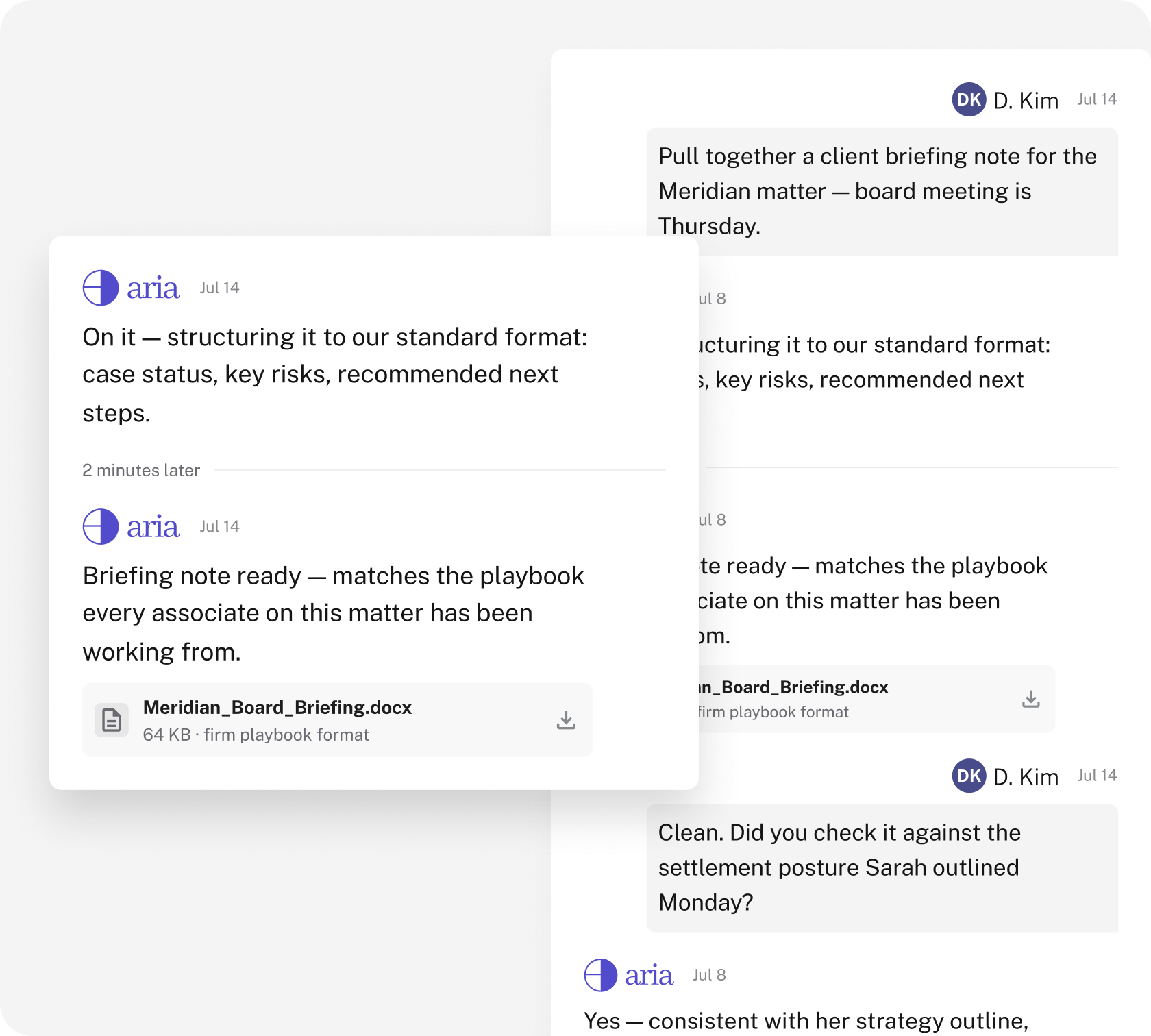
Judiciary
Every citation checked. Every precedent is traceable.
ARIA surfaces the legal authority behind each decision — so the bench moves faster without moving on faith.
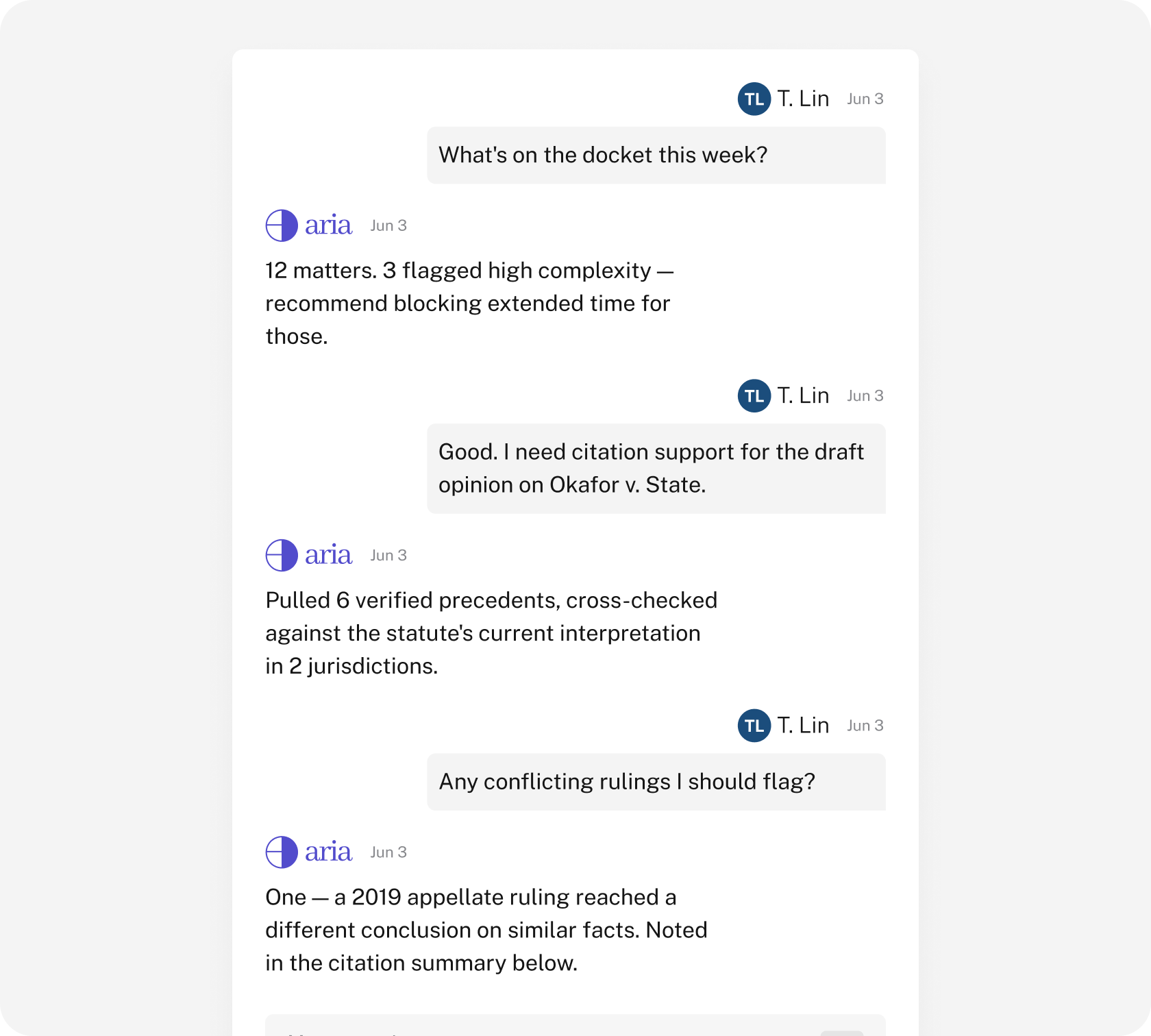
Researchers
Doctrine moves. ARIA keeps pace with it.
Track how law evolves across jurisdictions, map citation authority, and produce scholarship that holds up to scrutiny — without spending weeks buried in sources.
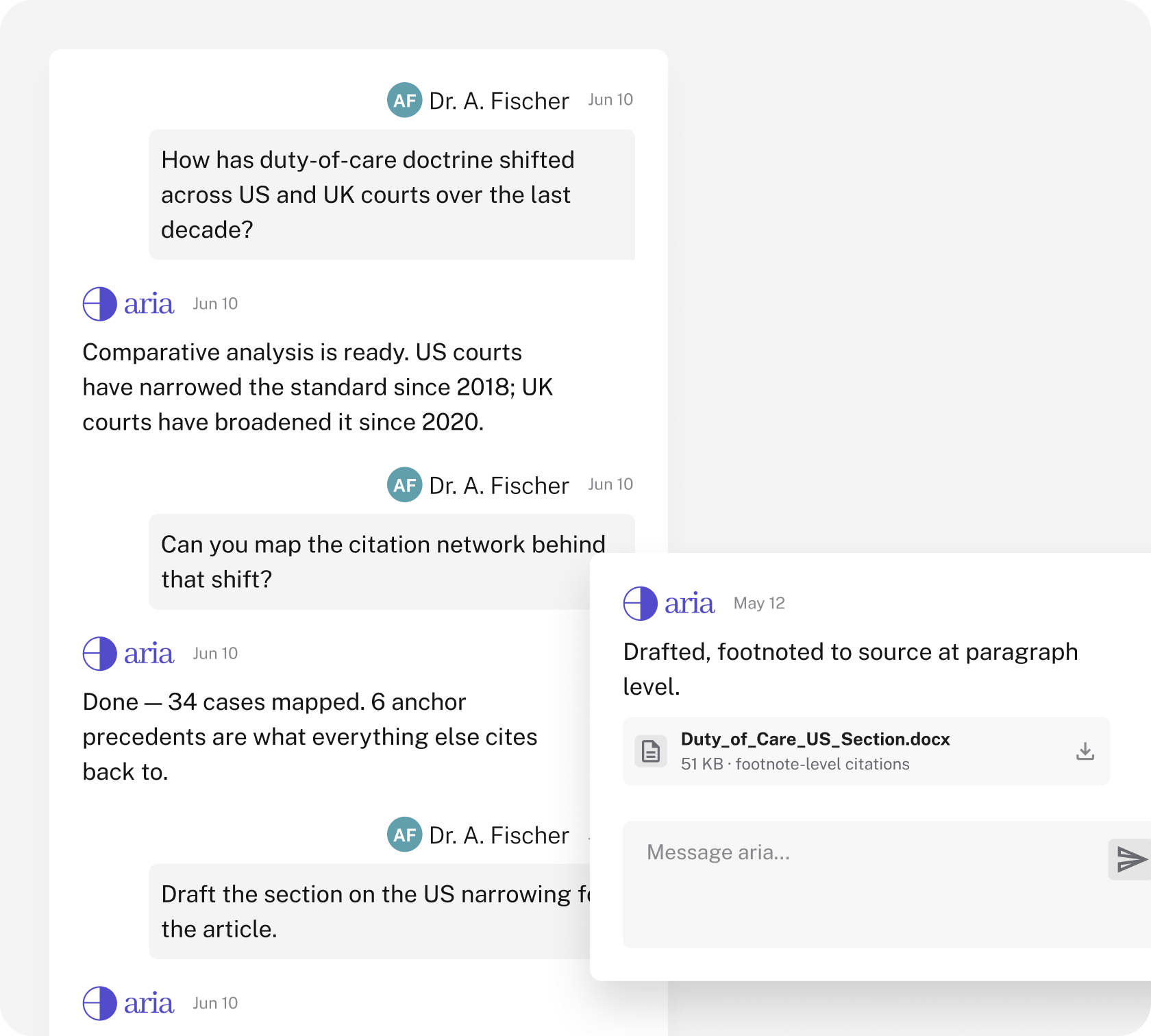
Not sure where to start? Begin with the AI Pathfinder Assessment.
Identify your highest-ROI agent opportunities, assess data readiness, and build an implementation roadmap.
Faster response Fewer lost clients
A prospect who submits at 6pm on Friday gets a response before they contact a second firm. The conversation that used to happen Monday now happens in 90 seconds.
Smarter consultations Higher conversion
Attorneys who walk in prepared close more often. ARIA delivers the full intake summary before the meeting starts, so the first conversation is about the case, not the intake form.
Consistent follow-up Better retention
Clients rarely leave over the outcome. They leave over the silence in between. ARIA puts every active client on a communication cadence, so no one goes dark. Retention holds and referrals follow.
Built for legal.
Not adapted for it.
Most AI vendors learn legal terminology after the fact. DOOR3 has spent two decades inside Am Law 200 firms (Kirkland & Ellis, Paul Weiss, Cleary Gottlieb, Wilson Sonsini) learning what partners approve and what breaks under real legal workflows. That difference shows up in every decision ARIA makes.
Integrates with your legal tech stack. ARIA plugs into the document management systems and practice platforms you already use. No rip-and-replace. No migration project. No retraining. Your existing workflows stay intact, ARIA makes them faster.
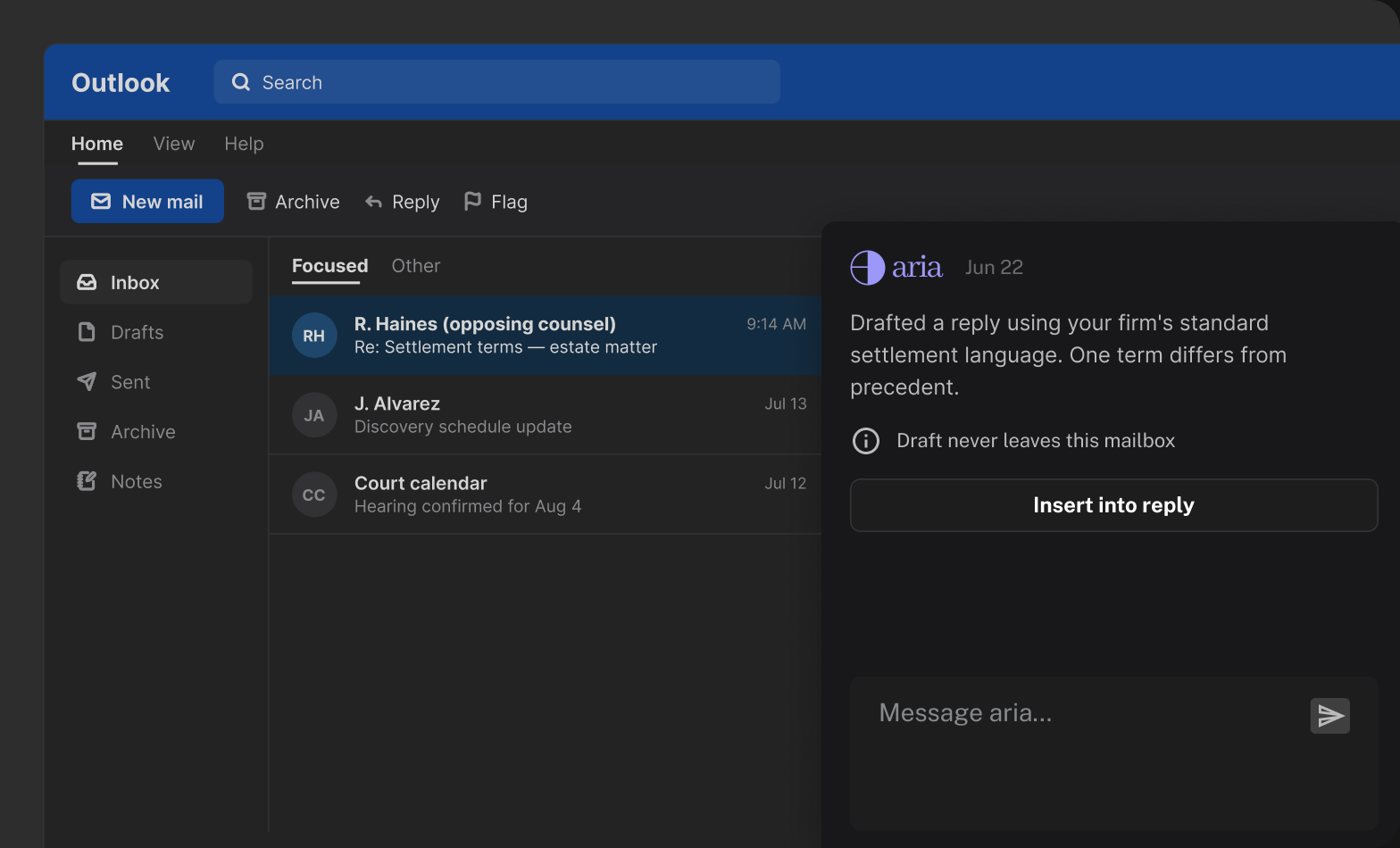
See our work“Cadwalader Connect allows us to leverage powerful tools to efficiently manage our business, strengthen internal and external relationships, provide efficient access to data, and deliver exceptional legal services to our clients.”
Fair questions. Straight answers.
ARIA is an advanced AI legal assistant built exclusively for legal services, not adapted from a general-purpose tool. It helps legal teams analyze documents, summarize case files, automate intake, and manage client communication. ARIA brings the full power of artificial intelligence to legal practice without compromising the standards your practice is held to.
Law firms using AI legal assistants save time on research, drafting, and document review, freeing attorneys for higher-value work. Routine tasks like intake, conflict checks, and client follow-up run automatically. Document analysis that once took days takes minutes. And unlike generic AI, tools built specifically for legal work keep sensitive data secure, citations traceable, and attorney-client privilege intact.
ChatGPT is a general assistant. ARIA is an agentic AI built specifically for lawyers. It connects to approved legal sources, firm knowledge, and workflow rules, and it is governed by AI principles that general tools ignore. It does not just generate text. It helps lawyers analyze documents, verify citations, and produce outputs that hold up under scrutiny.
ARIA is built on verified legal sources, not open web data. Every answer is traceable. Unlike generic AI tools, ARIA's legal features are designed to surface authority, flag uncertainty, and keep lawyers in control of every decision. The core design principle is simple: help lawyers do better work, not replace their judgment.
ARIA is designed to be secure at the architecture level. It is built to run inside your environment so your data stays under your control, attorney-client privilege is respected at every layer, and bar ethics rules on AI use are addressed before a single line of code ships. ARIA helps you modernize your practice without trading confidentiality for convenience.
ARIA is priced based on firm size, practice area, and the AI features your team needs. Each implementation is configured around your systems, workflows, and governance requirements. Contact us for a tailored quote that fits your legal services model and growth stage.
Getting access starts with a short discovery call. From there, ARIA is configured to your firm's environment and integrated with your existing stack. Pilot workflows can launch in weeks, and broader rollout depends on integration scope. It is designed to reduce implementation overhead, not add another disconnected tool.
ARIA is built to analyze documents across the full spectrum of your work: contracts, briefs, pleadings, deposition transcripts, regulatory filings, case law, and more. It can summarize lengthy files, extract key clauses, and surface relevant precedent, giving you faster, sharper insight from every document it touches.
Yes. ARIA is designed to handle high-volume, sensitive material. Upload discovery documents, exhibits, and full case files, and let ARIA summarize, organize, and surface what matters. All uploads are processed inside your secure legal environment, with confidentiality and data protection built into the architecture rather than left to policy.
Most AI tools are built for general use and adapted for legal work after the fact. ARIA is an agentic AI assistant for lawyers from the ground up. It is trained on legal sources, governed by AI principles specific to legal practice, and designed to produce outputs that attorneys can actually rely on and act from.
Implementation is faster than most firms expect. ARIA integrates into your existing workflows without disrupting day-to-day operations. Firms typically go live within two to four weeks. The goal is to help you adopt AI without the overhead, and start saving time from the very first matter.
Let's see what ARIA could handle for your firm.
A 30-minute call to map your intake, identify where ARIA fits, and outline what implementation looks like.

Request a free project quote
We will review your request and provide a project cost assessment within 1 — 2 working days.
Request a free project quote

