











linkedin

AI matter pricing agent for law firms

You can't quote a
fixed fee on work
you can't price.

MIRA is an AI agent that predicts transactional matter cost, duration, and staffing from your firm's own historical data, so AFAs become a competitive advantage, not a guess.

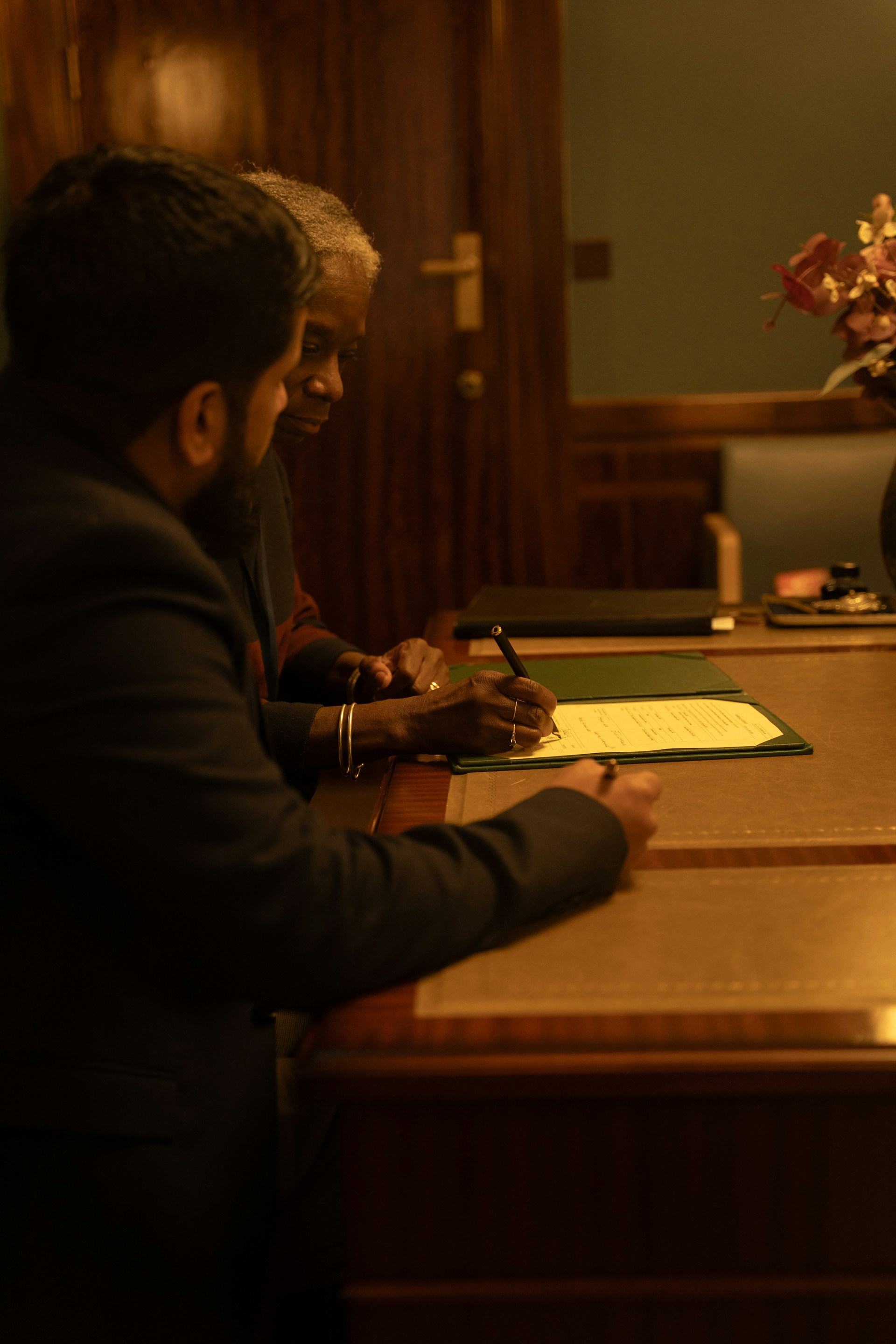
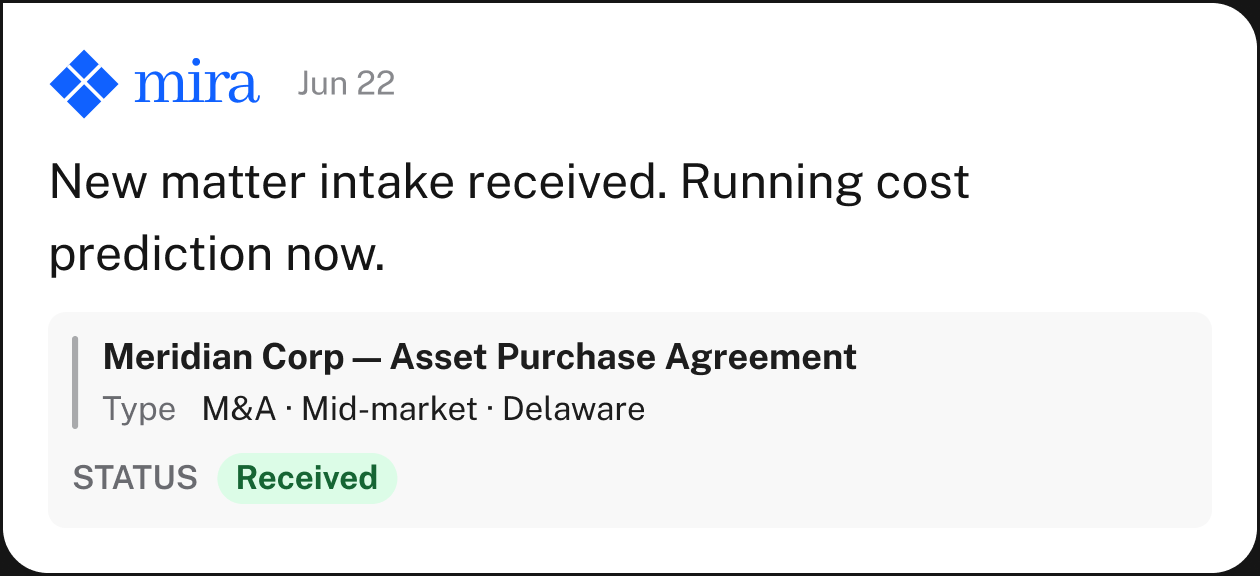
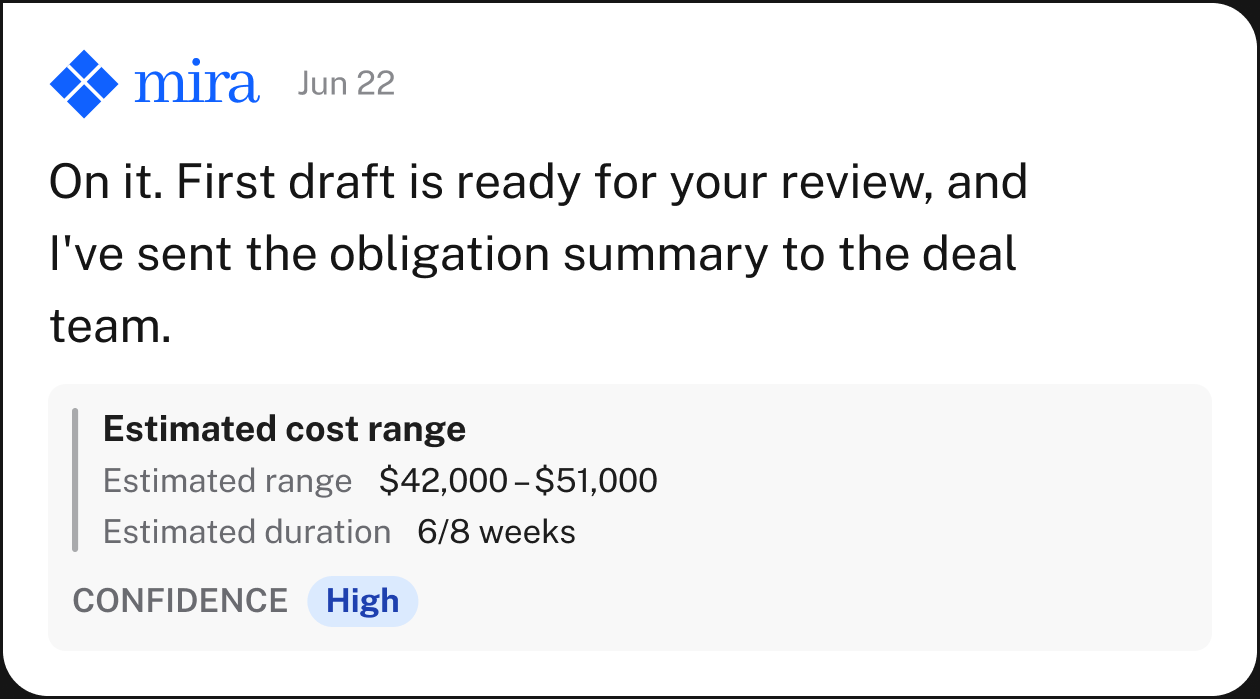
Two attorneys reviewing and signing a transactional matter file together MIRA notification: new matter intake received for the Meridian Corp asset purchase agreement, cost prediction running MIRA notification: first draft ready for review with an estimated cost range of $42,000 to $51,000 at high confidence

Trusted by leading law firms and legal teams across the Am Law 200

Kirkland & Ellis
Paul, Weiss
Nelson Mullins
Cadwalader
Akin
Lowenstein Sandler
Bryan Cave Leighton Paisner
Dorsey & Whitney
A&O Shearman
Schulte Roth & Zabel
Cleary Gottlieb
Best Best & Krieger

How MIRA’s AI matter pricing agent works

Three capabilities. One price you can stand behind.

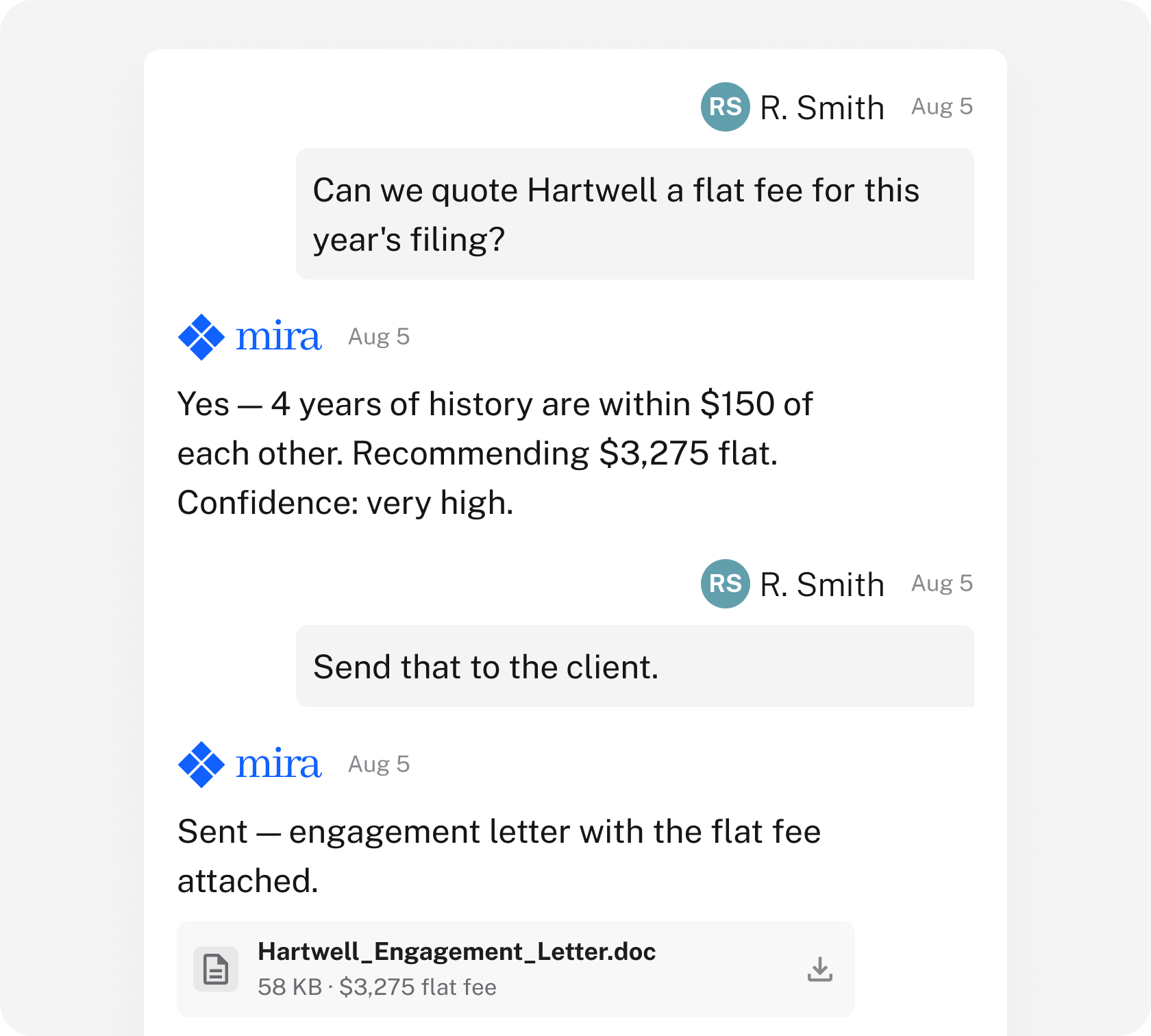
Cost prediction. An AI agent for legal pricing. MIRA predicts what a matter will cost before you open the file, learning from your firm’s own closed-matter history, jurisdiction, complexity, matter type, and opposing counsel, and returns a confidence range, not a guess.
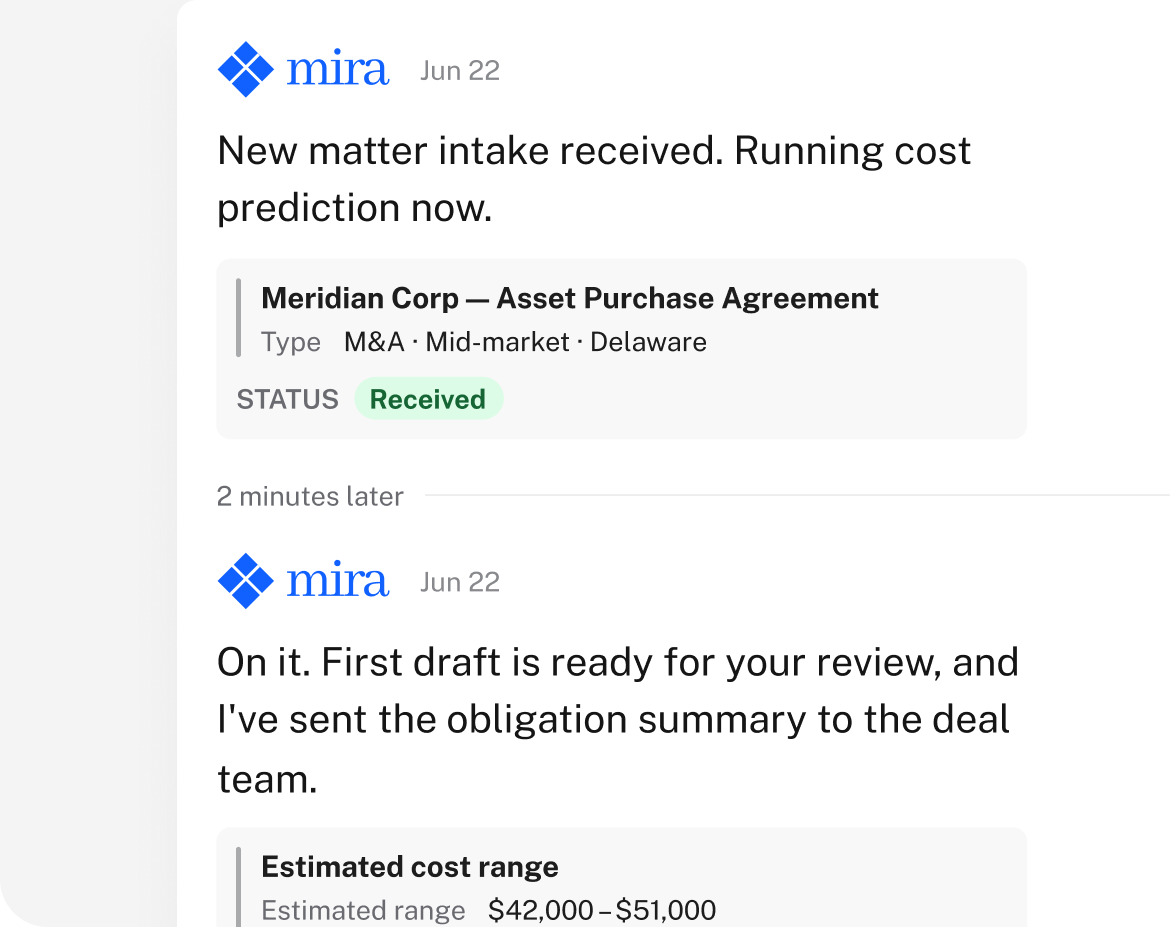
MIRA logging a new matter intake and returning an estimated cost range of $42,000 to $51,000 two minutes later

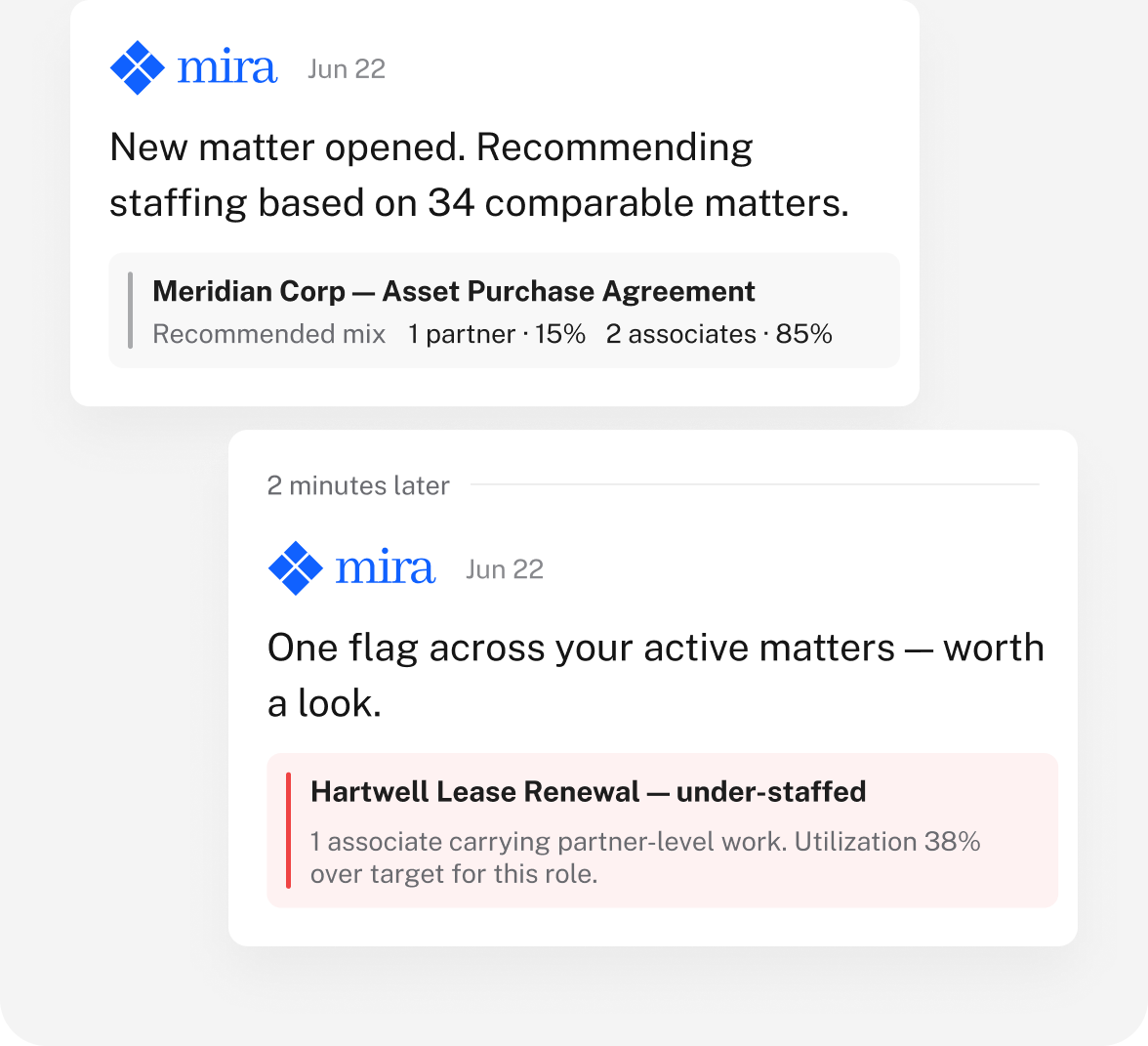
Staffing optimization. MIRA recommends the right mix of partner and associate time for the matter type, flags fee earners running over or under capacity, and tracks utilization to show which staffing actually stays profitable.

MIRA recommending a partner and associate staffing mix from 34 comparable matters and flagging an over-target utilization

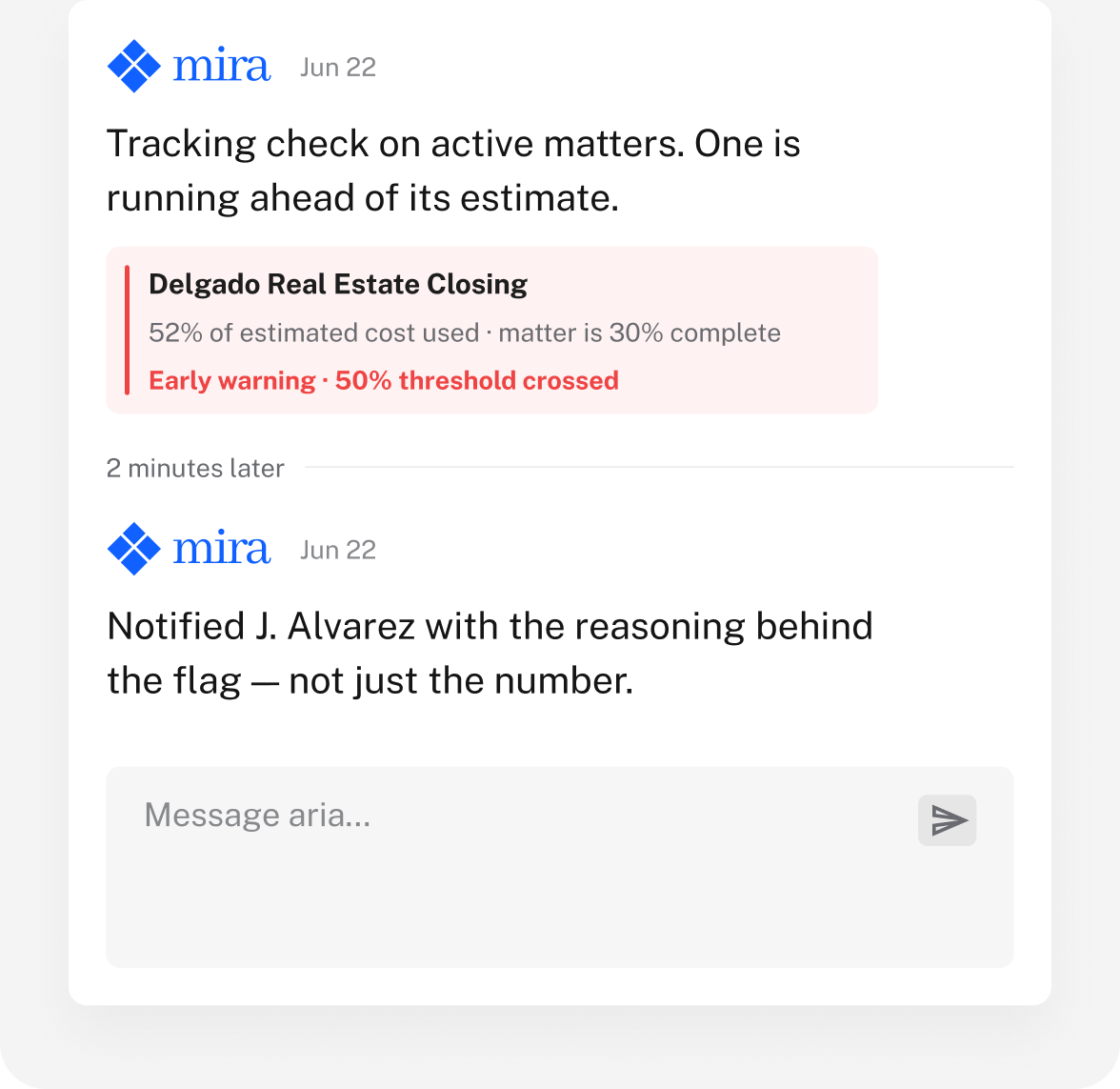
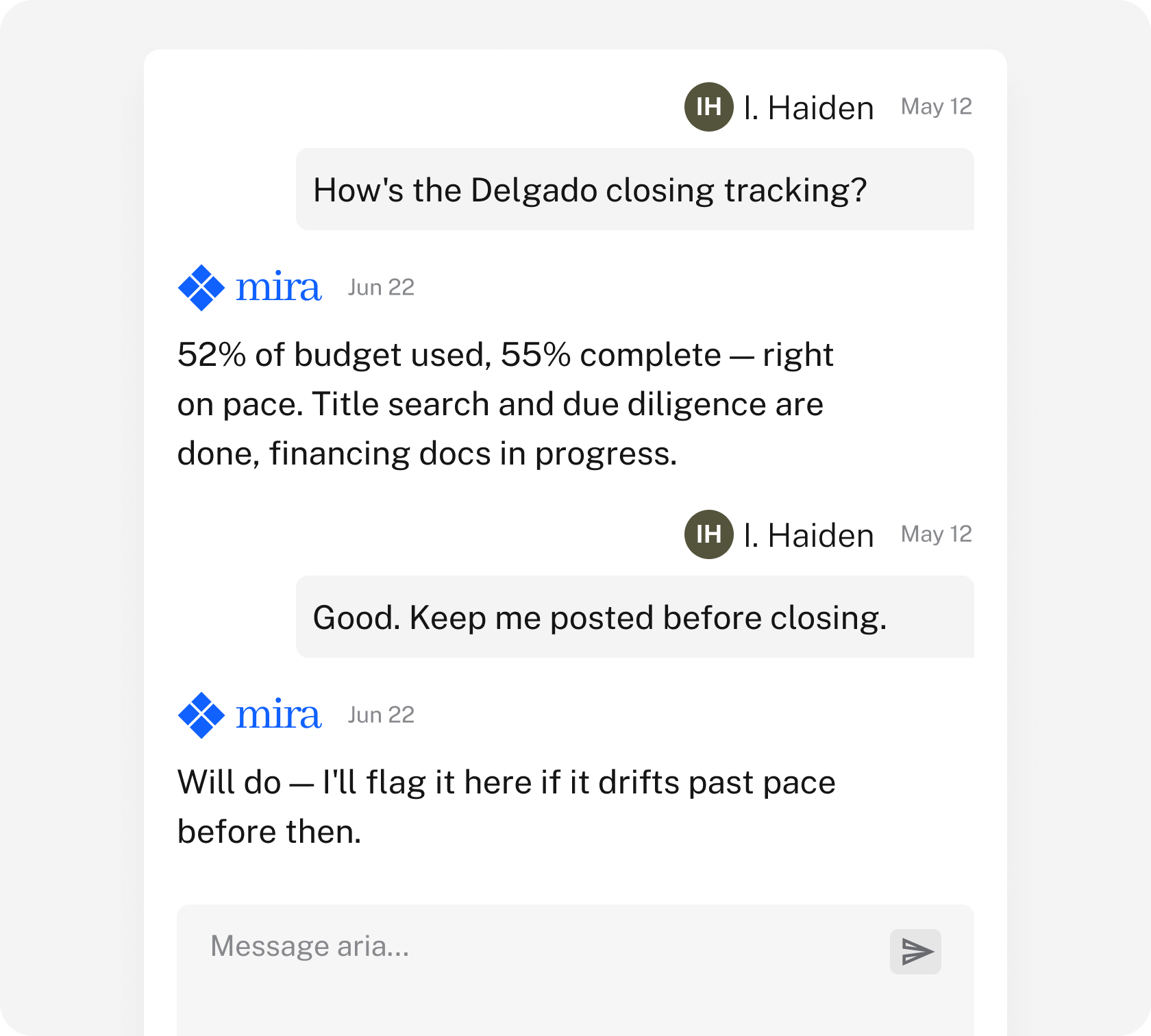
Budget alerts. MIRA flags matters tracking over budget at the 50% mark and notifies the partner with a plain-language explanation of why, never a black box.

MIRA raising an early warning that a matter crossed 50% of its estimated cost and notifying the partner with the reasoning

Why law firms need AI-powered matter pricing

Your biggest liability isn’t a lost case. It’s a bill nobody saw coming.

Guesswork,
priced
as fact.

Partners quote from memory. The same matter type gets wildly different estimates depending on who you ask — and the client only learns which guess was wrong after the invoice arrives.

Fixed fees, blind pricing.

Clients are asking for AFAs. The cost data exists — it’s just trapped across billing and matter systems you can’t query in the moment that matters.

The bill becomes the negotiation.

When a matter blows past budget, the invoice stops being paperwork. It becomes a conversation about trust — and some of those conversations end the relationship.

BigLaw wins on brand.

Mid-market firms can’t out-market BigLaw. They can out-price them — if they can stand behind the number before the matter opens.

MIRA doesn’t guess. It calculates. Every matter she processes makes the next prediction sharper.

Which legal matters can MIRA forecast

One model. Four groups where deals repeat.

Corporate & Commercial Transactions

M&A transactions · Commercial contracts · Corporate governance

Every deal priced before the term sheet is signed, not guessed after the closing binder is thick enough to know.

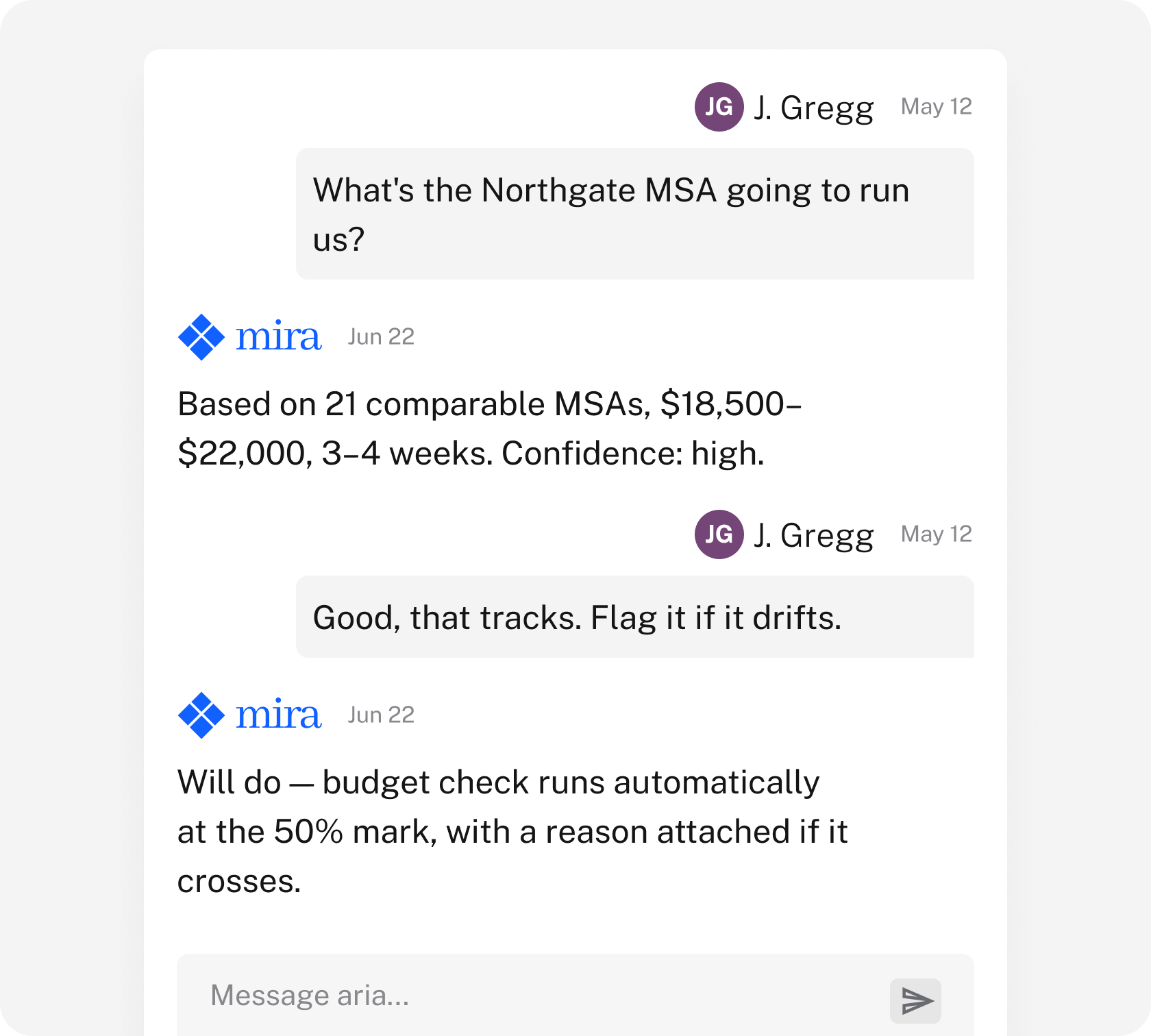
MIRA analyzes deal size, jurisdiction, and counterparty complexity against your firm's closed matter history, because the document formats and deal stages repeat, even when the negotiation doesn't.

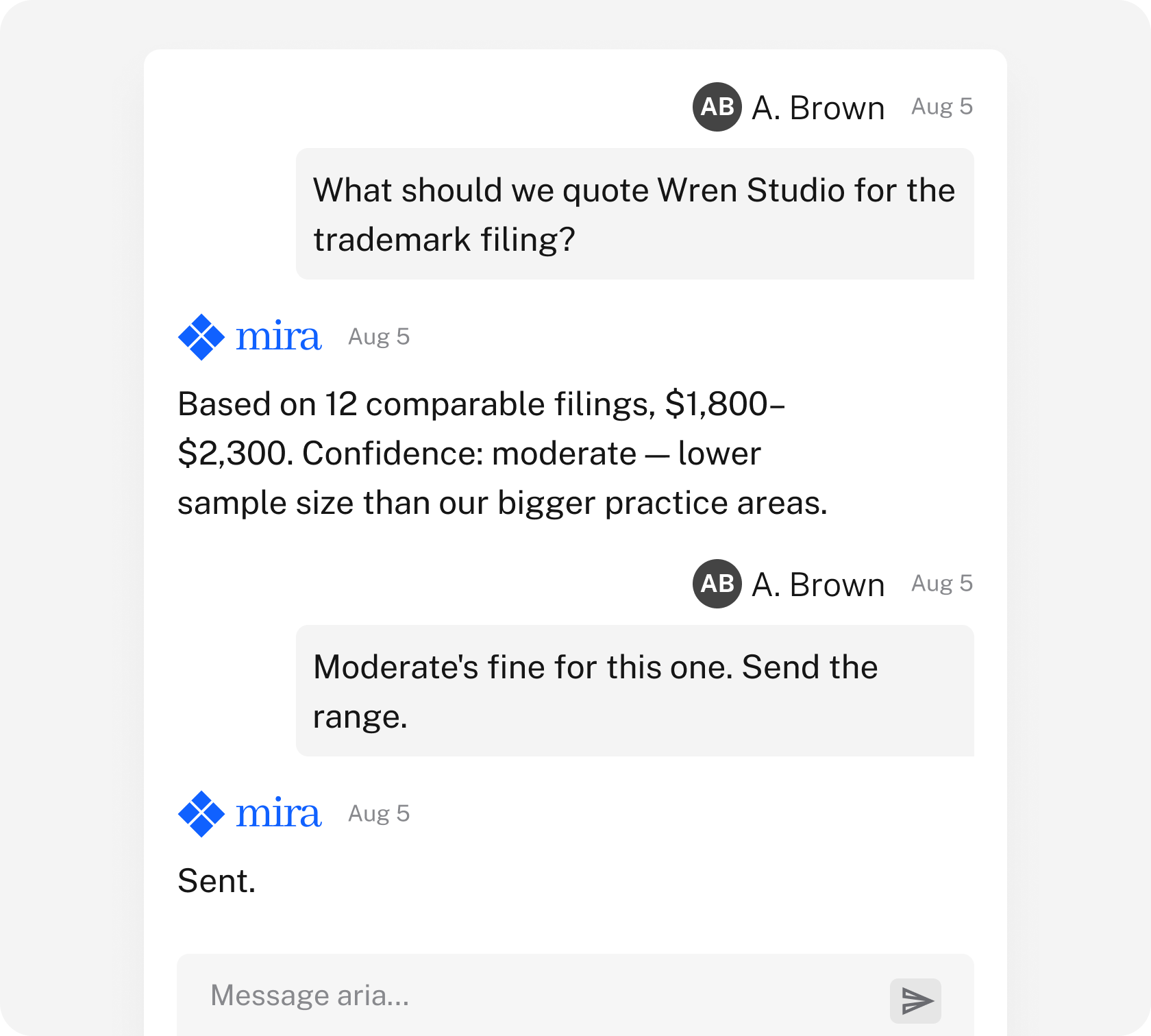
MIRA answering a partner’s question about an MSA with a cost range drawn from 21 comparable matters and a budget check at the 50% mark

Where MIRA doesn’t fit, on purpose.

Litigation · Arbitration · Criminal defense · Family law

These practices do use alternative fees today, usually contingency or capped structures that hedge against an uncertain outcome. MIRA solves a different problem: predicting the cost itself, which only works where the underlying process repeats. Litigation doesn’t have that.

From matter intake to budget monitoring

  1. Phase 1

    Intake

    A new matter enters the firm’s process. MIRA evaluates type, jurisdiction, and complexity.

  2. Phase 2

    Predict

    MIRA finds comparable matters in your history and generates a cost range, duration, and staffing mix.

  3. Phase 3

    Review

    The partner sees the reasoning, adjusts assumptions, and picks the fee structure.

  4. Phase 4

    Monitor

    Once the matter opens, MIRA tracks actual cost against budget and explains any drift.

  5. Phase 5

    Learn

    Closed matter data feeds back into the model, sharpening the next prediction.

Not sure where to start? Begin with the AI Pathfinder Assessment.

Identify your highest-ROI agent opportunities, assess data readiness, and build an implementation roadmap.

Timeline: 4-6 weeks

AI matter pricing

Business outcomes of
AI-powered legal pricing

Pricing certainty Offer AFAs

Historical data replaces partner intuition, quote fixed fees with confidence, not a guess dressed up as one.

Client retention Fewer disputes

Bills match expectations. Clients stay. The relationship survives the engagement instead of ending at the invoice.

Competitive edge Win on pricing

Mid-market firms can’t out-market BigLaw. They can out-price them, and pricing certainty is the close.

Why DOOR3 legal AI pricing agent

AI legal pricing built around your firm’s systems

Most AI vendors learn legal terminology after the fact. DOOR3 has spent two decades inside Am Law 200 firms, building the billing and matter systems mid-market firms actually run on. That difference shows up in every prediction MIRA makes.

Integrates with the systems you already bill through. DOOR3 has spent years building the billing and matter systems mid-market firms actually run on. MIRA doesn’t ask you to migrate anything, it connects directly to Aderant, Elite, Clio, and Thomson Reuters 3E, and reads matter context from iManage or NetDocuments where it needs precedent.

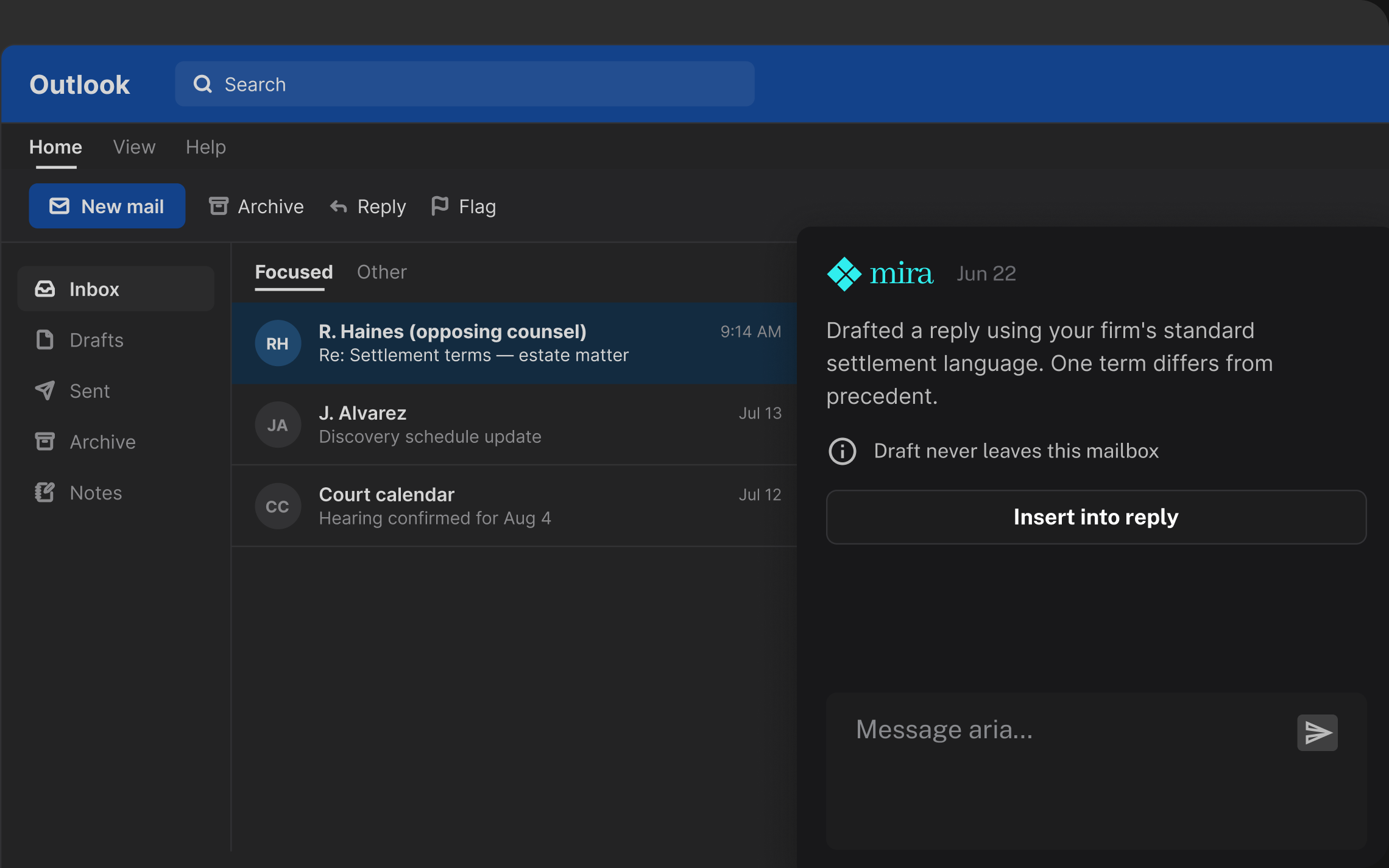
MIRA drafting a settlement reply inside an Outlook mailbox from the firm’s own precedent, without the draft leaving the mailbox

A prediction you can see the reasoning behind. MIRA doesn’t predict on day one. DOOR3 assesses whether your firm has enough historical signal first, a minimum of 5 years of closed matter data with final costs, before any model gets built. And once it does predict, partners see the reasoning, not just a number.

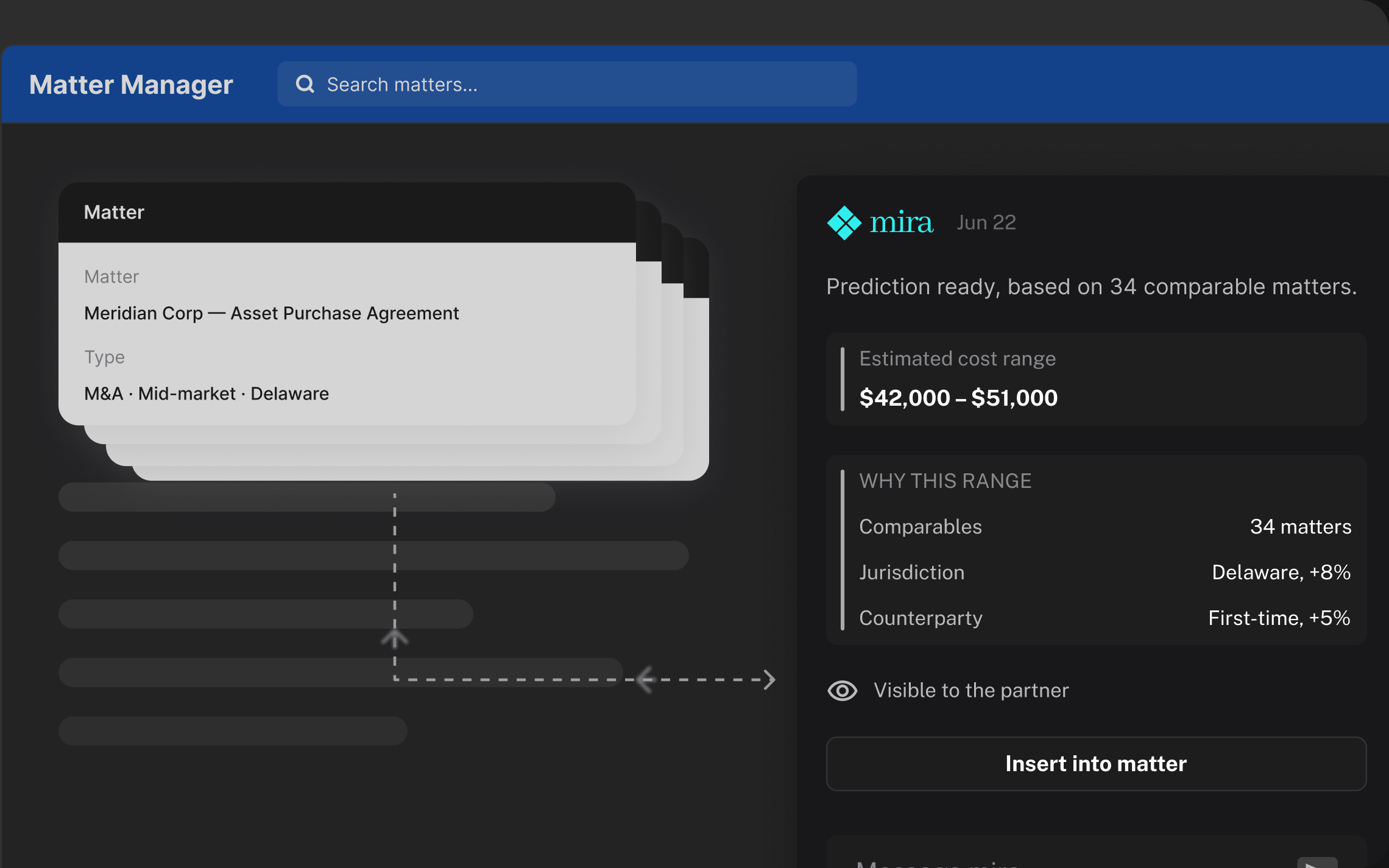
MIRA showing an estimated cost range inside a matter manager alongside the comparables, jurisdiction and counterparty factors behind it

“Cadwalader Connect allows us to leverage powerful tools to efficiently manage our business, strengthen internal and external relationships, provide efficient access to data, and deliver exceptional legal services to our clients.”

Patrick Quinn, Managing Partner, Cadwalader
See our work

FAQ’s about MIRA’s AI matter pricing agent

Fair questions. Straight answers.

What is MIRA?

MIRA is DOOR3's AI agent for transactional matter cost prediction. It analyzes new matter details against your firm's own historical closed-matter data to predict cost, duration, and optimal staffing — so you can offer fixed fees and AFAs with confidence instead of a guess.

How does MIRA actually predict a matter's cost?

MIRA learns from your firm's closed matters — jurisdiction, complexity, matter type, opposing counsel, and final cost — and returns a confidence range for the new matter, not a single number. The more comparable history your firm has, the tighter that range gets.

Why does MIRA give a range instead of one number?

Because a single number pretending to be certain is exactly the problem MIRA replaces. A range with a confidence level tells you honestly how much the prediction can be trusted — high confidence for well-documented matter types, moderate for lower-volume ones.

Why doesn't MIRA cover litigation?

Cost prediction depends on process consistency. Litigation involves judges, juries, opposing counsel strategy, and settlement dynamics — variables no historical model can reliably account for. MIRA works where the underlying process repeats: M&A, commercial contracts, real estate, lending, corporate governance, and similar transactional work.

How much historical data does our firm need before MIRA can predict anything?

A minimum of 5 years of closed matter data with final costs. Before any model is built, DOOR3 runs a data readiness assessment — if your firm's history isn't sufficient yet, we tell you that upfront, not after you've paid for a model that can't perform.

Is MIRA just averaging our past invoices?

No. MIRA weighs each closed matter by how comparable it actually is — jurisdiction, complexity, and counterparty factors all shift the prediction, the same way an experienced partner would adjust an estimate mentally, except MIRA does it consistently across every matter, not just the ones a given partner happens to remember.

Does MIRA replace a partner's judgment on staffing or pricing?

No. MIRA recommends a staffing mix and a cost range — partners see the reasoning behind every prediction, not just the output, and make the final call. MIRA is built to remove guesswork, not oversight.

How does MIRA keep our billing and matter data secure?

MIRA connects directly to the systems you already use — Aderant, Elite, Clio, Thomson Reuters 3E — and reads matter context from iManage or NetDocuments where needed. Your data stays inside your own environment; MIRA doesn't require migrating anything to a new system of record.

What does MIRA cost, and what's included?

Pricing depends on firm size, practice mix, and how much historical data needs to be assessed and modeled. Every engagement starts with the data readiness assessment — contact us for a quote scoped to your firm's actual practice areas and data maturity.

How long does it take to get MIRA running?

It starts with the data readiness assessment, which typically takes 1-2 weeks. From there, model training and integration timelines depend on how many practice areas you're predicting for and how clean your historical data is — DOOR3 scopes this with you before any commitment, not after.

Let’s see what your matters actually cost.

A short conversation about your billing data is enough to know if MIRA can predict from it. No commitment until we’ve confirmed the fit.

Door3.com