AI legal assistant vs legal chatbot: what is the difference?
08.13.2026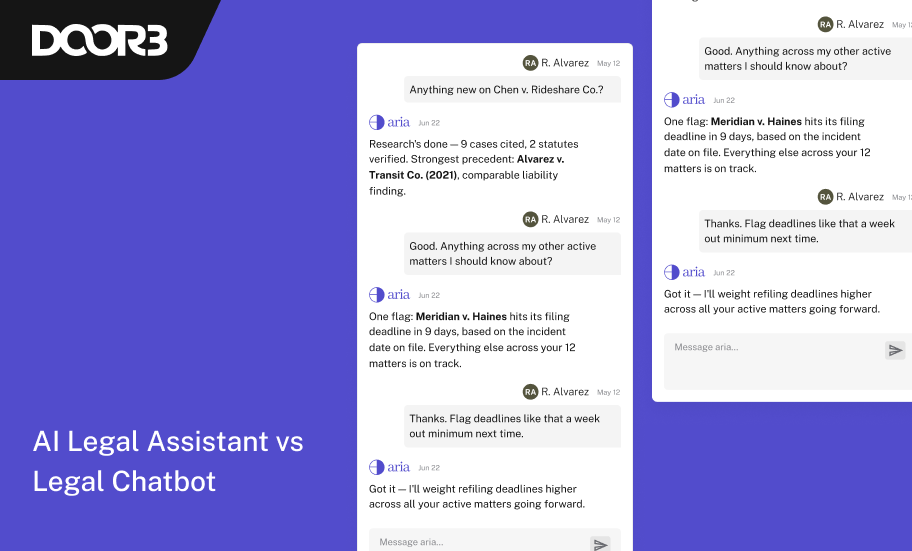
Key takeaways
- AI legal assistants and legal chatbots are not interchangeable. An AI legal assistant supports internal legal work, while a legal chatbot handles public-facing questions, client intake, and basic information.
- AI legal assistants help lawyers with legal research, document analysis, contract review, drafting, and other complex tasks involving confidential or matter-specific data.
- Legal chatbots are designed primarily for non-lawyers. They can answer FAQs, collect information, and direct users to appropriate resources, but should not provide tailored legal advice.
- A chat-based interface does not automatically make a tool a chatbot. The key differences are its intended users, data access, system integrations, capabilities, and guardrails.
- Law firms may benefit from using both tools, but each requires separate success metrics, data controls, governance policies, and human oversight.
- Organizations should choose based on the workflow they need to improve—not the product label used by the vendor.
The legal tech market has grown rapidly, and two terms keep appearing in product descriptions, procurement discussions, and vendor pitches: the AI legal assistant and the legal chatbot. Both rely on artificial intelligence, yet they serve fundamentally different purposes, audiences, and workflows. Understanding the distinction between an AI-powered legal assistant and a chatbot built for legal queries is essential before any organization commits budget or shares sensitive data with a new tool.
AI legal assistant vs legal chatbot at a glance
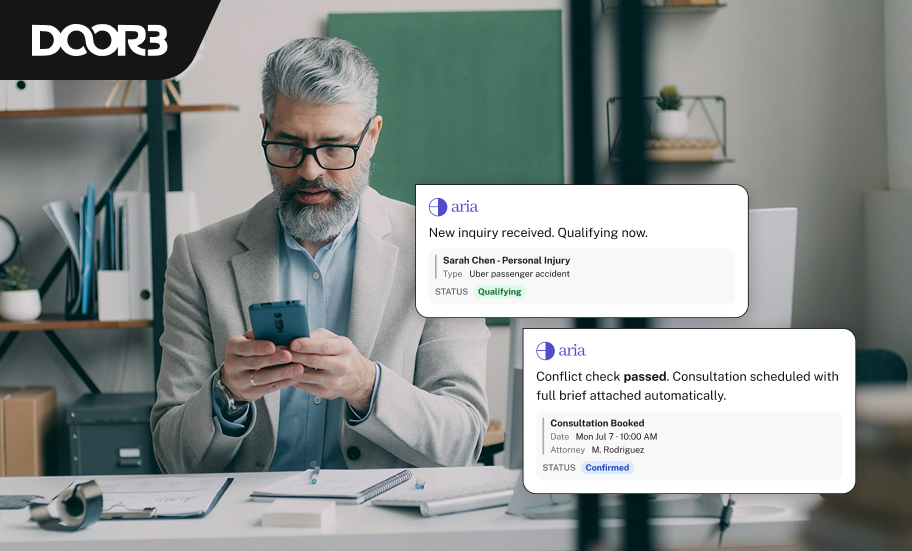
An AI legal assistant is a workflow and automation tool designed for legal professionals. It supports legal workflows and handles complex, multi-step work such as contract review, legal research, and document drafting. A legal chatbot, by contrast, is a conversational interface that responds to straightforward questions from clients, website visitors, or internal staff. Think of one as a behind-the-scenes productivity engine and the other as a front-door concierge. The confusion between them is understandable because both use natural language processing, but their design goals, data sources, and risk profiles differ significantly.
What is an AI legal assistant?
An AI legal assistant is legal software built to support lawyers, paralegals, and in-house counsel with substantive legal work across law firms and legal departments. It typically integrates with a firm's document management system, legal operations platform, practice management platform, knowledge base, or other AI systems. Rather than answering a single question in isolation, it can process large volumes of text, identify relevant clauses, flag risks, and suggest edits within a matter-specific context.
Who uses an AI legal assistant?
The primary users are legal professionals: associates reviewing due diligence documents, in-house teams managing contract portfolios, and paralegals preparing first drafts of pleadings. These users already possess legal training; the tool is intended to help legal professionals accelerate routine legal ops work within their legal practice rather than replace their judgment.
What can an AI legal assistant do?
- Summarise lengthy contracts and highlight non-standard terms, including change of control clauses
- Draft initial versions of agreements, letters, or memos
- Search internal precedent banks and licensed case law sources for relevant templates and authorities
- Cross-reference regulatory requirements against existing policies for specific legal tasks
- Use extraction to capture key legal data points from hundreds of documents during M&A review
What information does it work with?
An AI legal assistant typically operates on proprietary, confidential data: client files, internal precedents, matter-specific correspondence, and regulatory databases licensed by the firm. Some tools use LLMs to interpret this material, which is what separates them from a general-purpose AI tool. The data environment is controlled, with clear rules for the use of AI, and the outputs are intended for professional review before use.
What is a legal chatbot?
Legal AI chatbots are conversational interfaces that answer common legal questions in plain language. They sit on a website, a client portal, or an internal help desk and respond to queries through a chat window. The interaction is usually short, structured, and designed to resolve simple issues without requiring a human to step in.
Who interacts with a legal chatbot?
The audience is typically non-lawyers: prospective clients visiting a law firm's website, employees checking a company's internal policies, or members of the public seeking basic legal information. The chatbot is designed for people who do not have legal training and need guidance in accessible language.
What can a legal chatbot do?
A well-built legal chatbot can automate responses to frequently asked questions about legal processes, help users determine whether they need a lawyer, collect intake information before a consultation, and direct visitors to the correct department or resource. This can free staff from repetitive triage. A user's prompt may also trigger a simple document, such as a confidentiality agreement, built from a pre-approved template.
What should a legal chatbot not do?
A legal chatbot should not provide specific legal advice tailored to an individual's circumstances or make substantive legal decisions. Doing so creates regulatory risk, potential liability, and ethical concerns around the unauthorised practice of law. It should also not access or reveal confidential client data. Clear disclosure of the tool's limitations helps users understand that its role is informational and navigational, not advisory.
The key differences between an AI legal assistant and a legal chatbot
The distinction is not merely technical. It reflects different goals, user expectations, and governance requirements.
Internal legal work vs external communication
An AI legal assistant supports internal workflows. It helps lawyers do their jobs faster and with greater consistency. A legal chatbot faces outward. It communicates with people outside the legal team or even outside the organization. For a global legal team, this difference in audience shapes everything from the language the tool uses to the security controls it requires.
Internal legal work vs external communication
The directional flow of information also differs. An AI assistant pulls data inward, processing documents and research for internal consumption. A chatbot pushes information outward, delivering answers to external or non-specialist users. Misunderstanding this distinction can lead organizations to deploy the wrong tool for the wrong purpose, creating both efficiency and compliance problems.
Matter data vs public-facing information
An AI legal assistant works with confidential, matter-specific data: contracts, case files, privileged communications. A legal chatbot draws from publicly available or pre-approved content such as FAQs, general legal guides, and intake forms. Mixing these data environments without proper controls is one of the most common mistakes organizations make during implementation.
Different measures of success
Success for an AI legal assistant is measured in time saved on substantive tasks, reduction in review errors, and consistency of output across a team. Success for a legal chatbot is measured in user satisfaction scores, deflection rates (queries resolved without human intervention), and lead conversion for firms using it as a client intake tool. To evaluate whether either tool delivers effective AI support, teams should define these measures before deployment.
Can an AI legal assistant also be a chatbot?
Yes, but the overlap is narrower than most vendors suggest. Some platforms offer a chat-based interface for their AI assistant, allowing lawyers to ask questions in natural language rather than navigating menus. That does not make the tool a chatbot in the traditional sense. The underlying architecture, data access, and intended user remain those of a professional assistant. Similarly, a sophisticated legal chatbot might use the same large language model as an AI assistant, but its guardrails, data sources, and output constraints are configured for a non-specialist audience. The interface may look similar; the engineering underneath is not.
Does your organization need an AI legal assistant, a legal chatbot, or both?
The answer depends on where your bottlenecks sit and who you are trying to serve.
Choose an AI legal assistant when
- An AI legal assistant can help when your legal team spends excessive hours on document review, research, or first-draft creation
- You need to process large volumes of contracts or regulatory filings and ask your AI legal assistant questions grounded in those materials
- You need an AI-assisted process that improves consistency across legal output
- You need an AI-assisted process that improves consistency across legal output
- Your existing technology stack can integrate securely with confidential data, and you can define who may use the AI in production
Choose a legal chatbot when
- Your firm receives a high volume of repetitive enquiries from prospective clients
- Employees frequently ask the same policy-related questions
- You want to streamline client intake before a human consultation
- You need a 24/7 presence on your website or portal
Consider both when
Your organization has distinct internal efficiency goals and external communication needs. A mid-size law firm, for example, might deploy an AI assistant for its associates while running a chatbot on its website to qualify leads. The two tools serve different audiences and should be governed by separate policies.
Risks and governance requirements for a legal chatbot vs AI assistant
Both tools carry risk, but the nature of that risk differs. An AI legal assistant handles privileged and confidential information, so data security, access controls, auditability, and audit trails are paramount. Firms must verify where the data is processed, whether it is used to train the model, and who within the organization can access outputs. Vendor diligence may also include reviewing independent controls and evidence such as SOC 2 Type 2 certification, where relevant.
A legal chatbot carries reputational and regulatory risk. If it provides inaccurate information or crosses the line into specific legal advice, the organization may face complaints, liability claims, or scrutiny from regulators. Every AI-generated response should be checked against approved content, and disclaimers should be clear and prominent. Governance frameworks should treat these as two separate risk categories rather than a single "AI policy."




Final takeaway: choose the workflow, not the label
The real question is not whether to adopt an AI legal assistant or a legal chatbot. It is which workflows you want to improve and for whom. An AI assistant accelerates the work of trained professionals handling sensitive matters. A chatbot improves the experience of non-specialists seeking basic guidance. Conflating the two leads to poor procurement decisions, misaligned expectations, and governance gaps. When evaluating legal tools, start by mapping your processes, identifying your users, and defining what success looks like for each group. The right tool follows from the right question.
Frequently asked questions
Is a legal chatbot the same as an AI legal assistant?
No. AI legal assistants are increasingly used as professional-grade tools that support complex legal work with confidential data. A legal chatbot is designed for simpler, public-facing interactions. They may share underlying technology but differ in purpose, audience, and risk profile.
Can a legal chatbot provide legal advice?
A legal chatbot should not provide specific legal advice. It can offer general information, direct users to appropriate resources, and collect intake data. Providing tailored advice without proper licensing exposes the organization to regulatory and liability risks.
Can an AI legal assistant replace a lawyer or paralegal?
Not in 2026. An AI legal assistant accelerates and augments the work of legal professionals, but it does not exercise independent legal judgment. Human review remains essential for accuracy, ethical compliance, and client accountability.
Can law firms use both an AI assistant and a chatbot?
Absolutely. Many firms deploy an AI assistant internally for contract lifecycle management (CLM), research, and drafting while running a chatbot on their client-facing platforms. The key is to govern each tool separately, with distinct data policies and oversight structures.
How should law firms protect client data when using legal AI?
Firms should verify data residency, confirm that client data is not used for model training, enforce role-based access controls, and maintain audit logs. Vendor contracts should include explicit data processing agreements, and firms should conduct periodic reviews of how each tool handles information.