How to Overcome the Biggest AI Implementation Challenges
10.07.2026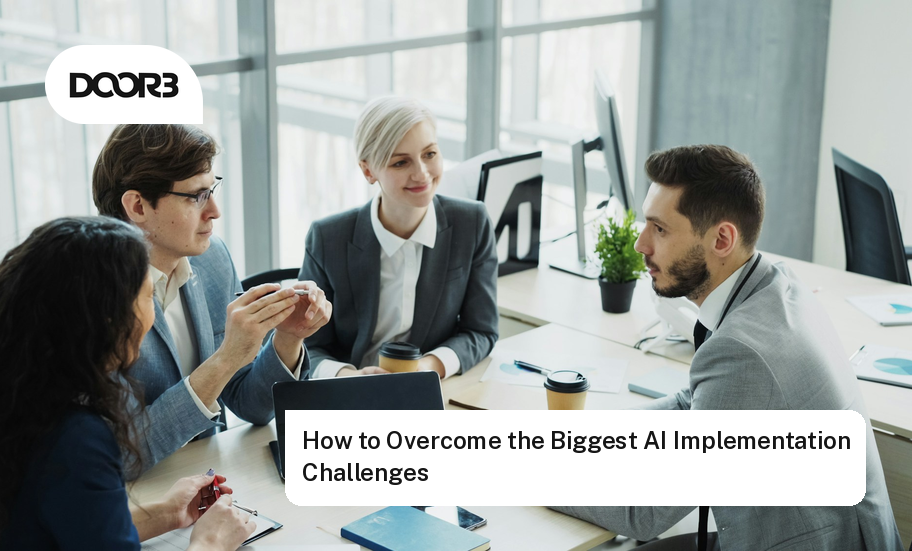
Key Takeaways
- Most AI implementation challenges are organizational, not technical. Data gaps, unclear ownership, and missing measurement stop more projects than model quality ever does.
- Fix the workflow before the model. Teams that map the process, set a baseline, and name owners first move faster than teams that buy tools first.
- Limit scope to one workflow and one success metric. A narrow pilot with written gate criteria produces a decision, while a broad rollout produces arguments.
- Treat data access and system integration as the project. If AI cannot reach the systems of record, it stays a demo.
- Plan adoption from day one. Training, feedback loops, and a tested rollback path decide whether staff trust the new step or work around it.
The pattern behind most failed AI rollouts is familiar: a promising demo, an excited team, a rushed deployment, then drift, climbing costs, and quiet abandonment. The models usually work. What breaks is everything around them: messy data nobody instrumented, legacy systems nobody mapped, costs nobody modeled at scale, and ownership nobody assigned. This guide works through each challenge with the practical fix, so an enterprise team can move one workflow from idea to production.
Challenge 1: Data lives in too many places, and nobody watches it
AI needs the same inputs a person would use to do the work, but in enterprise settings those inputs sit across an ERP, a case tool, a document store, and inboxes. Prototypes built on curated files look accurate, then accuracy drops the moment the integration pulls from real, messy systems.
How to fix it: inventory the data and add observability
Start with a data inventory for the chosen workflow. List every input, where it lives, how current it is, and how it can be reached. An API is best, a stable database view or export works, and manual uploads do not count as production access.
Then add observability from the start. Standard application logs were not built for probabilistic systems, so log model inputs, outputs, context, and evaluation scores over time, and put degradation dashboards in place before users start complaining. Treat data quality as an engineering task owned by someone named, not a background hope.
Challenge 2: Legacy systems block integration
Many enterprise workflows still run through platforms that were never designed for AI, from older ERPs to homegrown tools and mainframes. Teams either avoid those workflows or attempt screen-level workarounds with no monitoring.
How to fix it: map the critical paths and bridge them
Be honest about the infrastructure before committing to a roadmap. Map where data lives, identify which legacy systems sit between the AI layer and the workflows it must touch, and prioritize the critical paths instead of trying to modernize everything. Embedding AI inside the tool people already use fits assistive steps and keeps training light. An API or event layer between systems fits higher-volume work. A controlled wrapper around a closed system can bridge the gap, but treat it as temporary, monitor it, and price in the maintenance. Assessing the infrastructure first and building AI that integrates with what exists, rather than demanding replacement up front, is also the approach described on DOOR3's AI Services page.
Challenge 3: Nobody owns the outcome
AI projects often have a sponsor, a vendor, and several interested teams, yet no single person accountable for results. When outputs drift or exceptions pile up, everyone assumes someone else is watching. Systems without a named owner do not get maintained; they get abandoned.
How to fix it: name two owners and write down decision rights
Name two owners before work starts. The business owner answers for cycle time, quality, cost, and impact, and decides whether the workflow advances, pauses, or stops. The technical owner answers for the integration, model behavior, monitoring, and incident response. Settle the short list of decision rights in writing: who can change prompts, models, or data pipelines, who approves more autonomy, who can stop the workflow, and who reviews output samples each week. Start with a lightweight governance structure that grows with adoption rather than bolting it on after something breaks.
Challenge 4: Success was never defined, and costs were never modeled
Teams launch with goals such as improving efficiency or exploring AI, which cannot be tested. Months later, nobody can say whether the pilot worked, and finance starts asking uncomfortable questions.
How to fix it: set one metric with a baseline, and model costs at scale
Define one primary metric and a baseline before building. Common choices are cycle time, touch time per case, error and rework rate, or cost per case. Record current values over a few weeks of normal work, then write the threshold that justifies the next stage. DOOR3's Pathfinder approach builds its ROI model from the client's own workflow data and records every assumption, which is the same discipline on a smaller scale: use your numbers, not vendor benchmarks.
Model inference costs at realistic volumes at the same time. Prototypes are deceptively cheap, and a frontier model chosen for a narrow task can erase the margin as usage grows. Estimate cost per action at production scale, test whether a smaller or task-specific model does the job, and add cost tracking alongside accuracy and latency from day one.
Challenge 5: The pilot is too broad to finish
Choosing five departments and ten use cases guarantees competing requirements and no clear result. Enterprise stakeholders each add one more scope item until the timeline collapses.
How to fix it: narrow to one workflow with gated stages
Start with the business problem, not the model. Limit the first effort to one workflow, one team, and one metric. Score candidates on volume, rule clarity, data access, cost of error, and system openness, then pick the highest-scoring workflow that matters to the business. Run it through gated stages: a shadow run on real inputs with no customer impact, then assisted production on a limited share of volume, then a written decision to expand, fix, or stop. A system that reliably does one thing well outlasts one that almost does many things.
Challenge 6: Staff do not trust or use the tool
Even accurate AI fails when the people doing the work see it as extra effort, a threat, or a black box. Teams without a real understanding of model limits either over-trust outputs, letting errors slip through, or under-trust them, building shadow processes around the tool. Both are expensive.
How to fix it: train on behavior, keep people in the loop
Involve the workflow team in mapping and testing from the first week. Train people on how the models actually behave, not just the interface, including where AI drafts or recommends and where people still decide. Keep human-in-the-loop checkpoints wherever the cost of a wrong output is high. Publish the review cadence, act on corrections quickly, share early wins with numbers from the baseline, and make clear that the goal is removing repetitive work so staff can focus on judgment-heavy tasks.
Challenge 7: Governance, privacy, and bias arrive too late
Security, legal, and compliance reviews scheduled after the build tend to surface blocking issues around data handling, approvals, and audit trails. The project then restarts under new constraints. Bias carries the same late-discovery pattern: historical data carries past imbalances forward, and problems surface in edge cases or specific user groups that testing never covered.
How to fix it: bring reviewers in at scoping with proportional controls
Bring reviewers in at scoping, with a narrow question: what controls does this workflow need at its starting autonomy level? A drafting assistant needs usage guidance and logging. Steps where AI queues or executes actions need approval trails, boundary tests, and a documented stop path. Encrypt sensitive data, mask personal information, follow the regulations that apply in your industry and geography, and run privacy audits on a schedule. Audit training data for imbalances before deployment, test outputs across diverse scenarios rather than average cases, and keep people in the loop on high-stakes decisions.
Set expectations before you build
One more failure pattern cuts across all seven challenges: promises that outpace what was measured. When leadership judges the system against a standard it was never going to meet, even reasonable results look like failure, and the backlash sets adoption back for months.
Set expectations from controlled testing, not from what the technology could theoretically do. Communicate limits early to leadership, end users, and anyone affected by the output. Frame the first deployment as a learning investment with written gate criteria, and build incrementally. If the foundations are not there, inconsistent processes, scattered data, or no capacity to manage something new, waiting and fixing the groundwork first is the honest call.
A practical sequence that addresses all seven
The order matters more than the speed.
- Pick one workflow using the scoring factors above, and name both owners.
- Map it end to end, inventory the data, set up observability, and record the baseline metric plus the cost model.
- Set the starting autonomy level and the controls that match it, with reviewers involved early.
- Build the integration to the systems of record, then run a shadow stage on real inputs.
- Move to assisted production on limited volume, review results against the written threshold, and exercise the rollback path once before expanding.
Teams that want outside help with the first steps can use AI Pathfinder, which runs as a Snapshot over 10 business days, as Core over 3 weeks, or as Pathfinder plus pilot kickstart over 4 to 6 weeks.
Conclusion
AI implementation challenges repeat because teams treat them as surprises instead of a known list. Work through them in order: instrument the data, fit the existing systems, name owners, define success and model costs, narrow the scope, earn adoption, and set governance early. A workflow that clears those gates has evidence behind it, which is what turns a pilot into production. To pressure-test your own candidate workflow against that sequence, talk with the team behind DOOR3 AI Services or start with an AI Pathfinder engagement.




Frequently asked questions
What is the biggest challenge in AI implementation?
Data access usually decides the outcome. When inputs are scattered across systems or unreachable through stable integrations, AI cannot perform reliably in production. An inventory of every input and its access path, completed before building, surfaces the real project early.
Why do most enterprise AI projects fail?
They stall on organizational gaps rather than model quality: unclear ownership, undefined success metrics, pilots scoped too broadly, and governance that arrives after the build. Each has a practical fix, and the fixes work best applied in order before expanding scope.
How should a team choose its first AI workflow?
Score candidates on volume, rule clarity, data access, cost of error, and system openness. Pick one high-scoring workflow with one success metric, set a baseline, and run it through shadow and assisted stages with written gate criteria.
Do you need to replace legacy systems before adding AI?
Not usually. Assess the infrastructure first, then connect through available APIs, events, or controlled wrappers. Replacement makes sense only when a platform permanently blocks integration and the replacement case stands on its own.
How long does AI implementation take?
It depends on data readiness, system access, and reviewer availability. A structured assessment takes 10 business days to 6 weeks, and a gated build with shadow and assisted stages commonly takes a few additional months, with timing set by the workflow and its controls.