


.png)
AI Consulting for Manufacturers
You have the data. You do not have the AI layer.
Trusted by leading brands












Manufacturing AI use cases: Where the ROI is
The highest-impact manufacturing use cases share a common trait. They target work that is high-volume, high-cost, and currently dependent on manual judgment or fixed schedules. Below are the six areas where DOOR3's manufacturing AI systems deliver the fastest, most defensible returns.
Predictive maintenance
Equipment failure is the most expensive disruption on a plant floor. AI-driven maintenance models analyze sensor signals. Vibration, temperature, pressure, current draw. To detect failure patterns before they cause unplanned stops. The result: extend equipment life, reduce downtime, and shift maintenance from reactive to condition-based scheduling.
Quality inspection & defect detection
Manual inspection introduces inconsistency at scale. AI-powered vision systems trained on your specific products and defect patterns run quality inspection at line speed with a consistency no manual process can match. Real-time flagging also correlates defect data back to upstream process variables, improving quality control processes at the source rather than at the end of the line.
Production scheduling optimization
Scheduling is where manufacturing data goes to die in a spreadsheet. AI models optimize operations across constraints. Capacity, changeover time, material availability, demand signals. And surface a dynamic production plan through a live dashboard your planners can act on immediately.
Supply chain optimization
AI applied to supply chain management analyzes supplier performance, lead time variability, inventory positioning, and demand signals simultaneously. The output isn't a report. It's actionable insights your procurement team can use to reduce carrying costs, prevent stockouts, and streamline operations across the full network.
Demand forecasting
Traditional ERP-based forecasting relies on historical order data alone. AI models pull in a broader set of operational data. Market signals, customer order patterns, seasonal factors. To improve forecast accuracy and drive innovation in how production plans are built and adjusted.
Energy & resource utilization
AI applied to energy consumption, shift allocation, and machine loading identifies waste that is invisible in aggregate reporting. Targeted process optimization across these areas boosts efficiency without adding headcount or capital.
Ready to build your AI implementation plan?
A 30 minute conversation is enough to figure out whether AI Pathfinder is the right starting point. We'll ask about your workflows, your goals, and your constraints — then recommend the right engagement option.

Our AI consulting process for manufacturers
Phase 1
Business positioning
Where do you stand competitively on operational efficiency? Which competitors are deploying AI and in which areas? Where are the highest-cost operational problems?
Phase 2
Strategy
What are your operational priorities for the next 3 years? Where does AI fit, and where does it not? Build vs. buy vs. partner analysis for your specific situation.
Phase 3
People & process architecture
How does production planning actually work? Where are the manual steps that slow throughput and introduce error? Operator adoption mapping, where will resistance come from?
Phase 4
Data architecture
What data are you generating and where does it live? MES, ERP (SAP, Oracle, homegrown), sensor data (vibration, temperature, pressure), quality data (inspection records, defect logs). We map it all. Then tell you what is ready for AI and what needs work first.
Phase 5
System architecture
Full operational technology and information technology stack. MES, ERP, SCADA, PLCs, quality systems, maintenance platforms. What talks to what. What does not. Where the integration gaps are.
Phase 6
External vendors
Equipment vendors and data access rights. Software vendors and API availability. Third-party dependencies that affect AI deployment timelines.
What you get with AI pathfinder
Current State Audit
- Complete map of operational systems, data sources, and technology spend.
- Data readiness assessment by use case (predictive maintenance, quality control, scheduling).
- Gap analysis with specific blockers identified and ranked by severity.
Prioritized Opportunity Portfolio
Ranked AI use cases by ROI and feasibility for your environment. Top opportunities for manufacturers:
- Predictive maintenance (highest ROI, fastest payback)
- Production scheduling optimization
- Quality defect detection
- Demand forecasting
For each use case: expected savings, data requirements, implementation complexity, payback period.
Technical Roadmap
- Sequenced implementation plan starting with highest ROI, lowest complexity.
- Integration requirements for your specific MES, ERP, and sensor environment.
- Build vs. buy vs. partner recommendations. Data infrastructure work required before AI deployment.
Financial Model
- 3-year ROI projection by use case.
- Sensitivity analysis accounting for your production volume and cost structure.
- Business case formatted for leadership and board presentation.

DOOR3 AI consulting for manufacturing engagement models

Strategic Assessment
2-3 weeks
Initial exploration, leadership alignment
Outcomes:
- Phase 1-2 assessment
- High-level opportunity identification
- Executive summary

Comprehensive Pathfinder
4-6 weeks
Full diagnostic before committing AI budget
Outcomes:
- All 6 phases
- Prioritized opportunity portfolio
- Technical roadmap
- Financial model

Pathfinder + Pilot Design
6-8 weeks
Firms/operations ready to move immediately after assessment
Outcomes:
- Everything in Comprehensive
- Scoped pilot design for top use case with success metrics and team requirements
Who can benefit from manufacturing AI consulting
Where you're stuck today
- Manufacturers with MES and ERP systems where the AI layer has never been built.
- Operations leaders facing CFO pressure to reduce costs without adding headcount.
- Plants running equipment from multiple generations with inconsistent data formats.
- Companies that have run AI pilots that worked in demo and stalled in production.
The honest filter
- Leadership teams that need a defensible ROI case before the next capital allocation cycle.
- If your organization cannot act on the findings within 90 days, this is not the right engagement yet. The Pathfinder is for operations teams ready to move.
"DOOR3 is a trusted partner in the designing and building of our digital properties. For this project, DOOR3 was able to meet our goals within a tight timeline, working closely with our team."Joe Lalle, Vice President, Digital Product & Operations, WWE
Why manufacturers choose DOOR3 for AI consulting
We understand operational technology
- MES. SCADA. PLCs. ERP. Sensor networks.
- We know the difference between IT and OT environments — and how to build AI that works safely in both.
- Most AI consultants have never been on a plant floor. We design for real production environments.
We have the numbers
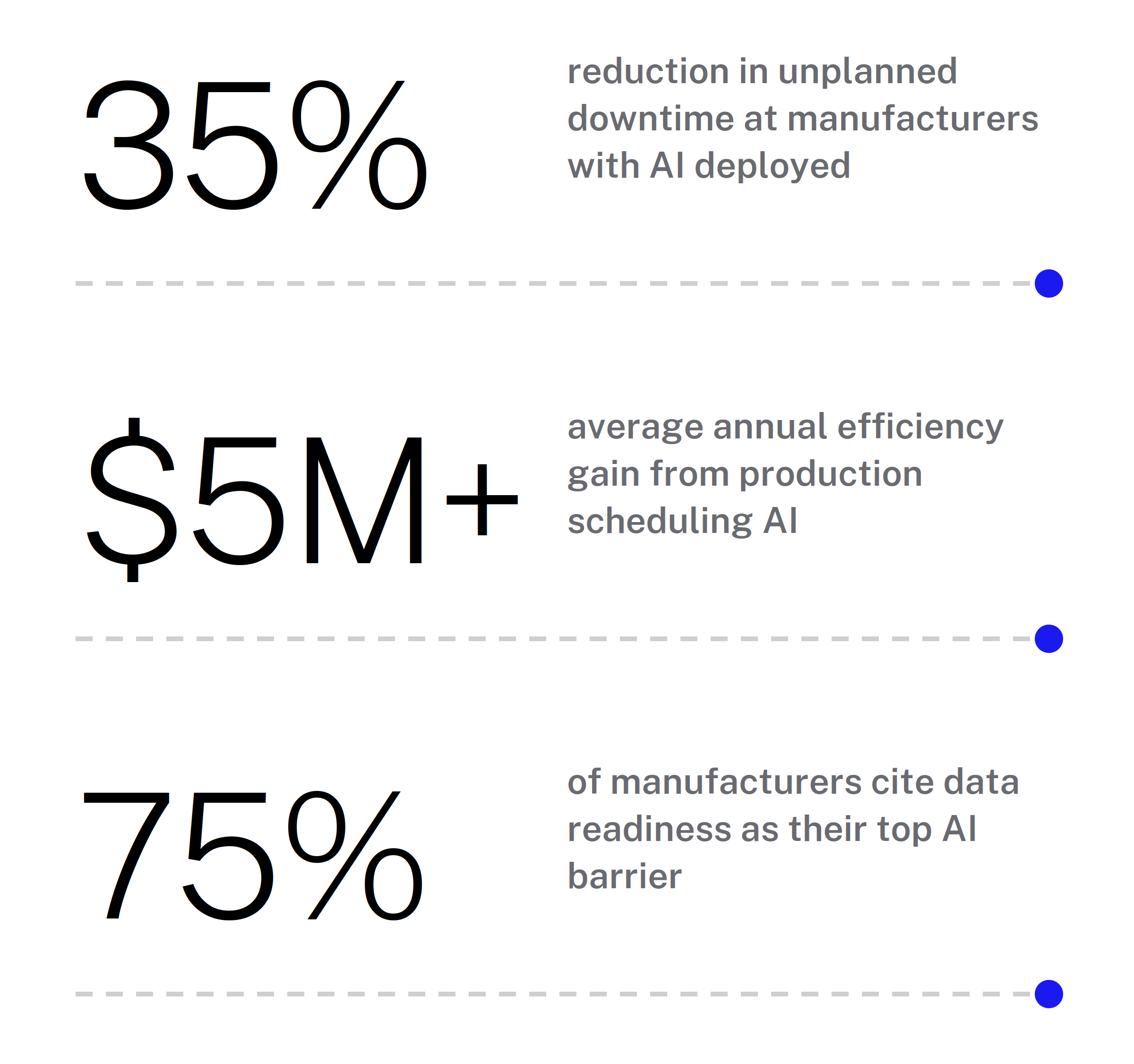
- 75% reduction in unplanned downtime.
- 0.2% defect rate vs. 3-5% manual inspection.
- $5M annual efficiency gain from scheduling optimization.
- These are results from real deployments. Not vendor projections.
No rip and replace
- Your equipment and systems are not going anywhere.
- We build AI that integrates with what you have — legacy controllers, proprietary MES formats, homegrown ERP.
- Our integration team has connected 1,000+ systems. We know where it gets hard.

AI built for industries, where the stakes are too high to guess.
Most AI fails in production because it wasn't built for your industry's regulatory, legacy, and operational realities. We've spent 20+ years building the enterprise systems you run your business on. That's the difference.

AI Pathfinder for Insurance
AI built for your actual environment, not a demo. We map opportunities across claims, underwriting, and core ops, integrated with Duck Creek, Guidewire, and legacy systems.
See the Pathfinder for insurance
AI Pathfinder for Legal
AI that respects the confidentiality, precision, and liability standards legal work demands. We map your highest-value opportunities across document review, contract analysis, and workflow automation.
See the Pathfinder for law firmsFrequently asked questions
What is AI consulting for manufacturing and why is it needed?
AI consulting for manufacturing is a structured engagement that identifies where AI creates real value, then maps the path to get there. Most manufacturers have data but lack the AI layer to act on it. The goal is to transform production without ripping out working systems, leverage AI against the highest-cost problems first, and turn fragmented manufacturing processes into a prioritized plan backed by proven AI solutions.
How can manufacturers assess their data readiness for AI implementation?
Start by mapping where production data lives and whether it is structured enough to train on. The most common blockers are siloed performance data across MES, ERP, and quality systems that have never been connected. A readiness assessment shows you exactly where your data falls short for AI, which use cases are viable without major infrastructure changes, and what has caused similar projects to fail before launch.
How to choose an AI consulting partner for manufacturing?
The right partner has been inside manufacturing environments before, not just consulted on them. They should know your systems. MES, ERP, SCADA, PLCs. Before the first meeting, not after the first invoice. DOOR3 has integrated 1,000+ enterprise systems and built on the platforms manufacturers actually run. That means less time explaining your environment and more time solving the real problems.
What are the common challenges in implementing AI in manufacturing?
The three most common: fragmented data that makes it impossible to automate operations at scale, workflow complexity that breaks clean pilot assumptions in real production conditions, and leadership pressure to justify ROI before data infrastructure is ready. Generative AI and other modern approaches add capability but do not solve underlying data architecture problems. The firms that automate successfully treat automation as an infrastructure project, not a software purchase.
How does AI integrate with existing manufacturing systems and legacy equipment?
Legacy equipment is the rule in manufacturing, not the exception. Plants running controllers from the 1990s alongside modern IoT sensors are exactly the environments DOOR3 designs for. We know where proprietary data formats break standard integration approaches and how to work around them. The result is an AI layer built on your real data, not a cleaned-up version of it.
Request manufacturing pathfinder
30-minute confidential discussion with DOOR3's practice leadership. Your operational priorities, current challenges, preliminary assessment of opportunities.
