AI Summit Barcelona 2026: DOOR3's Enterprise AI Takeaways
09.30.2026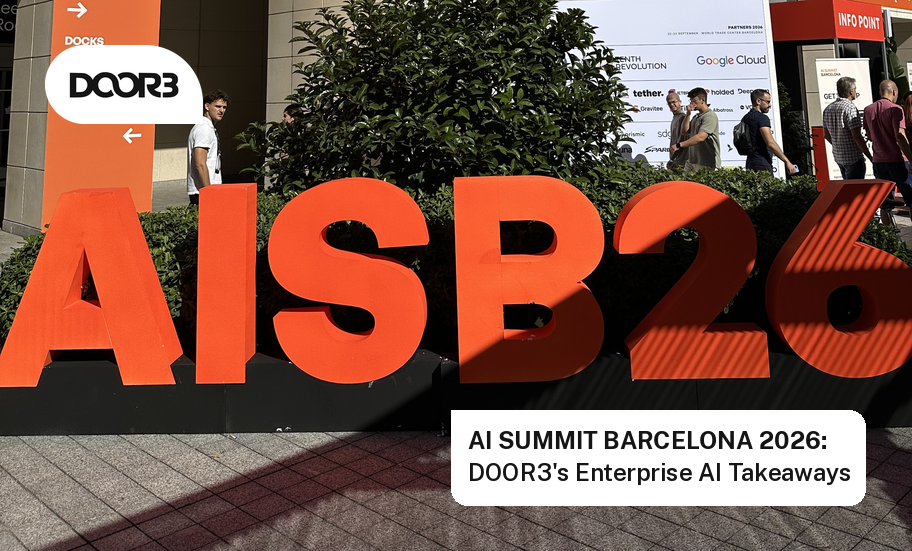 Two days at AI Summit Barcelona 2026 reinforced a shift we're seeing across our own client work: most organizations no longer need convincing that AI can create value. The harder question is how to make that value repeatable across an entire business.
Held September 22–23 at the World Trade Center Barcelona, the summit brought together people building, deploying, and scaling AI across industries.
The conversations went well beyond what the latest models can do. Again and again, they came back to a more practical challenge: how businesses move from isolated AI successes to systems and workflows that improve the way entire teams operate.
For us, a few themes stood out.
From Individual Acceleration to Organizational Impact
AI is already making individuals faster.
Employees can research faster, produce first drafts faster, analyze information faster, and automate repetitive tasks. But improvements at the individual level don't automatically translate into improvements at the organizational level.
We think of this gap as Acceleration Drift: individuals adopt AI and accelerate their own work, while the processes around them continue operating largely as they did before.
Closing that gap requires more than giving everyone access to an AI tool.
Organizations need to understand how work moves between people, teams, and systems, and redesign those workflows around the new capabilities AI creates.
The opportunity isn't simply faster individuals. It's a faster, more effective organization.
The Challenge Is Moving From AI Pilots to Scalable Systems
Another message came through clearly in Barcelona: choosing the right AI model is only one part of the equation.
Once an organization moves beyond experimentation, the difficult questions become much more operational.
How does AI connect with existing business systems?
What data should it have access to?
Where does human review belong?
How do teams evaluate whether its outputs are reliable?
How should AI-enabled workflows change as the organization learns what works?
These are integration, architecture, and process questions as much as they are AI questions.
A successful proof of concept might demonstrate what is possible. Creating lasting business value means embedding that capability into the technology and workflows people rely on every day.
Scaling AI Requires the Right Guardrails
As AI becomes more connected to business operations, governance becomes part of the architecture rather than something added at the end.
Organizations need clear boundaries around access, data, security, validation, and accountability.
The right guardrails create the trust teams need to use AI in meaningful parts of their work.
This becomes particularly important as businesses move toward AI systems capable of taking actions rather than simply generating information.
Scaling AI responsibly therefore means answering two questions at the same time:
What can we automate?
And:
What should we automate, under what conditions, and with what oversight?
Organizations that address both questions early are better positioned to move beyond isolated experimentation.
Focus Still Matters
Despite the rapid expansion of AI capabilities, another recurring theme at the summit was the importance of choosing focused opportunities.
There is enormous pressure to apply AI everywhere.
But the strongest opportunities are often much narrower: a specific workflow, a persistent operational bottleneck, a knowledge problem, or a process where automation can create measurable value.
Starting with a clearly defined problem gives teams something they can test, measure, and improve.
The objective isn't to have the most AI.
It's to identify where AI changes an outcome that matters to the business and then build from there.
The AI Conversation Is Changing
The most encouraging part of AI Summit Barcelona wasn't a particular demo or model announcement.
It was the change in the questions people were asking.
The conversation is becoming less about:
"What can AI do?"
It's becoming:
"How do we make this work inside our organization?"
That is a much more consequential question.
It shifts the focus from individual tools to organizational systems, from experiments to production, and from isolated productivity gains to measurable, team-wide results.
Those are also the questions we work through with clients at DOOR3: connecting AI to existing technology, redesigning workflows around it, putting the appropriate guardrails in place, and turning promising individual use cases into capabilities the wider organization can actually use.
AI Summit Barcelona made one thing clear: the next stage of enterprise AI won't be defined only by better models.
It will be defined by how well organizations integrate them into the way they work.
Ready to Move From AI Experiments to Organization-Wide Results?
DOOR3 helps organizations integrate AI into existing systems, workflows, and products in ways that are practical, secure, and built to scale.
Explore our AI and digital transformation capabilities or talk to our team about your next AI initiative.